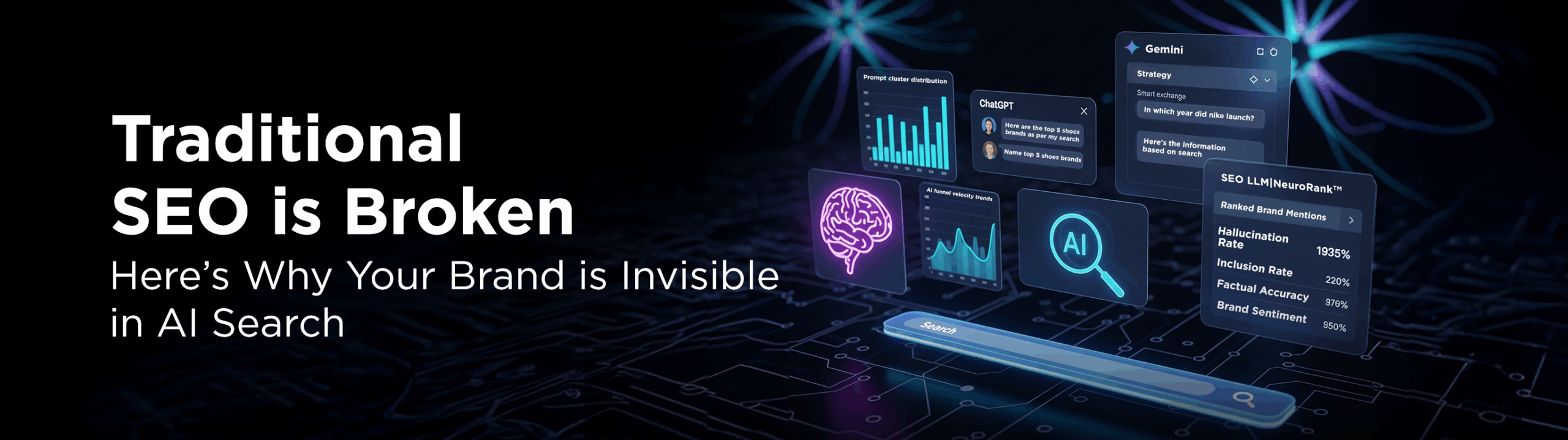

Imagine this:
You’re a CMO reviewing your marketing dashboard. Your brand ranks well on Google. SEO reports look green. Yet… your pipeline tells another story. Your brand isn’t being discovered in actual buying moments. Cold leads. Drop-offs. Missed conversations. It’s not your SEO team-it’s the game that’s changed.
And the real question is:
What happens when the buyer’s first touchpoint is no longer Google?
Welcome to the era of AI-first search-where traditional SEO is obsolete, and your brand’s visibility is dictated not by algorithms, but by language models.
The Shift: From Keywords to Conversations
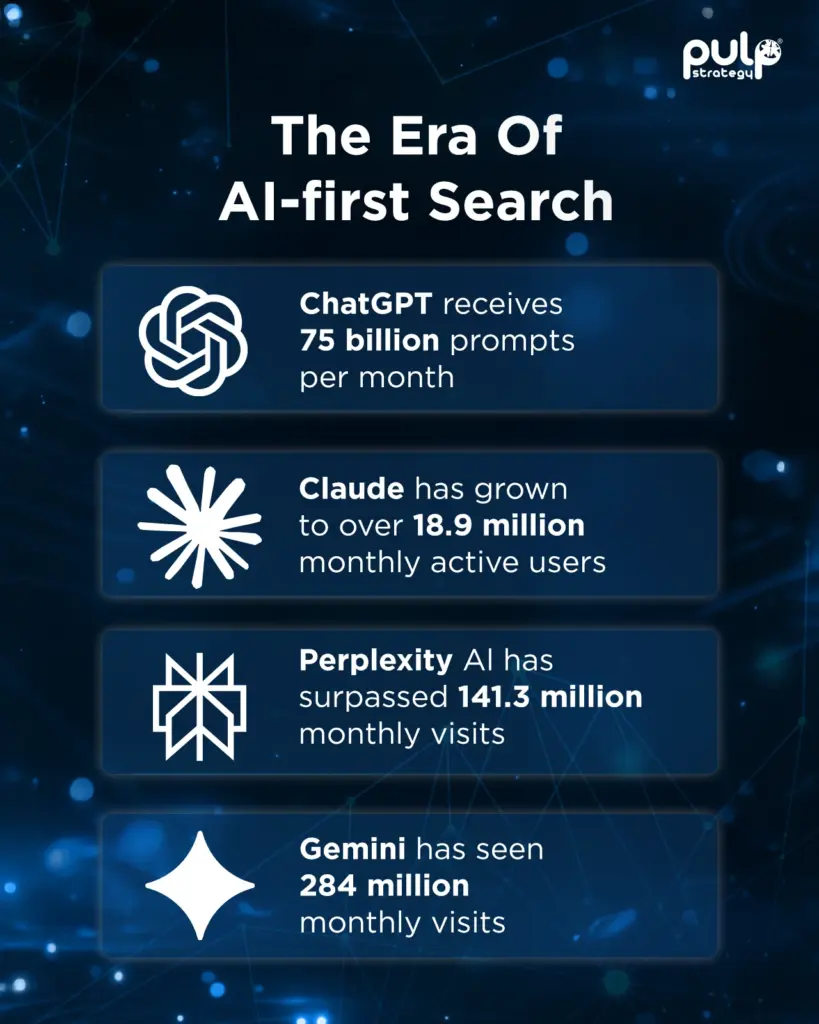
As of July 22, 2025, here’s what the AI discovery landscape looks like:
- Gemini continues to expand through native integration with Google Workspace and Android, now powering tens of millions of daily search interactions.
- ChatGPT receives an estimated 75 billion prompts per month, dominating AI-first search moments across every vertical.
- Claude has grown to over 18.9 million monthly active users, used widely in enterprise contexts.
- Perplexity AI has surpassed 141.3 million monthly visits, primarily for real-time information and product comparison queries.
These platforms collectively shape the buyer journey long before traditional websites are visited.
Example: A B2B SaaS buyer asks ChatGPT, “What are the best SEO tools for AI search optimization?” If your brand hasn’t been trained into the model’s memory or cited as a credible result, it simply won’t appear-regardless of your Google ranking.
Now consider a real-world B2C example: A consumer asks Gemini, “What are the safest baby soaps for sensitive skin?” If your FMCG brand-despite strong market share and dermatologist endorsements-isn’t represented in structured training data or citations, the AI may confidently recommend a niche DTC alternative that appears more often in prompt-compatible formats. This isn’t just a missed sale-it’s a lost opportunity to influence preference at the moment of decision.
This is the awareness gap that NeuroRank™ bridges: prompt presence inside the world’s most influential digital advisors. Large Language Models (LLMs) like ChatGPT, Gemini, Claude, and Perplexity AI are rapidly becoming the first stop for B2B buyers.
Not just for research-but for decisions.
These models aren’t browsing your website. They’re predicting answers. They don’t index in real-time. They generate responses based on what they trust, remember, and rank semantically.
This is the invisible battleground for brand relevance. And if your SEO strategy doesn’t operate inside these systems, your brand is simply not present where it matters most.
Why Traditional SEO Doesn’t Work in LLM Search
Most SEO teams still optimize for Google’s algorithm: crawlability, backlinks, page speed, keyword density. These matter-but only within search engines that index pages traditionally.
LLMs don’t operate that way.
They:
- Don’t crawl the web daily-they rely on trained data and curated sources.
- Don’t rank websites-they predict responses from memory.
- Don’t reward keywords-they prioritize semantic authority and trust signals.
- Are prone to hallucinations-and in that confusion, they either invent facts or showcase someone else.
So, even if you rank #1 on Google, ChatGPT might say nothing about you at all.
The Visibility Gap: Where Brands Get Lost
This new AI discovery landscape has created a dangerous phenomenon:
1. Hallucinations
Language models like ChatGPT and Gemini can misinterpret or fabricate brand mentions when they lack reliable data. If your brand isn’t properly embedded in their memory, it risks being replaced by generic references or worse, by a competitor. NeuroRank™ helps detect and fix these hallucinations by reinforcing your brand with accurate, structured information.
2. Brand Erasure
You might be the market leader in reality, but LLMs recommend who they remember, not who ranks. That memory is based on structured trust and citations-not your website metadata.
3. Aggregator Domination
Content aggregators (like, Medium) are frequently cited by LLMs. If your brand isn’t optimized to appear through these secondary sources, you’re invisible.
Enter LLM SEO: Visibility Where Decisions Happen
To win in this landscape, your brand must adapt from SEO for crawlers to SEO for cognition.
That means:
- Being included in relevant prompts
- Appearing as a trusted reference
- Influencing predicted patterns of the LLM’s response
This is LLM SEO-and it requires a new approach.
The Solution: NeuroRank™ by Pulp Strategy
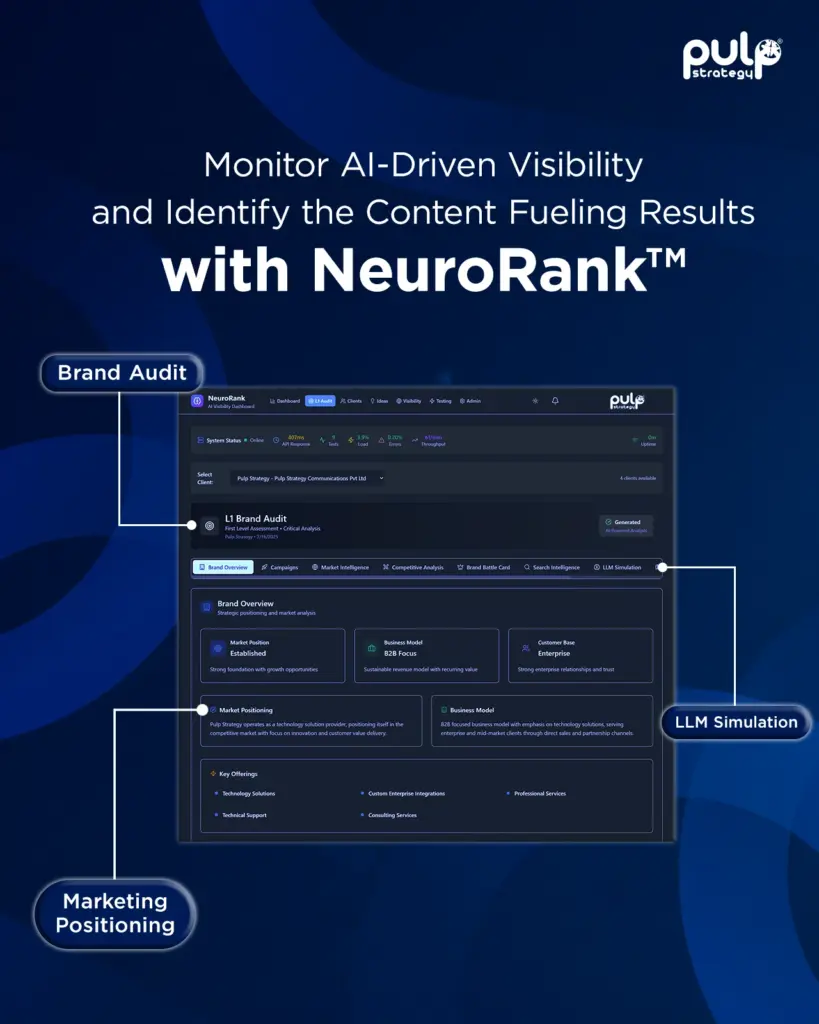
NeuroRank™ is India’s first LLM SEO system, built specifically to help brands gain AI-native visibility.
It doesn’t just guess at prompts. It audits, maps, and installs your brand into the memory structures of LLMs.
Here’s how:
Hallucination Indexing
We scan how LLMs like ChatGPT and Claude misrepresent, omit, or hallucinate your brand-then intervene to correct these errors with AI-trainable content and citations.
Prompt Inclusion Mapping
Using proprietary tools, we identify the prompts where your brand should appear-but doesn’t. We then seed the right trust signals to increase recall.
Semantic Trust Engineering
NeuroRank™ reconstructs your brand narrative in machine-readable formats. From schema to benchmark mentions, we teach LLMs how to trust and prioritize your brand.
Why This Matters to CMOs
This isn’t just about vanity visibility.
This is about pipeline, consideration, and category dominance in the channels where your buyer is now searching.
If you’re invisible to LLMs:
- You’re not recommended in the tools your buyers use.
- Your competitors are shaping the narrative-unopposed.
- Your ABM efforts hit a wall when buyers start with AI.
In short: if the machine forgets you, so does your buyer.
Actionable Steps: How to Fix It Today
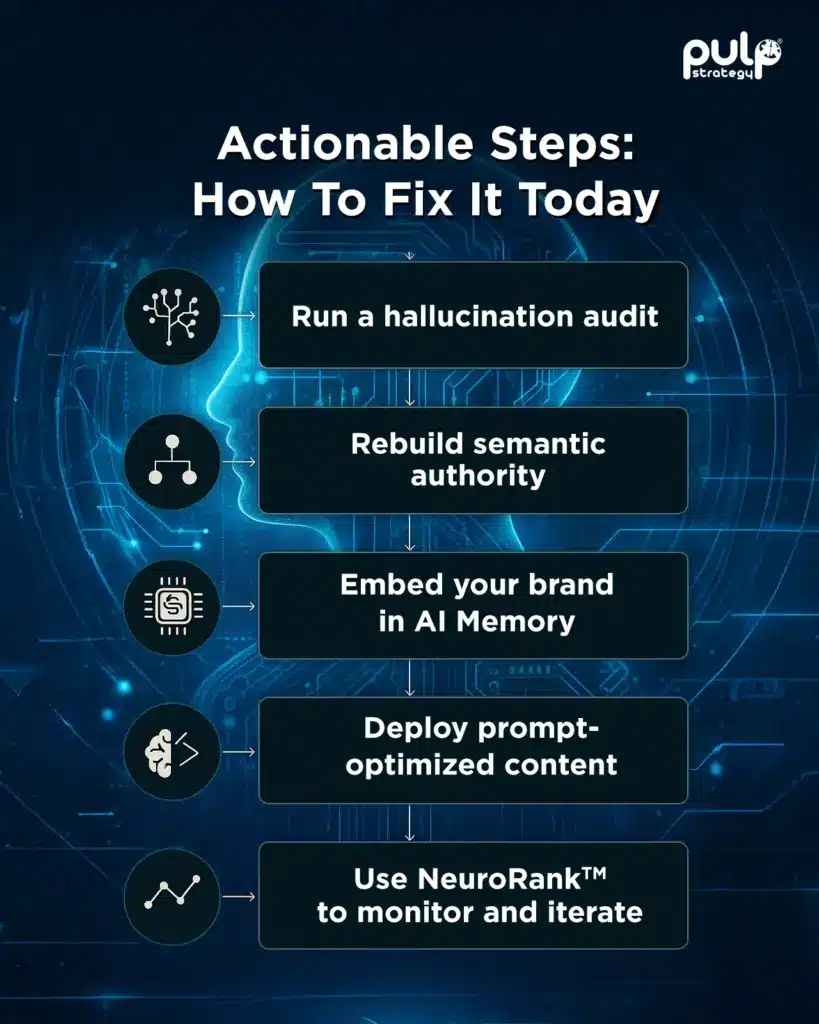
To reclaim visibility in AI-first discovery, your brand needs to:
Conduct an AI Visibility Audit:
Evaluate how your brand is being presented or potentially misrepresented across major AI platforms. Use tools that analyze AI-generated content to identify inaccuracies, omissions, or competitor references, enabling targeted content improvements to address these gaps.
Strengthen Topical and Semantic Authority:
Focus on building trust and relevance through meaningful content and context, rather than relying solely on traditional keyword strategies.
Increase AI-Facing Content Presence:
Ensure your organization or subject matter appears in credible sources such as open repositories, discussion forums, and research citations, making it more recognizable and trainable for AI models.
Create Content Aligned with AI Query Formats:
Develop content that mirrors the way users ask questions on platforms like forums, Q&A sites, and long-form publishing platforms to improve discoverability.
Continuously Monitor and Adapt:
As AI evolves, so should your digital strategy. Use analytics and performance insights to regularly refine and update your approach.
From Invisible to Irreplaceable
The old SEO playbook no longer wins visibility in a world where machines write the first draft of buyer intent.
It’s time to move beyond “ranking” and start focusing on recall.
If AI can’t find you, your customers won’t either.
But if AI trusts you, everyone else follows.
Get a free consultation to audit your brand’s LLM visibility with NeuroRank™.
Let’s make sure your brand is showing up where decisions are being made.