
Authored by: Ambika Sharma; Founder and Chief Strategist
Updated as on February 2026
Executive Summary
Online discovery is undergoing a structural reset that most tools are not yet calibrated to detect. Customer journeys are being compressed into AI responses. Bidding wars for high-intent keywords are driving up the entry price. As a result, acquisition economics are shifting: CAC is rising, attribution is fragmenting, visibility into the lead flow is weakening, and even CLV is being shaped upstream as AI frames how buyers understand product capabilities across the lifecycle. The result: fewer organic leads, more expensive paid leads, and competitors surging ahead. This is why every business today needs LLMO (Large Language Model Optimization).
Because this is not a niche disruption confined to one vertical or one company size. Companies and brands of all sizes are seeing a sudden dip in deal flow and lead quality. Regulated industries face representational risk in AI queries. Mid-market brands struggle against AI-reinforced incumbents. SMBs are structurally vulnerable to non-inclusion and loss of leads, as organic discovery and PPC are their primary growth channels. When organic reach compresses and paid efficiency declines due to high competition, growth stalls. Agencies face margin compression, while independent consultants face pressure to commoditize. The implication is structural: when influence shifts to AI systems, optimization alone cannot protect revenue. Governance becomes mandatory. NeuroRank™ was built for that governance layer. It is an LLMO system designed for everyone to control how their brands are interpreted and recommended in AI environments, with advanced LLMO (GEO + AEO + AIO + Technical SEO) capabilities.
The Highlights:
The Invisible Influence Gap: Metrics Paradox
Today, a buyer may spend 20 minutes conducting extensive research in ChatGPT or Perplexity to find the best options available in a product/service segment. They may receive synthesised vendor comparisons and preferred recommendations. Their mind is made up, days later, they visit a vendor’s website directly or through a Google Ad.
Traditional analytics attributes this journey to:
- Direct traffic
- Organic search
- Google PPC
But the AI interaction that shaped their decision is invisible. AI does not simply send traffic; it pre-qualifies and pre-convinces. Buyers arrive informed and decision-oriented. This breaks traditional SEO assumptions:
- Keyword rankings ≠ guaranteed visibility
- Domain authority ≠ inclusion in AI answers
- Traffic ≠ influence
Because AI SEO shifts the battleground from rankings to answer inclusion. This creates the Invisible Influence Gap:
- Buying decisions are shaped in environments analytics cannot track
- Brand perception is formed before measurable touchpoints exist
- Influence happens outside your attribution systems
When visibility disappears, governance disappears with it. And when governance disappears, revenue risk compounds quietly.
The Two Silent Revenue Killers: Hallucination and Non-Inclusion
AI-based discovery has not only changed how people find your brand online but also introduced two structural risks that directly affect acquisition economics. What makes these risks even more alarming is their lack of visibility.
Most brands don’t even have visibility into what AI systems are saying about them. They do not know how often they are being represented in AI-based queries. They do not know whether competitors are being substituted. They do not know whether the product capabilities are being accurately described. And without that visibility, they cannot act strategically.
1. Hallucination Risk
AI hallucinations impact the revenue stream. When an AI system misrepresents your product capabilities, omits differentiators, or inaccurately compares you against competitors, the effect cascades across the funnel.
- Trust formation weakens because buyers have already formed a biased opinion of the brand based on misinformation from AI-generated answers.
- Conversion rates decline because objections increase.
- Sales cycles lengthen when teams spend time addressing inaccuracies buyers absorbed during AI-driven research.
For regulated industries such as healthcare, finance, legal, and pharma, AI hallucinations can create compliance risks. If an AI answer misstates claims or product details, it can lead to legal and regulatory consequences. In these sectors, how your brand is represented is not just a marketing issue; it is a governance responsibility.
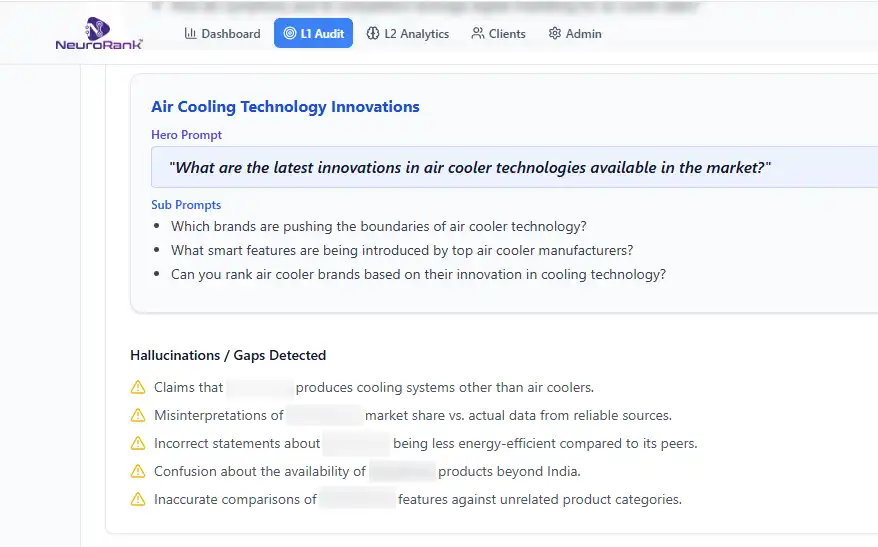
Add to all that the risk of non-visibility into exactly how AI is misrepresenting your brand, and the impact compounds.
2. Non-Inclusion Risk
More damaging than misrepresentation is an exclusion. AI systems rarely present ten equal options. They compress categories into three to five recommendations. If your brand is not included in that shortlist, you do not lose a click. You lose the opportunity to compete.
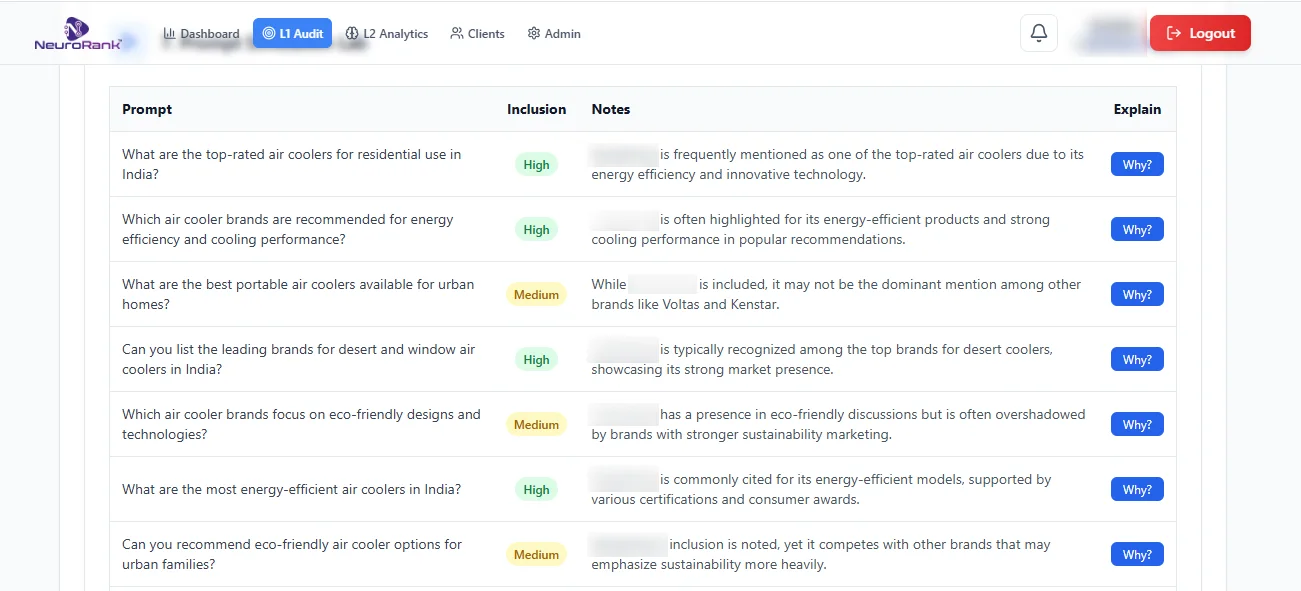
Leads fall off in the initial stages of discovery as non-inclusion builds an anchoring bias. CAC increases because paid media must now compensate for organic exclusion. Market share erodes silently.
Non-inclusion in AI answers is a major issue for brands today. But when you can’t even know that you’re being excluded, the damage compounds silently. Because there’s no insight to act upon. And this is affecting organisations across sectors.
NeuroRank™ LLMO System - If You Can See It, You Can Fix It
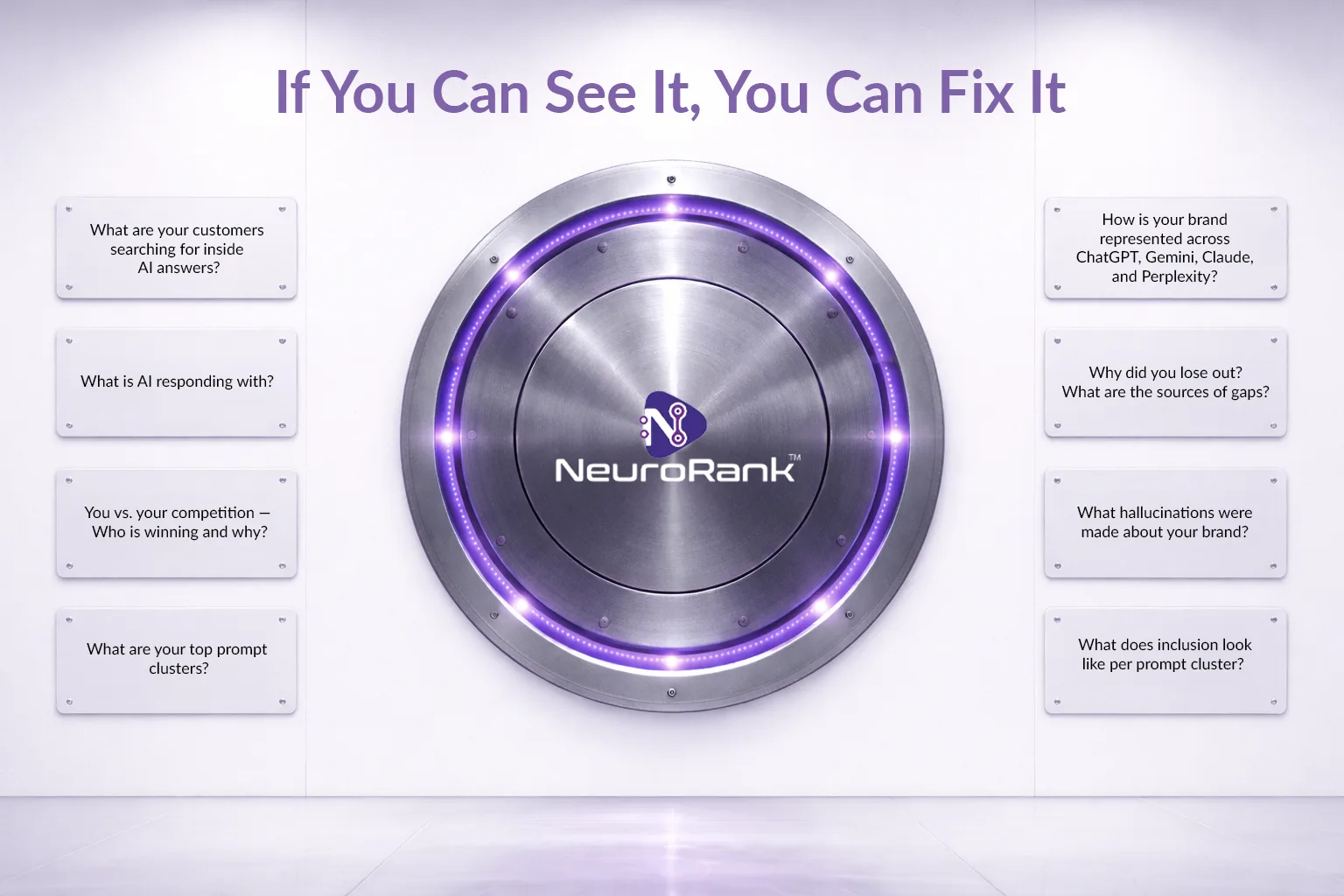
This is where NeuroRank™ comes in as your AI governance layer, turning invisibility into measurable control. It answers the following:
What are your customers searching for inside AI answers?
NeuroRank™ maps real buyer prompt clusters across high-intent, comparative and transactional queries that directly influence revenue.
What is AI responding with?
NeuroRank™ audits AI systems to capture actual generative engine answers, revealing how your brand is being framed in real time.
You vs. your competition - Who is winning and why?
NeuroRank™ benchmarks inclusion frequency, citation weighting, and narrative positioning across competitors to show who dominates and on what parameters.
What are your top prompt clusters?
NeuroRank™ identifies the exact AI queries driving consideration and revenue, not vanity searches, but decision-shaping prompts.
How is your brand represented across ChatGPT, Gemini, Claude, and Perplexity?
NeuroRank™ provides cross-model visibility, highlighting inclusion gaps and inconsistencies between platforms.
Why did you lose out? What are the sources of gaps?
NeuroRank™ traces exclusion or substitution back to authority imbalances, weak entity signals or citation asymmetry.
What hallucinations were made about your brand?
NeuroRank™ identifies hallucinations at the prompt level, including pricing errors, feature distortion, positioning drift, or capability misstatements.
What does inclusion look like per prompt cluster?
NeuroRank™ measures the frequency of inclusion across each prompt cluster.
What can you do to fix it?
NeuroRank™ provides structured corrective recommendations, supported by its human engineering layer.
Did the fix work? Is something missing?
Through continuous validation, NeuroRank™ retests prompts to confirm improvement and identify remaining gaps.
How has inclusion changed, and by what percentage?
NeuroRank™ tracks any movement in inclusion probability.
How are you performing regionally - Dallas vs Singapore vs India?
NeuroRank™ offers geo-level tracking to measure AI representation across markets.
All of this, and then there’s the differentiator.
NeuroRank™ lets you talk to your data. Your brand audit and competitive intelligence sit inside an interactive insights layer, allowing you to ask complex questions and receive actionable insights instantly. It transforms raw AI visibility data into clear roadmaps, protecting you from blind decisions and reactive strategy.
This is not mere reporting. It’s AI-level governance.
Why NeuroRank™ Is for Everyone
| Segment | AI-Discovery Problem | Business Impact | NeuroRank™ Governance Control |
| Large Enterprises | AI compresses user queries into 3–5 brand recommendations and your brand may be excluded or inaccurately represented | Organic traffic declines, PPC costs rise, CAC increases, and market share erodes | Diagnoses inclusion frequency, corrects authority signal asymmetry, restores presence inside AI answers |
| Regulated Industries | AI misinterprets risk disclosures and/or jurisdictional distinctions | Compliance exposure, trust erosion, and revenue leakage | Tests live AI outputs, identifies interpretation gaps, restores compliant AI representation |
| SMBs | AI excludes the brand from high-intent generative answers | Top-of-funnel compression, paid dependency, slowed growth | Audits visibility gaps, engineers inclusion signals, increases AI visibility probability |
| Upper Mid-Market Brands | AI amplifies incumbents while excluding emerging competitors | Shrinking organic consideration, CPC inflation, rising CAC | Identifies prompt exclusion, strengthens authority signals, breaks incumbent bias loop |
| Agencies | Client expectations shifting from keyword rankings to AI visibility governance | Retainer compression and competitive disadvantage | Enables a premium LLMO service line, repositioning the agency as an AI visibility governance partner |
| In-House SEO Teams | Strong rankings but weak generative AI presence, inbound lead flow weakens | Budget scrutiny, function marginalisation and leadership confidence erosion | Provides measurable AI inclusion visibility and corrective roadmap, reconnecting SEO to acquisition economics |
| Independent Consultants | Keyword-only advisory loses strategic weight | Pricing pressure and client migration | Adds AI visibility audits and governance layer, elevating position to premium advisory services |
The migration of influence into AI reasoning systems is not a niche trend. It impacts every participant in the market. It doesn’t matter how big your company is, what industry you’re in, or how much you spend. The impact shows up differently for each business, but no one is immune. The real question isn’t whether you’re exposed; it’s how that exposure is affecting your revenue, and whether you’re leveraging NeuroRank™ LLMO System to control it.
Large Enterprises: NeuroRank™ as a Governance Layer
Problem:
Consider this. You are a large D2C brand with products in the skin care category. The market is aggressively competitive. The battle for market share is always on. Your growth engine depends heavily on organic visibility and paid ads, where you spend roughly $20,000-$40,000+ per month.
For years, that model worked. If you ranked and you bid aggressively, you won visibility. Visibility translated into trial. Trial translated into repeat purchase. Repeat purchase translated to a loyal customer base that drove market share.
Then AI systems entered the discovery layer. Now, when a consumer asks: “Best actives serum for acne prevention.”
Google’s AI summaries no longer show 10 blue links and a row of ads. They generate a short list of three to five recommended products. The entire screen is dominated by a handful of names. Established legacy brands with years of branding investment may not appear at all. Challenger brands can suddenly dominate the conversation. A niche D2C product might be positioned as “better.” In some cases, your features are summarised inaccurately or stripped of context.
When AI systems compress categories into curated recommendations, here’s what brands face.
- Organic traffic has reduced because a major part of the discovery process has shifted to AI answers. It's a no-click situation.
- Brands that have not optimised for generative engines spend on Ads to compensate for the lost traffic. This means more advertisers compete for fewer decisive clicks, increasing PPC costs.
- CAC rises as more brands compete for fewer high-intent clicks.
- Your brand story risks being drifted if AI describes your products/offerings inaccurately or judges the consumer query as non-relevant in your brand context.
- Market share erodes quietly as LLMO-savvy brands gain disproportionate representation in AI summaries.
Solution:
This is where NeuroRank™ LLMO Full-Stack System steps in as a governance infrastructure. It offers visibility over how AI understands your brand and systematically engineers the signals that influence how AI systems weigh authority, resolve ambiguity, and form category shortlists.
For large enterprises, NeuroRank™ LLMO corrects signal asymmetry and strengthens brand authority across AI systems.
1. Measure AI Inclusion, Strengthen Organic Traffic:
With NeuroRank™ AI Visibility Diagnostics, you can measure real-time inclusion frequency across various prompt clusters. For example, you can check if Gemini or ChatGPT includes your brand in the results for the prompt “Best acne prevention serum.” And this visibility isn’t what your LLM model shows you; it is conditioned on your location and prompt history. NeuroRank™ provides clear visibility into your brand’s overall placement across major LLMs.
Once you have visibility over where your brand is missing, fixing it becomes easier, thereby making initial discovery for your potential buyers more reliable. As trust builds, buyers dig deeper to learn more about your brand. They visit the website, evaluate your social channels, watch YouTube videos, etc. This leads to an increase in overall organic traffic.
2. Competitive Signal Analysis to Bring Down PPC Spend
You can analyse your competitors to map out why certain competitors are being weighted more heavily inside AI summaries. Understand what authority signals are driving their inclusion. Study the gaps, fix them, and reduce overreliance on paid ads.
3. Correct Non-Inclusion and Misrepresentation, Bring Down the CAC
With NeuroRank™ L1 Audit, you get visibility into where (platforms), how, and why your brand is being misrepresented (or excluded) in AI responses. Once there’s visibility, NeuroRank™ suggests fixes that the human engineering layer handles.
This makes discovery and top-of-funnel entry easy for customers, thereby reducing CAC.
4. Reinforce Authority, Fix Brand Narrative Drift
NeuroRank™ audit provides deep insight into the sources AI systems rely on to construct your brand narrative. Once those authority signals are identified, the human engineering layer reinforces them by strategically aligning accurate, relevant information across high-impact platforms such as Quora, Reddit, and other authoritative domains.
5. Take Back Control of Market Share
With NeuroRank™, you gain complete visibility into how AI systems interpret and position your brand. Gaps are identified, corrected, and reinforced at the source. As inclusion improves and your brand begins to appear consistently in AI-generated recommendations, trust builds earlier in the customer journey, and market share starts shifting back in your favour as more customers are now ready to buy from you.
Regulated Industries: NeuroRank™ as Risk Control
Problem:
Imagine you are a large financial services company operating across retail banking, insurance, and wealth management. Your products and services are heavily regulated. Disclosures matter. Risk classification matters.
Now a user asks AI: “Best retirement savings plan.” The AI system summarises options and includes your brand, but:
- It simplifies risk exposure incorrectly.
- It omits mandatory disclaimers.
- It misstates return expectations.
- It blends retail and institutional offerings.
- It attributes features from one jurisdiction to another.
This becomes a regulatory concern, leading to a loss of trust and impacting the customer's journey, as customers fall off without digging deeper or choosing a competitive brand. And just like that, revenue takes a hit.
What’s worse is that your brand is not even included in the AI answers.
Solution:
NeuroRank™ LLMO System extends traditional risk governance into the AI reasoning layer, giving you complete control over how your brand is represented by AI.
1. Identify and correct interpretation gaps:
NeuroRank™ systematically tests live AI systems (ChatGPT, Gemini, AI Overviews, Perplexity) against mapped high-intent prompt clusters relevant to your sector. It identifies where your brand is being misrepresented and the source of the misrepresented information causing it. This creates visibility into AI-driven exposure before it becomes a public risk, thereby helping you restore those trust signals.
2. Map and close inclusion gaps
NeuroRank™ measures the frequency of inclusion across prompt clusters. If your brand is not included in any of the prompt clusters, the human engineering layer takes over, and we run a 1-month sprint to restore your brand within those prompt clusters.
SMBs: NeuroRank™ as a Growth Engine
Problem:
Say you are an SMB without large pools of VC funding to back you up. You don’t have an enterprise brand pull either. Your growth depends heavily on two things: organic traffic and paid search.
But AI systems have changed that.
Organic Traffic Compression: Customers get answers to their queries directly from AI-generated summaries. If your brand isn’t included in the AI answers, it leads to fewer top-of-funnel visits, slower compounding traffic and reduced inbound lead volume.
Rise in PPC spend: When organic discovery declines, brands rely on PPC to offset lost traffic, leading to higher spend to maintain revenue.
And what’s even more alarming is the fact that you don’t even have visibility over what’s impacting your revenue.
Solution:
NeuroRank™ measures whether your brand appears in high-intent, decision-driving prompts, not vanity searches, but queries tied directly to revenue. It identifies where and why you are missing inside AI summaries. Post the analysis, it recommends the necessary fixes, which the human engineering layer addresses by strengthening the authority signals that matter.
This not only offers you visibility but also increases your inclusion probability inside AI-generated answers, driving organic traffic and reducing spend on paid ads.
Upper Mid-Market Growth Brands: Breaking the Incumbent Reinforcement Loop with NeuroRank™
Problem :
Mid-market growth brands are different from SMBs and enterprises. They have traction. They have a budget. They have performance engines working. But they’re stuck in what can be called the Incumbent Reinforcement Loop, where AI systems disproportionately amplify established brands in answers. So, what this means is:
Exclusion from AI answers: Your brand is excluded from generative shortlists despite strong SEO fundamentals, giving incumbent competitors an upper hand in strengthening their already strong market share.
Rising Paid Traffic Dependency: When AI compresses shortlists and you’re not included, organic consideration shrinks; paid must compensate; CPC pressure intensifies as the bidding war heats up; and CAC creeps upward.
But what if you don’t even have visibility over that? How will you fix what you can’t see?
Solution:
NeuroRank™ fixes this by first offering visibility over where and why your brand is being excluded or misrepresented by AI. It then pulls up a list of prompt clusters tied to purchase decisions that can be improved. This increases the inclusion probability in generative summaries while reducing paid traffic dependency.
Agencies: NeuroRank™ as a Revenue Multiplier
You’ve built your agency around the key value proposition of ranking improvement, technical audits, and content execution, charging $800–$1,500/month. But in this AI-based discovery era, things have changed. Agencies now face:
Retainer Compression: As AI reshapes discovery, clients are no longer impressed by keyword growth alone. They’re evaluating agencies based on AI visibility and LLMO capability. The scope of expectation expands. At the same time, skilled LLMO professionals are scarce, and upgrading an SEO team fast enough to meet this shift isn’t easy. The result? Pricing pressure, stalled retainers, and competitive disadvantage in new business conversations.
Competitive Pitch Disadvantage: In new business pitches, forward-thinking brands now ask about AI search strategy, LLM optimisation, inclusion in generative answers, and how you plan to manage query fan-out. If you cannot answer these questions clearly and with structure, you immediately lose strategic credibility. The pitch shifts from “Who ranks better?” to “Who understands AI-driven discovery?” and agencies without a defined LLMO capability fall behind.
Commoditization Risk: When an agency’s value is tied solely to keyword rankings, backlink count and impressions growth, it competes in a crowded, price-sensitive market with no differentiation. As AI-driven discovery reduces the strategic weight of rankings alone, agencies that don’t evolve into AI visibility governance see margin pressure, shorter contract cycles, and reduced upsell potential.
Solution:
For agencies, the NeuroRank™ LLMO system is not just an added service; it is a positioning upgrade and a revenue multiplier. NeuroRank™ allows agencies to evolve from SEO executors to AI visibility stewards by offering them complete governance over AI visibility, citation architecture, and generative inclusion frequency; capabilities that are not easily automated or commoditised. What this means is:
1. Launch a Premium LLMO Service Line:
Agencies can introduce new revenue streams like AI visibility audits, generative engine inclusion reports, prompt cluster mapping, competitive AI positioning analysis, etc. - all of which NeuroRank™ offers.
2. Strengthening Client Retention and Retainer Compression:
NeuroRank™ is designed with a built-in maker–checker framework that ensures high-quality execution from day one. It identifies what needs to be fixed, provides clear guidance on how to fix it, and then validates whether the changes have delivered measurable impact. Performance is tracked over time, with structured reporting that demonstrates improvement in AI visibility and inclusion. This creates transparency, accountability, and proof of progress, helping agencies strengthen client trust, reduce churn risk, and protect retainer value.
3. Win New Business with AI-First Positioning:
With NeuroRank™, you can upgrade your brand positioning from:
“We improve rankings.” to: “We govern how AI systems recommend your brand.”
That is a positioning leap from being just an agency to being strategic advisors, AI representation controllers and revenue protection partners, thereby aiding in winning new pitches.
In-House SEO Teams: LLMO as Strategic Relevance
You lead the SEO or Media operations in a multinational company.
You built a high-performing engine: steady organic growth, 1st page keyword dominance, and a finely tuned paid media system. By traditional standards, everything works.
Then the entire discovery landscape flips upside down. AI summaries enter the discovery layer. Lead flow begins to dip. Ranking reports look strong, but their influence weakens. Suddenly, the metrics that once defined success no longer explain revenue movement, and the pressure from leadership escalates.
Even though, by traditional standards, your brand is performing well, it’s not visible in AI-generated answers. Leadership starts asking tough questions like: “Why are we not visible in ChatGPT?” Your reports don’t answer those questions. This leads to:
Function Marginalisation: For in-house teams, it is about survival as SEO risks being reframed as maintenance rather than a growth function.
Budget Scrutiny Despite Strong Metrics: If SEO cannot demonstrate ownership of AI visibility, leadership starts cutting down and reallocating budgets.
Influence Shift: When lead flow slows, and AI visibility remains unaddressed, external consultants and agencies step in with AI-first narratives. They begin reframing the problem, and suddenly, your internal SEO strategy looks incomplete.
Leadership Confidence Erosion: Each time leadership searches your category in ChatGPT or Gemini and sees a competitor highlighted or your brand described inaccurately, confidence weakens. It feels like the brand story is being shaped somewhere outside your control, and no one internally owns it.
Solution:
For in-house teams, NeuroRank™ LLMO System serves as insulation against SEO teams and helps prevent them from becoming obsolete. It allows the team to learn and adapt quickly, with a negligible margin for error. NeuroRank™ becomes your strategy and execution guide, and you can regain control within 3-4 days by driving complete visibility into AI inclusion, strengthening lead flow, and directly tying the function to customer acquisition economics.
Independent Consultants: LLMO as Premium Differentiation
You've built a solid consultancy, charging $150–$250/hour. A few enterprise retainer clients at $3K–$7K/month. You're the SEO expert they call when they need strategic thinking.
But now, clients are increasingly requesting generative visibility audits, prompt cluster mapping, and citation analysis across AI systems. This means:
Expertise Commoditization: Consultants who remain confined to retrieval optimisation risk being perceived as operational support rather than strategic advisors. This impacts hourly rates and retainer stability.
Client Upmarket Migration: If you cannot articulate a generative visibility strategy, you risk losing accounts, not because you lack skill, but because the scope of “SEO” has expanded.
Downward Pricing Pressure
When clients believe AI tools can replace portions of SEO execution, they push back on rates. Without differentiation beyond keyword optimisation, consultants enter pricing competition.
Solution:
If you are an independent consultant, NeuroRank™ LLMO creates a premium advisory layer for you. It enables consultants to evolve from SEO practitioners into AI discovery strategists by offering:
Offering AI Visibility Audits as a High-Value Entry Service: Using NeuroRank™, consultants can deliver: Generative engine inclusion audits, competitive AI positioning reports, prompt cluster mapping and citation asymmetry analysis.
Moving from Keyword Strategy to Model Strategy: Instead of asking: “What keywords should we rank for?” You’ll ask: “How does AI interpret your brand in high-intent decision contexts?” and “What prompts matter to me the most from a revenue perspective?”
Strengthening Upmarket Credibility: When pitching larger clients, NeuroRank™ positions you as a forward-thinking strategic advisor, which you can leverage to increase retainer size.
The Compounding Nature of LLMO: Why Delay Is a Strategic Cost
LLMO is not a campaign. It is not a one-time optimisation cycle. It is a reinforcement system.
Large language models operate on probabilistic weighting. The more consistently a brand is cited across authoritative sources, the more clearly its entity is defined, and the more frequently it appears in generative outputs tied to purchase-intent prompts, the stronger its representational gravity becomes.
- Inclusion frequency compounds.
- Citation density compounds.
- Prompt cluster coverage compounds.
- Narrative consistency compounds.
Competitors who establish early reinforcement inside generative systems benefit from cumulative advantage. Their brand becomes a default inclusion. Their authority becomes a pattern. Displacement then becomes more expensive than initial establishment.
In traditional SEO, rankings fluctuate. In generative ecosystems, reinforcement solidifies. The cost of delay is not measured in lost impressions. It is measured in increasing effort required to reclaim representation.
Measurable Outcomes: What NeuroRank™ Delivers in Practice
NeuroRank™ is not positioned as a theoretical LLMO infrastructure. It is deployed to produce measurable shifts in acquisition efficiency and AI-driven visibility within defined timeframes. Across implementations, four performance patterns consistently emerged:
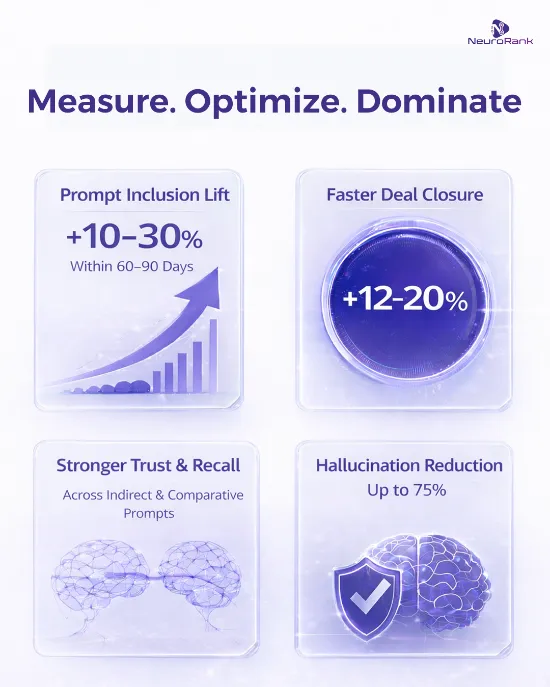
By reinforcing entity clarity, strengthening citation architecture, and aligning structured signals with generative retrieval logic, organisations typically see a 10–30% lift in inclusion across commercially relevant prompts within 60–90 days.
Faster Buyer Progression: 12–20% Improvement in SQL Velocity
NeuroRank™ deployments have shown 12–20% improvements in SQL velocity as:
- Objection cycles shorten
- Lead qualification accelerates
- Conversion from MQL to SQL improves
Trust Recall in Indirect and Comparative Prompts
NeuroRank™ strengthens inclusion not only in direct “best vendor” prompts but also in indirect and comparative scenarios:
- “Alternatives to [competitor]”
- “Compare X vs Y”
- “Is [brand] better than…”
Trust recall in these contexts indicates that the brand is not merely visible but embedded within the logic of AI systems.
Hallucination Reduction: Up to 75% Correction of AI-Generated Misinformation
Through structured entity reinforcement and authoritative citation alignment, NeuroRank™ reduces the frequency of misinformation in generative outputs. Deployments have achieved up to 75% correction of inaccurate AI-generated descriptions over defined intervention cycles.
Revenue-Level Implications
These outcomes map directly to marketing performance variables:
- Higher inclusion probability stabilises CAC by reducing reliance on paid compensation channels.
- Accelerated SQL velocity improves pipeline throughput.
- Trust recall strengthens win rates in competitive cycles.
- Hallucination reduction improves conversion efficiency and protects compliance exposure.
How to Get Started with Neurorank™
NeuroRank™ structures implementation through a disciplined 30-day sprint model designed to move organisations from AI visibility uncertainty to measurable inference control within a defined cycle. The objective is stabilisation of representation across generative systems.
Scan: Live Model Behaviour Intelligence
Every sprint begins with a reality check. NeuroRank™™ scans live AI systems to understand how your brand is currently represented across priority prompt clusters. This includes:
- Inclusion frequency across high-intent and comparative prompts
- Competitive substitution patterns
- Citation source weighting
- Trust signal density
- Hallucination exposure
Engineer: Precision Signal Construction
Once gaps are identified, corrective engineering begins. Human LLMO experts design and deploy structured reinforcement across priority signals that influence model interpretation. This includes:
- Strengthening entity clarity across authoritative domains
- Reinforcing consensus signals in model-referenced ecosystems
- Aligning citation architecture with commercial prompt clusters
- Correcting narrative inconsistencies that trigger hallucination risk
Conditioning: Live Model Memory Reinforcement
Engineering alone does not create a compounding advantage. Conditioning does. NeuroRank™™ activates live conditioning cycles that reinforce priority prompts and structured signals across the AI ecosystem. The objective is to influence model memory patterns through consistent, authoritative reinforcement.
This is where LLMO becomes compounding. Repeated exposure to aligned signals increases the likelihood of inclusion in future generative responses. Conditioning increases the probability that your brand becomes a default inclusion inside AI-generated shortlists.
Validate: Prompt-Level Impact Verification
The loop closes with validation. NeuroRank™™ re-tests live prompts across major AI systems to measure shifts in:
- Inclusion frequency
- Narrative stability
- Competitive displacement
- Trust recall in indirect and comparative prompts
Validation ensures that changes are not theoretical. They are observed inside real model responses. This transforms LLMO from a speculative effort into a feedback-controlled system.
Closing Thought: The Layer You Cannot Ignore
Organic discovery hasn’t lost its fundamentals. It has just gained a new layer. AI reasoning systems now sit between intent and revenue.
When buyers ask AI to synthesise a product/service, compare vendors, or validate decisions, representation becomes the gatekeeper of opportunity. That gatekeeper is not controlled solely by rankings. The strategic question is no longer whether AI affects search. It is whether your revenue model accounts for inference-driven discovery.
If you are responsible for organic growth in any capacity, enterprise leadership, regulated operator, agency strategist, in-house SEO, or independent consultant, the operating environment has already shifted.
You can continue optimising for visibility. Or you can govern representation and upgrade to Generative Engine Optimisation (GEO)/Large Language Model Optimisation (LLMO).
Because in the inference economy, revenue does not disappear overnight. It erodes quietly wherever representation is left to chance.
And LLMO governance is how you stop it.