
By Ambika Sharma, Founder and Chief Strategist, Pulp Strategy
Updated October 2025
Executive Overview
Modern CMOs are balancing creativity and control. As one CMO aptly said, “We don’t need more content; we need a story everyone can follow.” That captures the essence of today’s challenge: narrative clarity in a fragmented ecosystem.
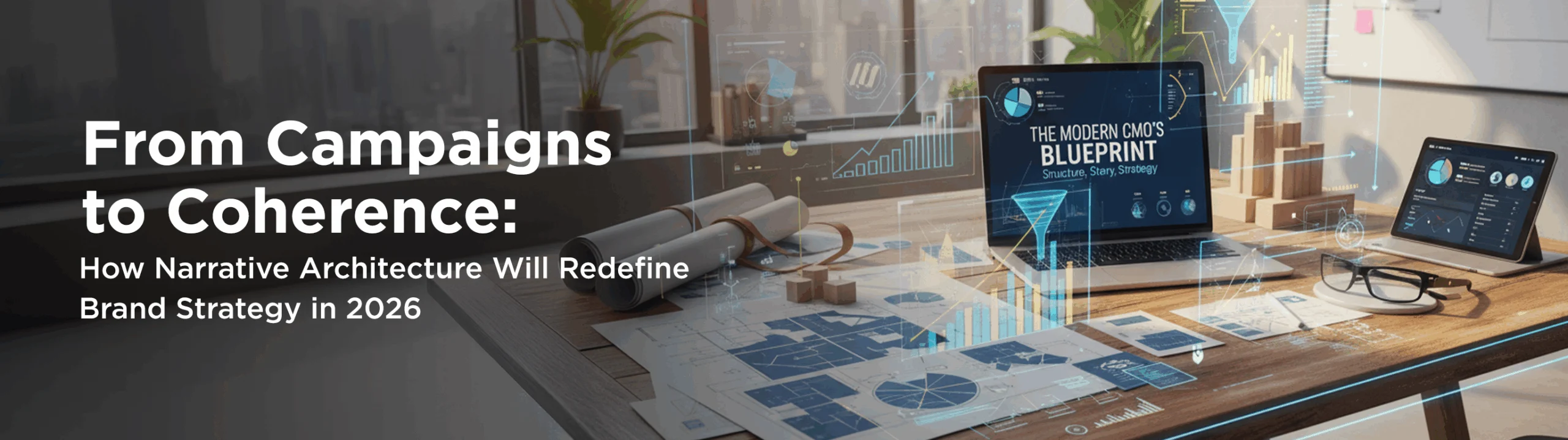
In a market defined by scrutiny and short attention spans, brands are navigating an age where storytelling equals strategy. Fragmented campaigns and inconsistent narratives erode trust and waste resources. This article reframes narrative architecture as a growth system linking brand strategy, brand marketing, brand positioning, and go-to-market strategy frameworks into measurable business impact.
Drawing on Pulp Strategy’s success with global and Indian brands like Philips Body Grooming, Dabur Charcoal, Michelin, and Think Gas, it explores how these brands used storytelling to transform performance and perception. Philips unified its messaging to bring forward conversations around body grooming, accelerating consideration and leading the category. Dabur Charcoal repositioned itself for GenZ in a digital-first environment. Think Gas built trust in a low-emotion category through consistent storytelling, becoming a billion-dollar brand.
This article also integrates verified insights from Gartner [1][2][3][4], Forrester [5][6][7], McKinsey [8][9], and KPMG [10] on brand investment, storytelling efficiency, AI trust and consumer behavior. Together, these insights demonstrate how coherent brand narratives shape preference, pricing power, discoverability, and leadership credibility.
Why Narrative Architecture Matters in 2026
As of 2025, Indian CMOs face a paradox: marketing technology has multiplied reach but splintered story. Boards demand faster growth and clear ROI, yet brands lose coherence across channels. The hidden cost: weak recall, higher churn, and lower equity.
Gartner’s 2025 CMO Spend Survey [2] reveals that only 22% of CMOs prioritise brand marketing. However, the same report shows that consistent brand storytelling can deliver up to 30% stronger long-term ROI than purely performance-led approaches. This underscores that brands investing in coherent storytelling build sustainable equity, while others compete for short-lived attention.
Narrative architecture offers structure in chaos. It translates brand strategy into a system that governs messaging, content, and customer experience. In cautious markets, this coherence turns communication into control and volatility into visibility.
As one FMCG brand leader put it, “You can’t optimise a message that doesn’t hold together.” Narrative architecture fixes that foundation before growth can scale.”
“Narrative coherence is the bridge between creativity and performance, the discipline that lets brands stay human while scaling algorithmically.” Ambika Sharma
What It Really Means for CMOs
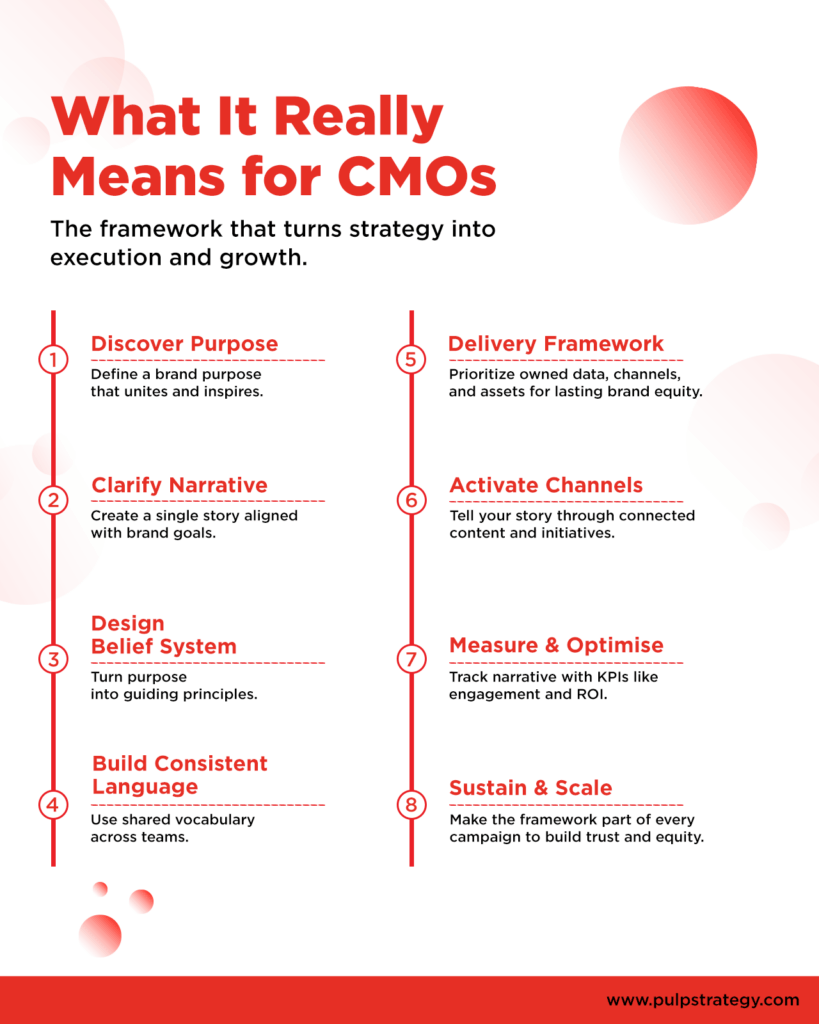
Narrative architecture is not a buzzword or a creative indulgence; it is the framework that transforms strategy into execution and into revenue growth. The bridge between narrative, design, and performance. Its brand strategy, brand marketing, brand positioning and GTM strategy made actionable through systems, tools, and processes that deliver real-world outcomes.
It enables CMOs to embark on a seven-step journey to success powered by the Narrative Architecture Framework:
- Discover Purpose – Define a clear brand purpose that unites leadership and inspires internal teams.
- Clarify the Narrative – Craft a single unifying story that aligns with your brand strategy and long-term goals.
- Design the Belief System – Translate purpose into principles that guide every message, campaign, and experience.
- Build the Language of Consistency – Create shared vocabulary across marketing, sales, and product teams to ensure unified expression.
- Delivery Framework – Build owned systems that prioritise data, channels, and brand assets over rented ecosystems to create long-term brand equity.
- Activate Across Channels – Execute the narrative through connected content, GTM initiatives, and omnichannel storytelling.
- Measure and Optimise – Link storytelling and creative assets to measurable KPIs such as engagement, recall, and ROI.
- Sustain and Scale – Institutionalise the framework to ensure every future campaign reinforces equity, trust, and discoverability.
Forrester’s 2025 Brand Experience Index [5] shows that brands leading in narrative coherence see 1.6x higher customer preference and 1.4x greater willingness to pay a premium than those with fragmented messaging. The implication is clear: consistency is not an aesthetic choice, it’s a business multiplier.
McKinsey’s State of Consumer 2025 Report [8] echoes this: consumer trust is now built less on price and more on “brand consistency, story truth, and visibility across channels.” CMOs who master this discipline will lead the next growth wave.
Narrative clarity doesn’t just make brands memorable, it makes them investable.
How Indian Consumers Reward Consistency and Meaning
Indian consumers buy meaning, not media. As of 2025, with 700+ million digital users, attention is the scarcest commodity. Consumers reward reliability and emotional clarity.
Consumer Insight:
- Consistency = trust. Repeat exposure signals reliability.
- Emotion = premium. A brand with conviction justifies higher value.
- Familiarity = preference. Repetition builds recall and affinity.
Forrester’s BX Index 2025 [5] notes that Indian consumers exhibit 19% higher brand switching when storytelling feels inconsistent. In other words, every broken message is a lost customer journey.
Indian consumers forgive mistakes, but not inconsistency.
Real World Scenario: Dabur Charcoal’s post-pandemic repositioning showed that trust isn’t built on claims but on consistent purpose, linking social currency, Gen Z dating trends, and habit. Similarly, Think Gas's consistent storytelling with authenticity built a tribe of loyalists who shared and participated in the narrative rather than browsed through it.
The Five Pillars of Durable Brand Narratives
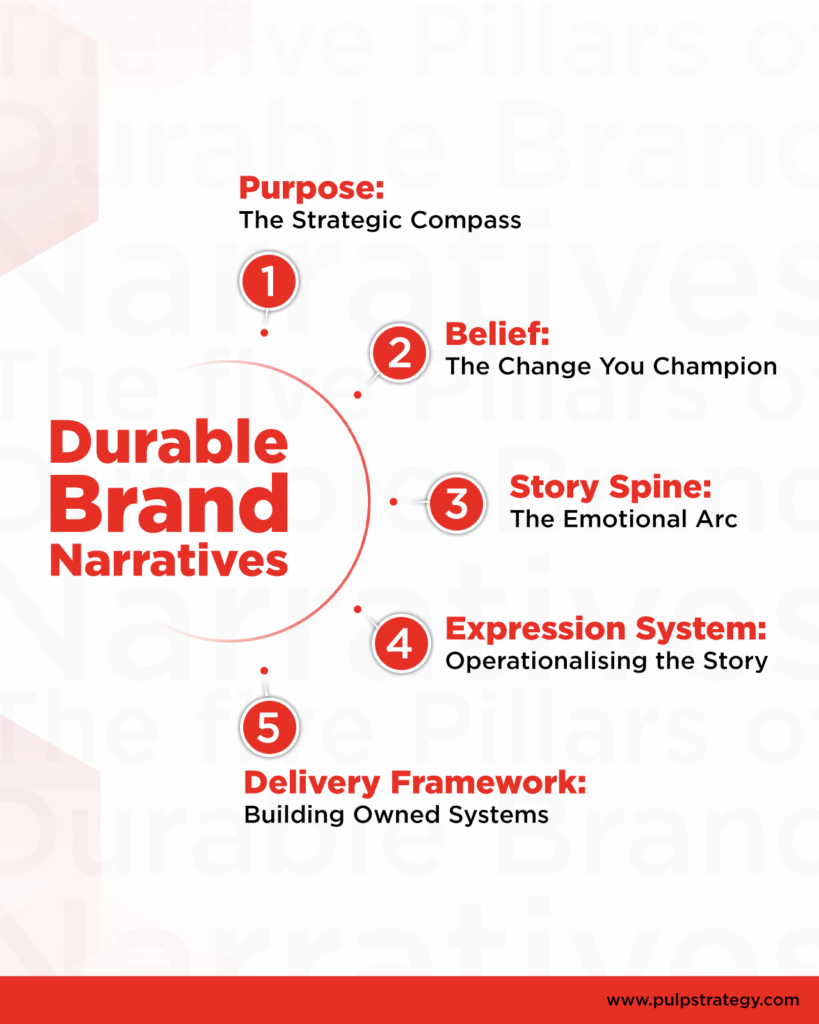
1. Purpose: The Strategic Compass
Define why you exist beyond product. Indian brands succeed when purpose aligns with social progress. Gartner [1] highlights “brand meaning alignment” as one of six global marketing trends driving resilience. The implication: when purpose is clear, campaigns become cohesive and content becomes compounding.
2. Belief: The Change You Champion
Beliefs transform purpose into conviction. Think Gas stood for safe and sustainable progress, turning a functional product into a movement. Their leadership team used this belief to align marketing and policy communication in record time. The result: higher trust, lower churn, and stronger internal advocacy.
3. Story Spine: The Emotional Arc
The narrative journey that humanizes commerce. Consumers remember transformation, not transactions. A B2B SaaS CMO observed, “Our pipeline grew faster when we stopped selling features and started telling outcomes.” This insight captures a broader truth: emotion drives conversion even in rational categories.
4. Expression System: Operationalising the Story
Language, tone, and visual identity ensure the story feels the same everywhere, from ad film to chatbot. CMOs who manage their story as a system reduce creative waste, align faster with GTM, and outperform peers in discoverability.
Pro Insight: Narrative systems are not creative doctrine, they are operational efficiency tools for modern marketing.
5. Delivery Framework: Building Owned Systems
Brands that rely entirely on rented ecosystems lose long-term control over discovery and loyalty. A delivery framework ensures ownership of data, channels, and storytelling infrastructure. It prioritises first-party ecosystems such as brand websites, CRM, and proprietary content hubs to reduce overdependence on social or algorithm-driven platforms. This foundation helps CMOs future-proof brand visibility, maintain control of audience data, and ensure that their story remains discoverable even as digital algorithms evolve.
Building the Modern Distribution Ecosystem
Distribution today is about ownership, control, and measurable value. Brands that depend on rented platforms face volatility, while those that invest in owned ecosystems build deeper trust and consistent ROI.
Modern distribution strategies start with owned systems: brand websites, CRM, data platforms and automated communication layers that drive continuous engagement. Investing in martech infrastructure, personalization, and automation across site journeys, email, and WhatsApp improves both loyalty and conversion. Heat maps and behavior analytics reveal actionable insights, while AI-powered personalization creates relevance. Conversational agents and instant response tools ensure every consumer gets timely, consistent support.
Closed-loop communities and proprietary platforms add another layer of durability. They enable direct feedback, co-creation and advocacy while strengthening long-term brand equity. Combined with GEO and AI search optimization, these ecosystems connect visibility with measurable revenue attribution.
McKinsey’s 2025 Consumer Trust Report [8] notes that Gen Z ranks social media as the least trusted source of brand information in India. This shift underlines why owned ecosystems and direct communication are essential to brand trust and consumer retention.
NeuroRank™ by Pulp Strategy supports this model by linking storytelling with discoverability, optimizing brand narratives, schema, and structured data for GEO and AI search. These integrations drive sustainable, high-value organic growth.
Brands that build owned ecosystems create control, attribution, and loyalty that lasts beyond algorithms.*
Conclusion
The future belongs to brands that build clarity, ownership, and authenticity into their narrative, not those that rent attention or chase trends. In a market where consumer attention is finite, coherence and meaning are the new performance drivers. A strong Narrative Architecture ensures that communication creates tangible value for the consumer and measurable growth for the brand. It connects consistency in message with loyalty, revenue and long-term preference.
At Pulp Strategy, we view this shift as a defining moment for marketing leaders. The modern CMO’s role is not only to communicate value but to design systems that sustain it, ensuring that every consumer interaction reinforces the brand’s promise and deepens trust. The brands that thrive in 2026 will be those that treat narrative as both strategy and infrastructure: purposeful, owned, and built for enduring growth.