
Author Ambika Sharma, Founder and Chief Strategist
Updated March 2026
Executive Overview
The fundamental architecture of digital discovery has shifted from a "keyword-match" model to a "synthesis-first" model. As Google rolls out Query Fan-Out and AI Overviews, the majority of informational and consideration-phase search queries are being resolved within the LLM interface itself. Brands that are not optimized for Large Language Model Optimization (LLMO) are facing an "invisible auction" crisis: their ads are being served for intent that the AI has already satisfied with a competitor’s synthesis. This article explores why traditional SEO and SEM are failing, the 20% to 50% drop in organic traffic, and how the NeuroRank™ framework allows brands to reclaim visibility by engineering content for model cognition and AI SEO.
The Highlights
Why Traditional Search is Now a "Pick-Pocketing" of Your Budget
What is Google Query Fan-Out and How Does it Erasure Your Brand?
The Structural Shift: LLMO vs. SEO
Impact Metrics: The Great Decoupling of 2025-2026
Revelations from The GEO Benchmark Index 2025
Case Study: Reclaiming Authority in the Personal Care Sector
The NeuroRank™ 5-Pillar Framework for CMOs
NeuroRank™: The AI Governance Layer
Key Takeaways for the C-Suite
What is the impact of Google Query Fan-Out on media ads?
Google Query Fan-Out erodes search ad efficacy by satisfying user intent through AI-synthesized answers before a click occurs. Brands not optimized for LLMO see a 15–25% increase in CPC and decreased CTR, as traditional ads are pushed below AI Overviews that often omit non-structured brand data.
How does LLMO affect organic traffic for brands?
LLMO (or GEO) optimization determines a brand's inclusion in AI-generated summaries. Neglecting AI SEO Optimization can lead to a 20% to 50% decline in organic traffic. While traditional rankings may remain, the "zero-click" nature of AI retrieval means impressions no longer guarantee website visits or conversions.
What is the difference between SEO and LLMO?
While SEO focuses on matching keywords to page ranks, LLMO (Large Language Model Optimization) focuses on anchoring entities in a model's latent space. LLMO ensures a brand is "recalled" and "synthesized" into an AI’s final answer, moving beyond mere link placement to become an internalized fact for the AI.
Why Traditional Search is Now a "Pick-Pocketing" of Your Budget
For two decades, the CMO’s mandate was simple: buy the top of the page. Today, that page is being rewritten in real-time. We are currently witnessing a structural transformation where search engines have transitioned from being "libraries of links" to "engines of answers."
As of 2025, data across 408,000 prompt simulations suggests that generative answers are rarely linked to traditional websites. If your brand is absent or misrepresented in those answers, you are participating in a media auction that has already decided you don't exist. You are paying for a click on a query where the user has already received a "consensus answer" that favored your competitor. This is not a disruption; it is a bloodbath for brands relying solely on best AI for SEO chatbots without a deeper governance strategy.
What is Google Query Fan-Out and How Does it Erasure Your Brand?
The primary driver of this shift is a technique called Query Fan-Out. Instead of treating a search as a single keyword request, AI-powered engines "fan out" the original query into 10–15 parallel sub-queries to explore every facet of user intent.
The Fan-Out: The AI triggers sub-queries for "ingredient safety of [Brand X]," "dermatologist reviews for redness," and "cruelty-free luxury serum comparisons."
The Erasure: The AI then synthesizes these findings into one definitive answer. If your content only targets the "root term" and fails to provide structured, machine-legible data for the "branches," you are bypassed during the retrieval stage, regardless of how high you rank in Chat GPT SEO modules.
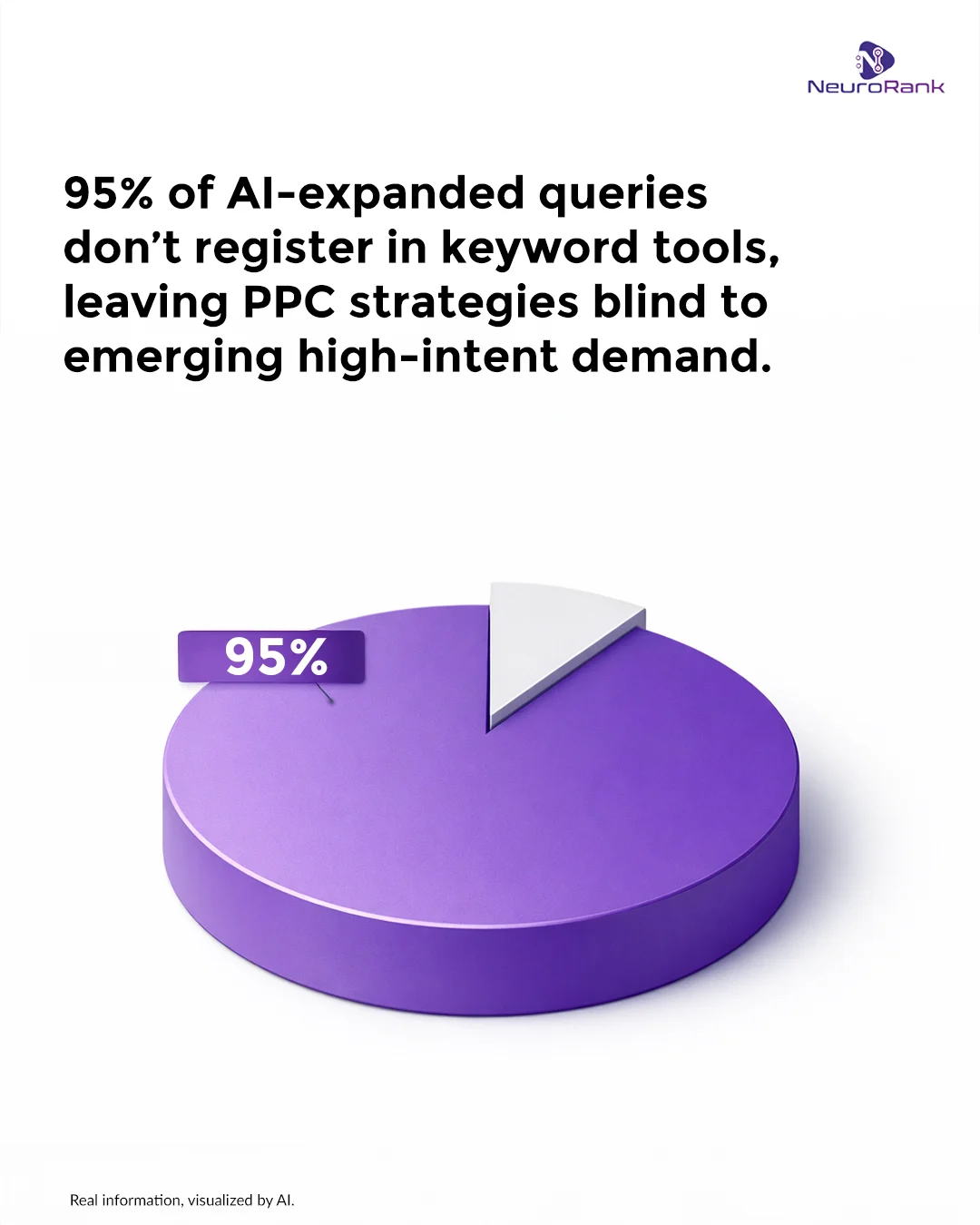
As of 2026, recent data shows that 95% of fan-out phrases show zero monthly search volume in traditional keyword tools, yet they are the gatekeepers of generative visibility. If you aren't in the fan-out, you aren't in the sale.
The Structural Shift: LLMO vs. SEO
Traditional SEO AI tools are often "blind" to this new reality because they rely on scraping index tables rather than probing the latent space of a model. Moving from Best AI SEO Software to true AI SEO requires a shift in technical philosophy.
| Feature | Traditional SEO (Legacy) | NeuroRank™ LLMO (The New Standard) |
| Mechanism | Scraping Index Tables | Direct Model Probing & Latent Mapping |
| Data Nature | Deterministic (Links/Rank) | Probabilistic (Synthesis/Weights) |
| Logic | Keyword-to-Page Matching | Anchoring Entities in Model Memory |
| Action | Static Content Publishing | Active Model Conditioning & Training |
| Agency Role | Tactical Implementation | Strategic Governance & Narrative Control |
Impact Metrics: The Great Decoupling of 2025-2026
The shift toward AI-driven retrieval has created a measurable divide between brand impressions and actual referral traffic. This makes AI SEO software integration critical for attribution.
Organic Traffic Impact
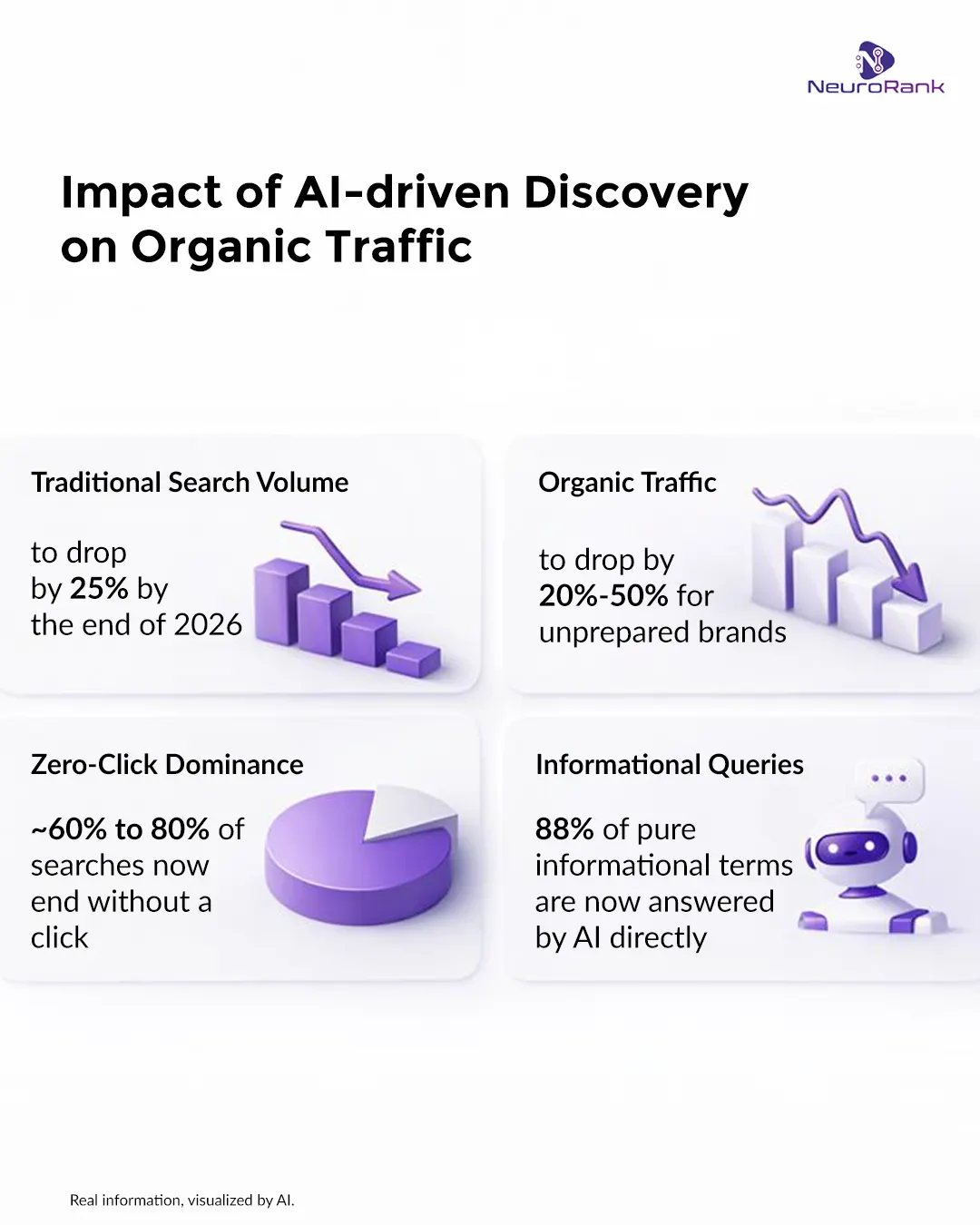
Organic Traffic Drop: 20% to 50% decline for unprepared brands (Source: Gartner/McKinsey).
Zero-Click Rate: ~60% to 80% of searches now end without a click. Queries triggering AI Overviews show an average zero-click rate of 83%.
Informational Queries: 88% of pure informational terms are now "fanned out" and answered by AI directly.
Media (Ads) Impact
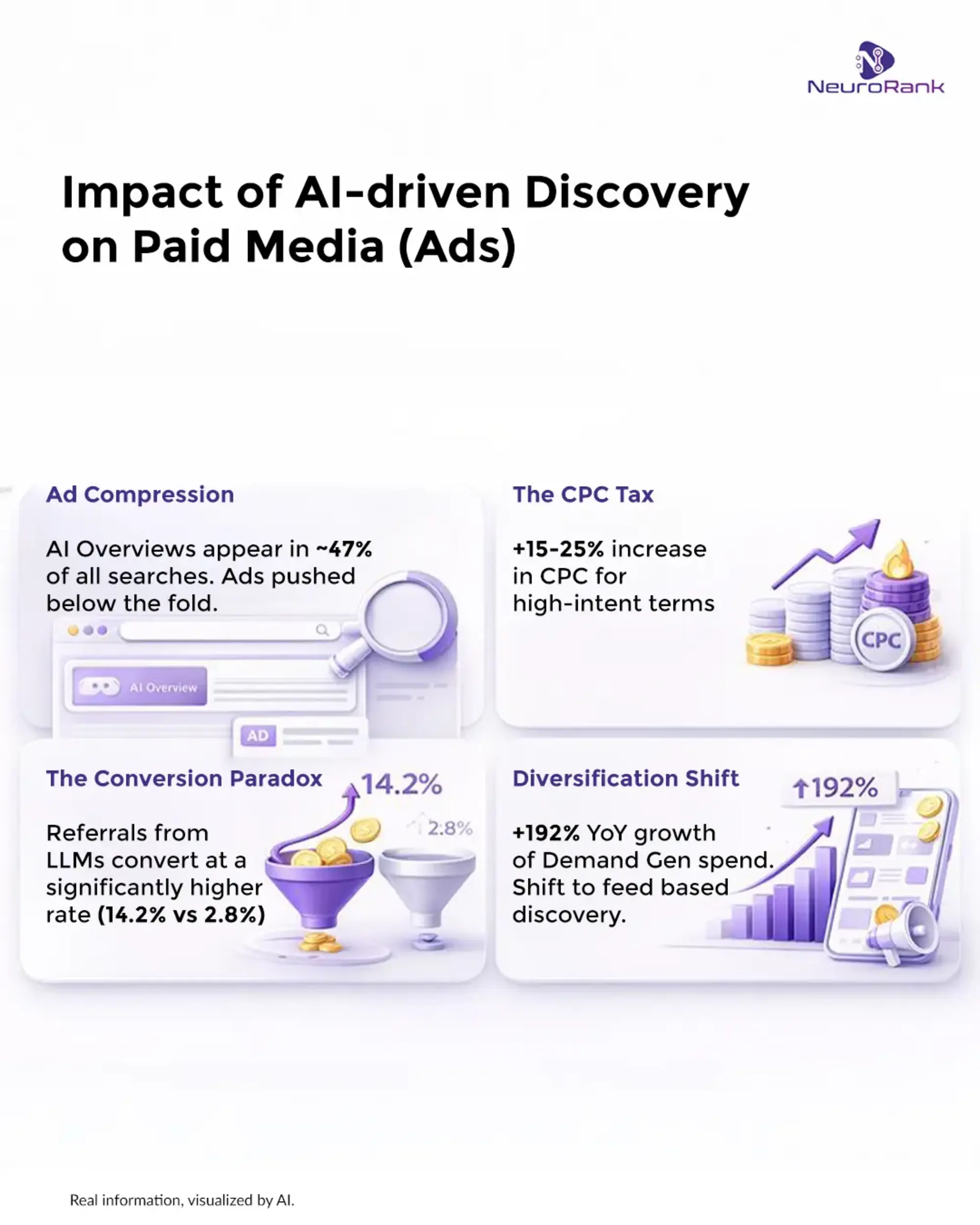
The CPC Tax: Brands see a 15% to 25% increase in CPC for high-intent terms as they fight for the remaining clickable real estate.
The Conversion Paradox: While volume is lower, referrals from LLMs convert at a significantly higher rate (14.2% vs 2.8%) because the AI has already pre-sold the intent.
Diversification Shift: Advertisers are pivoting to feed-based environments; Demand Gen (Discovery) spend has surged 192% year-over-year.
Revelations from The GEO Benchmark Index 2025
The GEO Benchmark Index 2025, derived from over 408,000 prompt simulations across leading LLMs, reveals a staggering gap between brand marketing and model recall. The GEO Benchmark Index 2025 report uncovers that brand discoverability has structurally decoupled from traditional search dominance.
Key Data Points from The GEO Benchmark Index 2025:
- Systemic Invisibility: 68% of brands are entirely absent from AI-generated shortlists within their own primary categories.
- Factual Hallucinations: 52% of brands encounter factually incorrect summaries, ranging from fabricated pricing to misattributed parent companies.
- Identity Drift: 88% of brands suffer from naming inconsistencies or cross-model recognition issues, failing to maintain a coherent "Entity Signal."
- Negative Sentiment Bias: 90% of consumer brands exhibit a disproportionate negative sentiment skew in AI syntheses, as disgruntled user-generated content often out-weights verified brand data.
The Commercial Value of AI Inclusion:
The GEO Benchmark Index 2025 corroborates recent data from the Adobe Digital Insights Report (January 2026) and Gartner, showing that the generative AI discovery layer is now a primary driver of high-intent commerce.
- Traffic Explosion: As of January 2026, Adobe Analytics reports that traffic to retail sites from generative AI tools has surged 693.4% year-over-year.
- Conversion Alpha: AI-referred shoppers are 31% more likely to convert than traditional traffic sources. On high-intent shopping days like Thanksgiving, conversion rates from AI referrals peaked at 54% higher than non-AI traffic (Adobe Holiday 2025 Recap).
- Revenue Per Visit (RPV) Surge: AI-driven RPV has skyrocketed by 254% year-to-date in 2026, outperforming the 84% growth observed in mid-2025.
Deep Engagement: Shoppers arriving from AI assistants (like ChatGPT, Gemini, and Perplexity) are 33% less likely to bounce, spending 45% more time on-site and viewing 13% more pages per visit, signaling that AI has already pre-qualified the solution for the user.
Case Study: Reclaiming Authority in the Personal Care Sector
A global personal care brand found that major AI assistants were consistently excluding its premium anti-aging serum from "best for sensitive skin" recommendations. Instead, models were citing a legacy forum post from 2019 that incorrectly claimed the product contained a known irritant, an ingredient the brand had removed years prior during a reformulation.
The NeuroRank™ Intervention: By utilizing the NeuroRank™ conditioning loop, the team mapped the "Identity Drift" where the AI was conflating old Reddit reviews with the current product identity. Within 45 days, the team deployed schema-reinforced ingredient disclosures and re-conditioned the model using 4 new high-authority clinical seed sources.
- Result: 85% reduction in ingredient-related hallucinations.
- Impact: 55% increase in category inclusion probability within the "Sensitive Skin" prompt cluster in 60 days.
The NeuroRank™ 5-Pillar Framework for CMOs
To move from "machine-legible" to "machine-preferred," leadership must adopt the NeuroRank™ proprietary methodology, often described as the pinnacle of best LLMO tools:
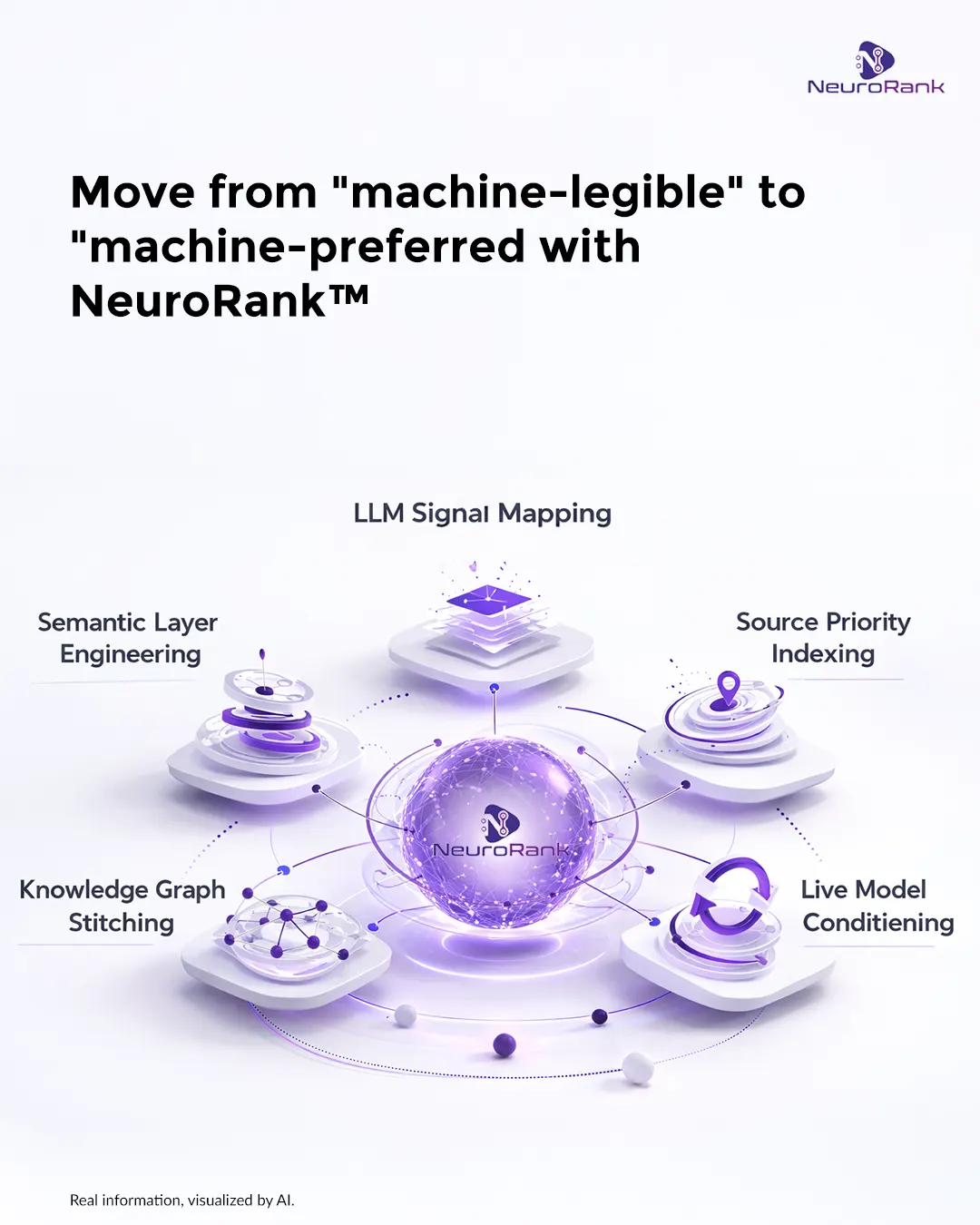
2. Semantic & Answer Engineering: Re-architect content into model-preferred, answer-first, and entity-anchored structures (Q&A, explainers, and schema-rich formats) that influence synthesis, not just retrieval.
3. Authority & Source Conditioning: Seed and reinforce your brand across model-trusted ecosystems (Reddit, Quora, Medium) that shape training, retrieval, and reinforcement loops.
4. Knowledge Graph & Entity Control: Establish durable brand-author-topic interlinks that make your brand machine-legible and resilient to narrative drift or hallucination.
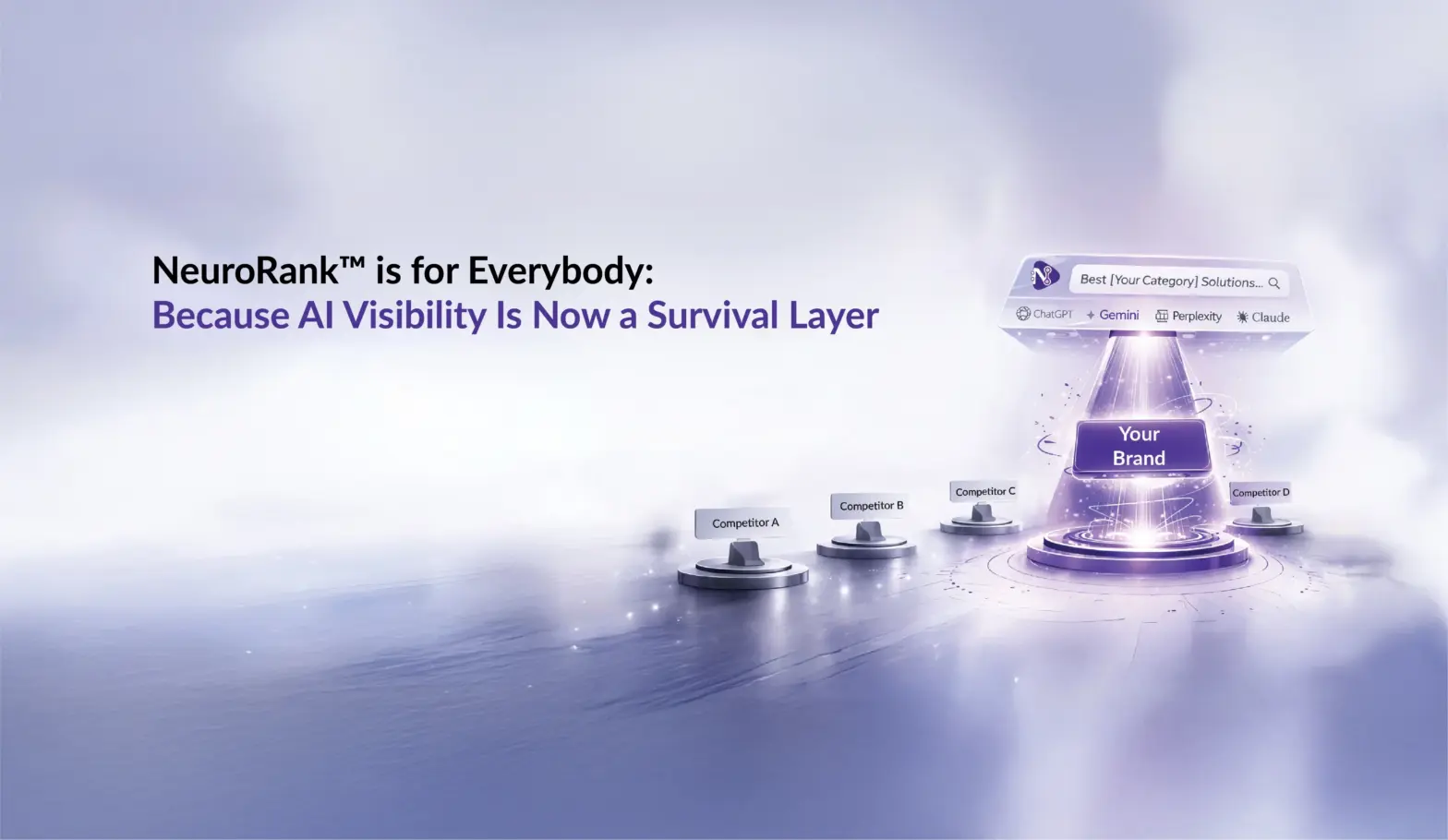
5. Live Model Conditioning: Execute continuous prompt testing and recalibration across ChatGPT, Gemini, Claude, and Perplexity to improve inclusion rates and correct capability misstatements as models evolve.
NeuroRank™: The AI Governance Layer
This is where NeuroRank™ comes in as your AI governance layer, turning invisibility into measurable control. It is the engine that unifies the best geo tools, best aio tools, and best aeo tools into a single, cohesive roadmap. NeuroRank™ makes teams of all sizes faster to market by automating the intelligence gathering that previously took months of manual audit.
By answering the following, NeuroRank™ saves wasted media spend and enables a go-to-market speed that prevents revenue loss:
- What are your customers searching for inside AI answers?
NeuroRank™ maps real buyer prompt clusters across high-intent, comparative, and transactional queries that directly influence revenue. - What is AI responding with?
It captures actual generative engine answers, revealing how your brand is being framed in real time. - You vs. your competition - Who is winning and why?
It benchmarks inclusion frequency, citation weighting, and narrative positioning across competitors to show who dominates. - What are your top prompt clusters?
Identifies the exact AI queries driving consideration, not vanity searches. - How is your brand represented across ChatGPT, Gemini, Claude, and Perplexity?
Provides cross-model visibility, highlighting inclusion gaps and platform inconsistencies. - Why did you lose out?
Traces exclusion back to authority imbalances, weak entity signals, or citation asymmetry. - What hallucinations were made about your brand?
Identifies pricing errors, feature distortion, or positioning drift at the prompt level. - What can you do to fix it?
Provides structured corrective recommendations supported by a human engineering layer. - Did the fix work?
Continuous validation retests prompts to confirm improvement.
- How are you performing regionally - Dallas vs Singapore vs India?
Offers geo-level tracking to measure AI representation across markets.
The Differentiator: Talk to Your Data
NeuroRank™ lets you talk to your data. Your brand audit and competitive intelligence sit inside an interactive insights layer, allowing you to ask complex questions and receive actionable insights instantly. It transforms raw AI SEO visibility data into clear roadmaps, protecting you from blind decisions and reactive strategy. This is not mere reporting; it’s the evolution of ai seo software into AI-level governance.
Key Takeaways for the C-Suite
- PPC is now Intent-Based, not Keyword-Based: Without LLMO, your PMax and Broad Match campaigns are bidding on intent that the AI has already diverted to competitors.
- Silence is a Compounding Disadvantage: Once a model "learns" to cite a specific brand for a category, it creates a self-reinforcing cycle that is difficult for late entrants to break.
- GEO is the New SEO: Generative Engine Optimization is the infrastructure for brand survival in 2026.
Is your brand invisible in the AI synthesis?
Stop paying for clicks that don't convert. Benchmark your AI visibility today with the world's most advanced seo ai tools.
Key Takeaways
- Query Fan-Out erases brands that only target broad keywords by exploring parallel sub-intents.
- Organic traffic for unoptimized brands is projected to drop by up to 50% through 2026.
- LLMO is a structural shift from "ranking" to "anchoring" your brand in an AI's memory.
- NeuroRank™ provides the only unified governance system to reclaim your "Share of Model" across best ai seo software and specialized geo tools.