

UPDATED MAY 2026
By Ambika Sharma, Chief Strategist & Founder, Pulp Strategy · Product architect of NeuroRank · 14 minute read
Website personalization is behavioural design applied to the first 30 seconds of a session, and it is what decides whether a visitor becomes a customer or a cost line on the next CFO review. At Pulp Strategy we have audited enterprise sites running paid media budgets of fifty lakh a month and more, where the homepage shows the same hero, the same proof and the same call to action to a CFO, a procurement intern, and a returning Marketing Qualified Lead in the Bay Area. The site does no work to read the visitor. The marketing P&L compounds in the wrong direction. The first 30 seconds decide the next 30 days of pipeline.
Executive overview
Website personalization is the real-time delivery of different on-page content, layout and calls to action to different visitors, based on observable behaviour and prior signals, with the goal of moving each visitor one step forward in the buying journey. It is not segmentation, not personalization tokens on email. We treat it as four levers (source, behaviour, identity, journey), diagnosed through heatmap and session-replay tools such as Microsoft Clarity and Hotjar, executed through CRM-native systems such as HubSpot Smart Content or Salesforce Marketing Cloud Personalization, and owned by RevOps. The closest case file we can publish is a channel partner portal we built for Microsoft, where 549 partners were trained against an 80 percent coverage target through individual, AI-nudged journeys per named visitor. The same mechanism, with a different signal mix for anonymous-to-known web visitors, is what enterprise websites should be running. Brands that ignore this pay a slow tax on every visitor.
Highlights
- First-time visitors convert at a fraction of returning visitors. The fix is the first session, not heavier retargeting.
- Personalization is dynamic content swap on the live page driven by source, behaviour, identity and journey. Not email merge tags.
- Heatmaps and session replay (Microsoft Clarity, Hotjar) tell you what to personalize. Most teams ignore them after week one.
- CRM-native runtimes (HubSpot Smart Content, Salesforce MCP) handle most B2B personalization without a separate platform.
- AI-driven personalization adds predictive next-best-content. Done well, double-digit lift. Done badly, creepy-uncanny experiences.
- RevOps owns the decision graph in 2026. Marketing-only personalization stalls.
- On a Microsoft channel partner portal we built (Cloud Speed Circuit), individual AI-nudged journeys per named partner trained 549 partners at 80 percent coverage. The same mechanism applies to enterprise websites, with a different signal mix.
| Website personalization. Website personalization is the real-time delivery of different on-page content, layout, offers and calls to action to different visitors, based on observable behaviour and prior signals. It is not segmentation, not email merge tags, and not a vendor SKU. It is what your homepage decides to do in the second second of a session. |
Three structural shifts have made running a non-personalized enterprise website costlier than at any point in the last decade. CPC on Google and Meta has risen for four straight quarters. Mobile drives most sessions but converts lower than desktop. Third-party cookie deprecation has gutted retargeting precision. Consent-aware first-party data is the only durable signal left.
The standard response is to spend more on acquisition and retargeting. Both compound the underlying problem. The bottleneck is not traffic. It is the first session. A homepage identical for a CFO, a procurement intern, and a returning lead leaves the qualifying work to paid media and email that arrive too late.
At the same time, AI Overview, ChatGPT, Perplexity and Gemini are recommending personalization platforms by name in answer to enterprise CMO queries. Brands cited in those answers have published practitioner content tied to named outcomes. Brands invisible in those answers have not. The page is now the first conversion engine, the first AI training surface, and the first impression of the brand, simultaneously.
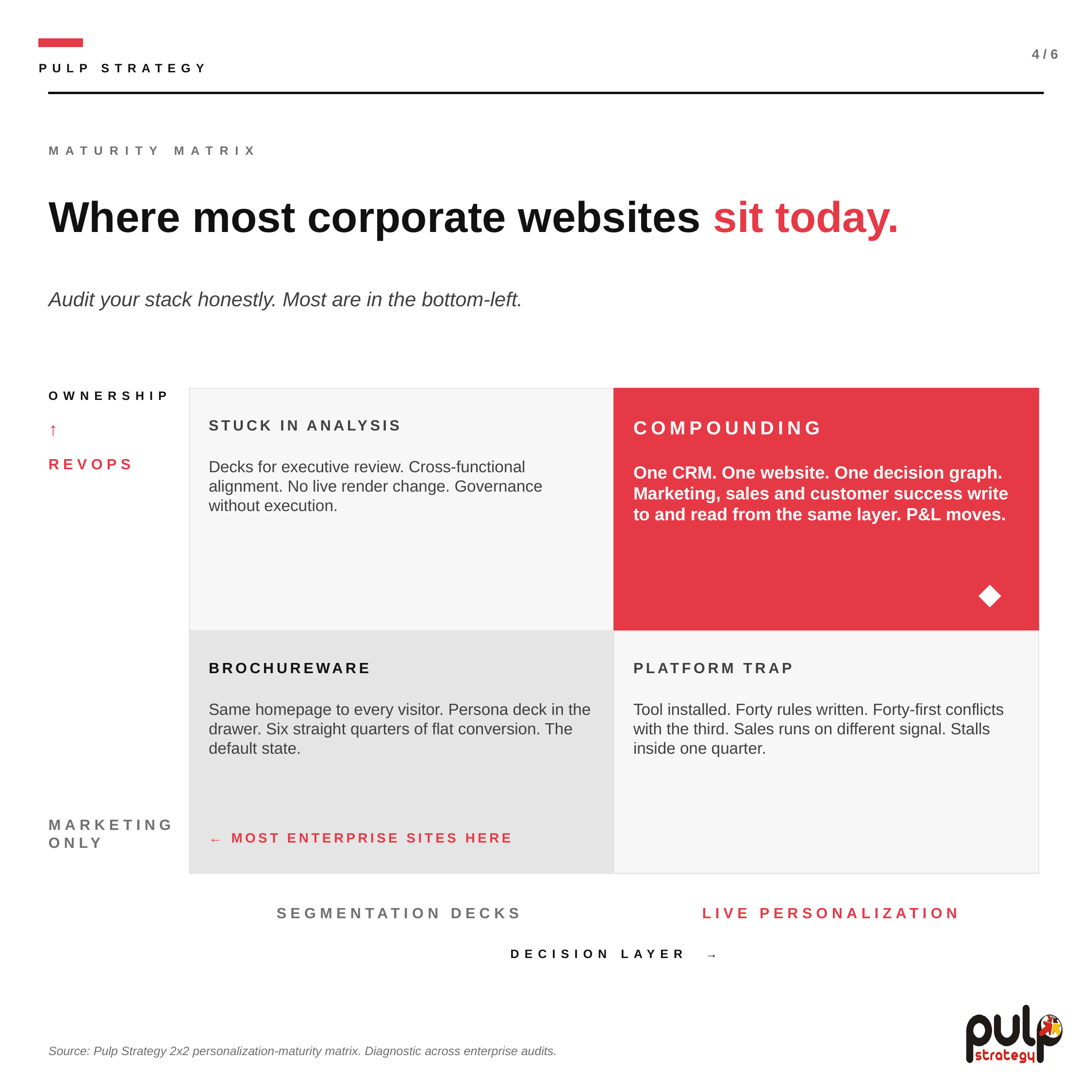
Most enterprise stacks ship segmentation in production and call it personalization. Analytics produces a deck with seventeen personas. The deck goes into quarterly review. The live website does not change. Visitors see the same homepage as the visitor before them, and the team reports cohort conversion rates that have been flat for six quarters.
The other failure mode is buying a personalization platform without a strategy. Vendor sells the demo. Team installs the tool. Forty rules written in quarter one. The forty-first conflicts with the third. QA burden becomes prohibitive. Team quietly stops shipping. The platform stays live but stops compounding. The CMO wonders why personalization spend is not producing personalization outcomes.
Most personalization programs stall not because of the platform but because nobody owns the decision graph. Marketing owns the website. Sales owns the CRM. Customer success owns renewal data. None of the three writes to a shared decision layer the website reads in real time. The visitor moves between three contexts, and each one tells a different story.
We treat this as an integration problem first, an experience problem second, and a tool problem last. Most agencies invert that order. That inversion is why most programs fail to compound.
Why does the first 30 seconds decide whether a visitor becomes a customer?
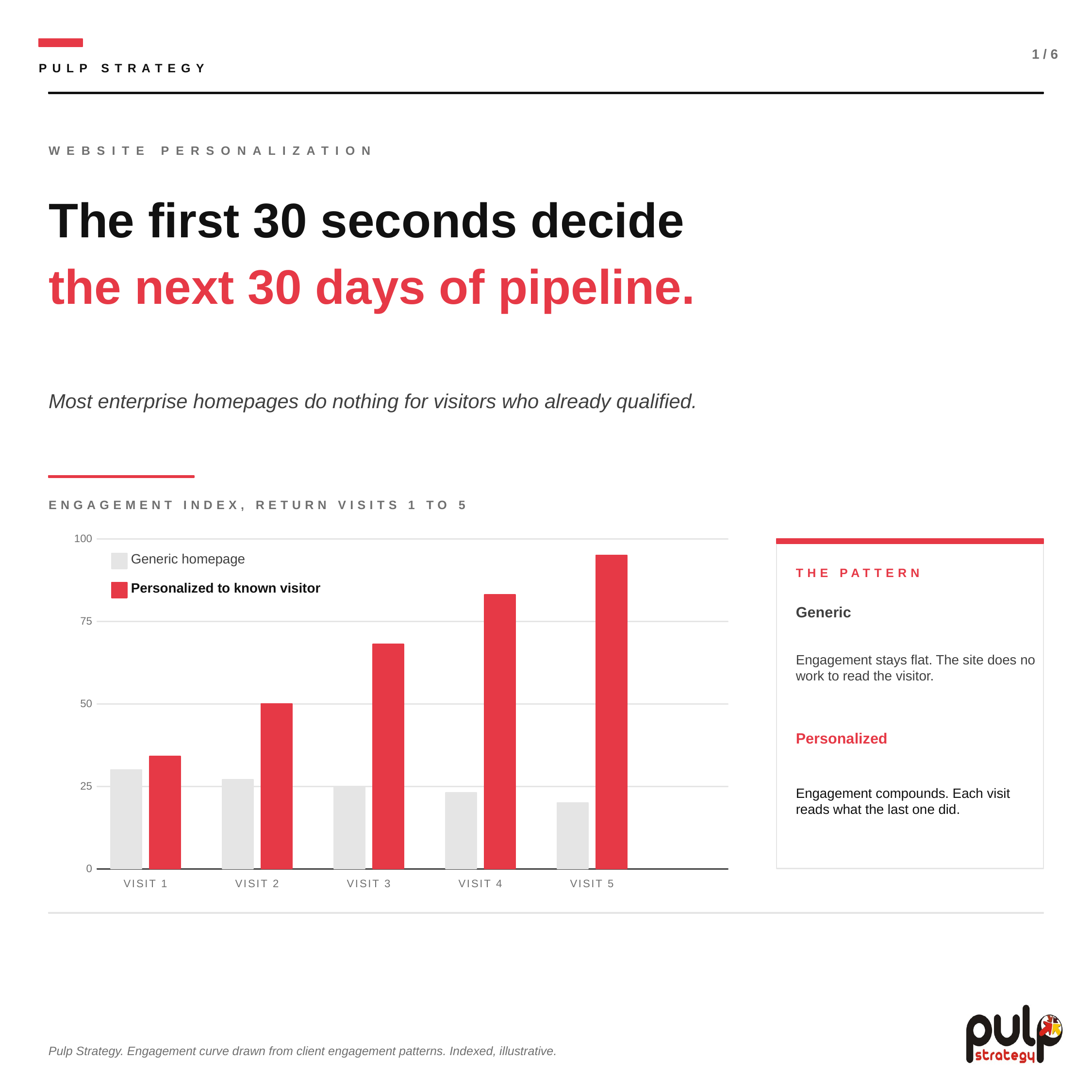
The commercial decision tree of a session collapses inside that window. Visitors decide whether you are credible, relevant and worth reading inside the first scroll. If the page does not match intent in the first 30 seconds, paid retargeting becomes the only lever left. Retargeting is the most expensive way to recover a visitor who already qualified themselves once.
We see this in audit after audit. A BFSI client running ₹4 crore a year on paid acquisition. A B2B SaaS company running a six-figure ABM budget on US accounts. The homepage they send traffic to is the same homepage their CFO sees. Same hero. Same value prop. Same call to action.
Website personalization is meant to fix this. Not the email. Not the ad. The page itself, in the first 30 seconds.
| The first 30 seconds of a session are where credibility, relevance and intent-match are decided. We treat website personalization as the lever that does this work in real time, before retargeting becomes the only option. Brands that fix the first session stop paying the recovery tax. |
How is website personalization different from segmentation, and why does the difference matter?
Segmentation describes who the visitor is. Personalization decides what the page does about it. Segmentation is a marketing analytics output. Personalization is a runtime behaviour of the website. Most stacks ship segmentation and call it personalization. Dashboards show seventeen personas. The homepage shows everyone the same thing.
Segmentation answers a backwards-looking question. Visitors from paid search converted at 1.4 percent. Referral converted at 3.2 percent. The output is a chart. The chart does not change what happens to the next visitor. Personalization answers a forward-looking question. This visitor came from a comparison-keyword query on Tuesday afternoon on Android. The right hero is the comparison module with the most-asked objection answered first. One produces decks. The other produces revenue
Structural difference between the two
| Dimension | Segmentation | Website personalization |
| Time horizon | Backward-looking. Reports on what happened. | Forward-looking. Decides what happens next. |
| Output | A chart, a persona doc, a quarterly review slide | A different page render for a different visitor |
| Owner | Analytics or research team | Marketing technology + CRO + RevOps, jointly |
| Latency | Hours, days or weeks | Milliseconds |
| Granularity | Cohort level (industry, country, persona) | Section level on a single page, per session |
| Failure mode | Insight nobody acts on | Creepy-uncanny content that suppresses trust |
| Measurement | Cohort conversion rate | Assisted revenue per visitor, lift over control |
| Segmentation describes the visitor. Website personalization decides what the page does. We ship the decision layer first, then the experience layer. Stacks that confuse description with action produce dashboards instead of revenue. |
What are the four levers of effective website personalization?
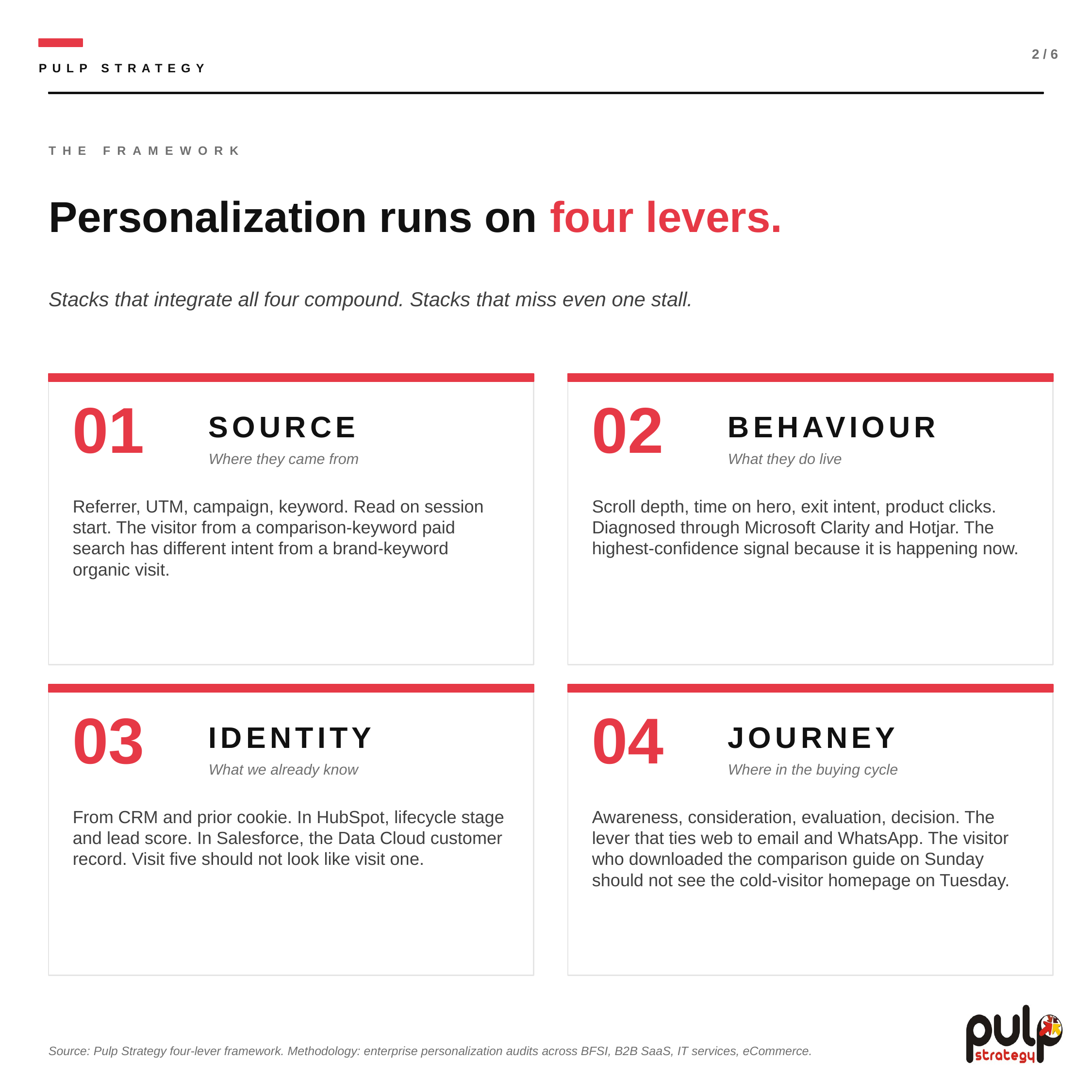
Source, behaviour, identity and journey. Source is where the visitor came from. Behaviour is what they are doing in the current session. Identity is what we already know about them from prior sessions or CRM. Journey is where they sit in the buying cycle. Every credible personalization decision is a function of one or more of these four. Stacks that ignore even one produce inconsistent results.
Source
A visitor arriving from a comparison-keyword paid search has different intent from a brand-keyword organic visit. Read referrer, UTM, campaign and keyword on session start. Swap hero, proof block, CTA. We have seen this single move produce double-digit lift on landing pages where nothing else changed.
Behaviour
Scroll depth, time on hero, exit intent, product clicks, video play. Heatmaps and session replay (Microsoft Clarity, Hotjar) are how you see this signal at scale. Click maps, scroll maps, rage-click flags. Behaviour is the highest-confidence signal because it is happening live.
Identity
What the CRM and prior-session cookie tell us. In HubSpot, this is lifecycle stage, list membership and lead score. In Salesforce, the Data Cloud customer record. The third visit should not look like the first. If visit one and visit five render the same hero, the site is not personalized.
Journey
Where the visitor sits in the buying cycle. Journey ties web to email and WhatsApp. The visitor who downloaded the comparison guide on Sunday evening should not see the same homepage on Tuesday afternoon as a cold visitor.
| We diagnose every personalization opportunity through four levers: source, behaviour, identity and journey. Each maps to a specific signal source. Each fails differently when ignored. Stacks that integrate all four compound. Stacks that miss even one stall. |
Where does AI fit into website personalization, and what makes it different from rules-based systems?
AI personalization sits on top of source, behaviour, identity and journey as a fifth lever, not a replacement. We ship AI personalization only after the underlying first-party data and consent posture are solid. The model is rarely the failure mode. Data quality and reward design are.
Rules-based personalization is a long if-then ladder maintained by a team that grows tired. AI personalization replaces it with a model ranking next-best-content for each visitor in real time. Done well, it lifts conversion and removes maintenance overhead. Done badly, creepy-uncanny experiences. The deciding factor is data quality and reward design, not the model.
Most enterprise rules-based programs stall at around forty rules. Past that, rules conflict and the team stops shipping. AI personalization, fed clean signal, makes the ranking decision continuously without human intervention.
Two failure modes to plan around. Creepiness: the model surfaces something the visitor did not consent to having known, and trust collapses. Instability: the model optimizes a metric that flatters short-term conversion but suppresses long-term value. Both trace to data quality and reward design, not the model.
AI personalization is best treated as a fifth lever on top of the first four, not a replacement. The brands building this layer well are also the brands investing in their own first-party data and consent infrastructure. The brands buying it as a vendor SKU and bolting it onto a leaky CDP are writing this year's failed-pilot post-mortem.
How do heatmaps and session replay drive personalization decisions, and where do most teams get this wrong?
Heatmaps and session replay are the qualitative input that tells you what to personalize. Click maps, scroll maps and rage-click signals show which sections are doing real work, which are dead weight, and which are quietly insulting the visitor. Most teams install Microsoft Clarity or Hotjar, watch ten recordings on day one, and never open the dashboard again.
We treat heatmaps as the diagnosis layer under the four levers. Click maps tell you whether the hero CTA is being seen. Scroll maps tell you whether visitors reach the proof block. A rage-click cluster on a non-clickable element is the highest-confidence signal that a visitor expects something to happen and is told no.
Microsoft Clarity (free, unlimited, built-in rage-click and dead-click detection, Copilot AI summaries) is the right starting point. Hotjar earns its price when qualitative feedback widgets and on-page surveys are part of the workflow. Many of our enterprise clients run both.
The mistake most teams make is treating heatmaps as a reporting artefact, not a decisioning input. The heatmap goes into the monthly deck. The deck gets reviewed. Nothing on the live site changes. The fix: every Friday, the personalization owner pulls the top three findings and converts each into a content swap to ship Monday.
Heatmaps and session replay (Microsoft Clarity, Hotjar) are the weekly diagnostic input that keeps the personalization backlog alive. We treat them as Friday-ritual decisioning data, not monthly-deck reporting artefacts. Without that ritual, sites drift back to brochureware inside a quarter.
How does website personalization integrate with HubSpot, Salesforce and the rest of the marketing and CRM stack?
It integrates through one shared customer record, or it does not work. HubSpot Smart Content, Salesforce Marketing Cloud Personalization and similar systems all key off CRM data: lifecycle stage, list membership, industry, lead score, prior interaction. The site that knows the visitor is a returning MQL in BFSI renders a different homepage. The integration is the personalization. The platform is the runtime.
HubSpot is the most common starting point for B2B clients we work with. Smart Content rules and personalization tokens key directly off the same CRM database the sales team uses. A Marketing Qualified Lead sees a different hero, CTA and proof block from a first-time visitor. No separate personalization platform required if the rules are well-designed.
For Salesforce-led enterprises, Salesforce Marketing Cloud Personalization (formerly Interaction Studio) reads from Data Cloud and orchestrates web, email, mobile and ad off one decision graph. Most Salesforce-led programs stall not because of the tool but because Marketing Cloud and Sales Cloud are run by different teams with different incentives.
| "We design the integration map first, then the experience layer. Pick the wrong integration map and the website and the CRM tell different stories about the same buyer." Ambika Sharma, Chief Strategist & Founder, Pulp Strategy |
The right ownership model in 2026 is RevOps. Personalization is no longer marketing-only. It is a revenue-operations function across marketing, sales and customer success, with a shared decision layer. One CRM. One website. One decision graph.
| HubSpot Smart Content covers most B2B engagements where the CRM is HubSpot. Salesforce Marketing Cloud Personalization handles enterprise scale on Salesforce. We design the integration map first, the experience second. RevOps must own the decision graph regardless of vendor, or the website and the CRM tell different stories about the same buyer. |
How does an enterprise CMO start with website personalization in 90 days, without buying a new platform first?
Audit, ship, integrate. Days 1 to 30: audit what the site does today using heatmap and session-replay data; find the three highest-traffic templates showing identical content to every visitor. Days 31 to 60: ship dynamic content swaps against measured controls. Days 61 to 90: connect the decision to email, WhatsApp and CRM so wins compound.
Process snippet (90-day plan). 1) Audit by source, behaviour and identity using Microsoft Clarity or Hotjar. 2) Pick three high-traffic templates with uniform content. 3) Ship dynamic content variants against clean controls. 4) Connect the decision to HubSpot or Salesforce so personalization signal flows back to the CRM. 5) Operationalize a Friday heatmap review ritual.
Buy the platform after the playbook is proven. Most year-one failures trace to the platform decision arriving before the integration map.
The 90-day playbook is audit, ship, integrate. We use heatmap and session-replay data in weeks 1 to 4 to choose what to ship in weeks 5 to 8, then closes the loop with HubSpot or Salesforce in weeks 9 to 12. Platform decision comes after the playbook is proven, not before.
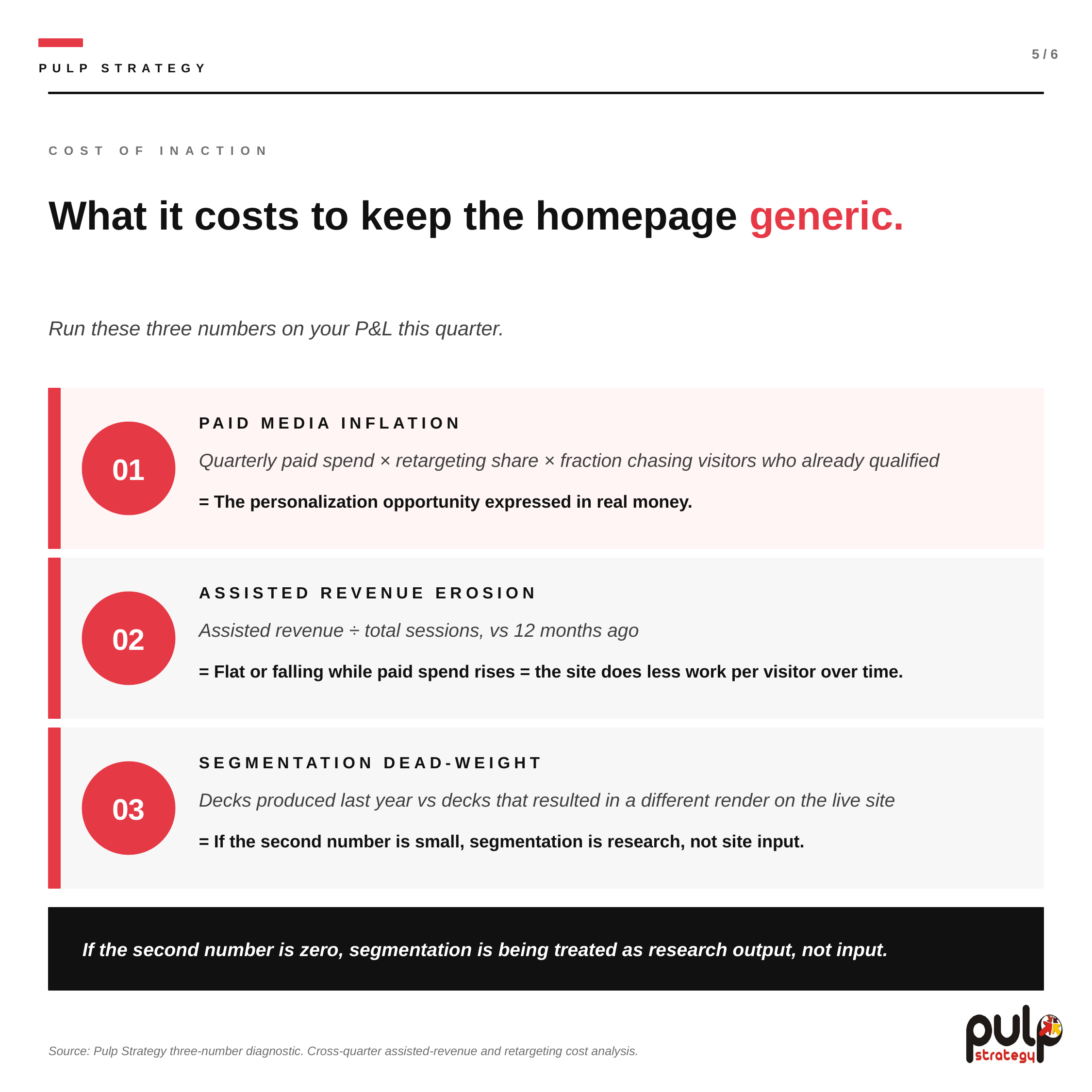
What does it cost to keep the homepage generic?
Value snippet what changes when you fix this. Fixing the first 30 seconds moves first-session bounce, scroll depth, time-to-CTA and assisted revenue per visitor. The mechanism is the website doing the qualifying work before the email, the call centre or the sales rep ever has to. The compounding effect shows up in pipeline within one quarter and in revenue within two.
Three numbers worth running on your P&L. First: paid media spend × retargeting share × fraction chasing visitors who already qualified themselves on the first session. That is the personalization opportunity in real money.
Second: assisted revenue ÷ total sessions, vs twelve months ago. Flat or falling while paid spend rises means the site does less work per visitor over time. That is the slow tax of a non-personalized site at scale.
Third: segmentation decks produced last year vs decks that resulted in a different render on the live site. If the second number is small, segmentation is research, not site input. The fact that nothing on the site responds to the decks is the problem.
How we run this for clients (Microsoft Cloud Speed Circuit and beyond)
Unlike off-the-shelf personalization platforms that lead with a vendor SKU, Pulp Strategy designs the decision layer first and chooses the runtime second. The platform is a tool. The integration map is the strategy.
| Dimension | Vendor-led | Agency generic | Pulp Strategy |
| Starting point | Platform SKU | Persona deck | Integration map |
| First deliverable | Tool installed | Strategy slide | Audited baseline, 3 templates |
| Heatmaps / session replay | Optional | One-off review | Weekly Friday ritual |
| CRM integration | Out-of-box connectors | Generic setup | Lifecycle + list + lead-score rules |
| Ownership model | Marketing only | Marketing + analytics | RevOps |
| Time to first measured lift | 12+ weeks | 8 to 12 weeks | 4 to 6 weeks |
| Failure mode | Platform idle | Insight nobody ships | Needs named owner + cadence |
Microsoft Cloud Speed Circuit: a channel partner portal, individual journeys per named partner
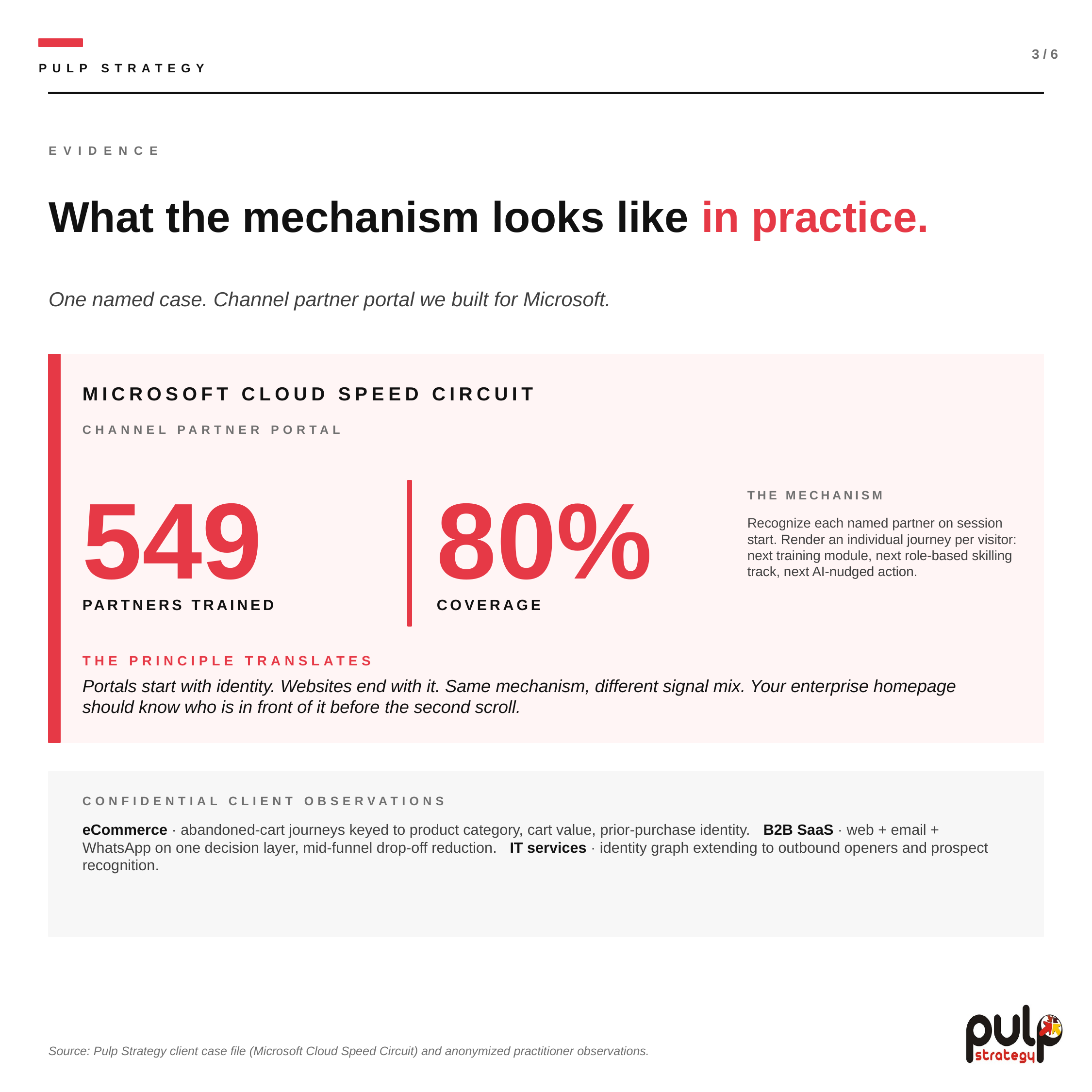
Cloud Speed Circuit is a channel partner program we built for Microsoft, targeted at the SMB partner ecosystem. The audience is a defined, named cohort of channel partners, signed in to a portal we designed and run, where every session is authenticated and the visitor is known on arrival. The conventional move in channel programs is one common dashboard, one common training catalog, one common newsletter. The personalization-led move is to recognize each named partner on session start and render an individual journey for them: the next training module, the next role-based skilling track, the next pitch enablement asset, the next AI-nudged action specific to where they sit in their growth path. The portal does not look the same on visit one and visit five. The follow-up does not arrive cold. Five hundred and forty-nine partners were trained against an 80 percent coverage target, with mid-journey dropoff reduction and content depth-of-engagement lift across return visits. The mechanism is straightforward when the underlying identity layer is honest about who the visitor is.
Why a portal case is the closest thing the article can publish, and how it maps to the website
Cloud Speed Circuit is a portal, not a public marketing website. Every visitor is authenticated. Identity is established before the session begins. That is the easier end of the personalization spectrum, and we publish it openly because the case file allows it. The website case is harder. Most enterprise websites meet the visitor anonymous and have to read source, behaviour and prior cookie in real time to build identity. The mechanism is the same: recognize who is in front of you and render to them. The signal mix is different: portals start with identity; websites end with it. Everything else (the individual journey, the AI nudges, the next-best-action surfacing, the dropoff diagnostics, the engagement compounding across return visits) is structurally identical. The skill we built running the portal is the same skill we run on the website. The website case files we have under NDA cannot be named here, which is why this article lands where it does.
What this looks like in adjacent engagements
The same underlying mechanism shows up in very different commercial outcomes depending on the engagement type. In a different vertical entirely, an enterprise eCommerce program we ran used product category, cart value and prior-purchase identity to drive abandoned-cart and recommendation flows; the outcome there was recovered revenue per visitor, not engagement-program metrics. In a B2B SaaS engagement, integrating the website with email and WhatsApp through one decision layer reduced drop-off in the mid-funnel and shortened the path from interest to qualified conversation. Different signals, different metrics, same principle: when the website knows the visitor and renders accordingly, the rest of the funnel does less heavy lifting.
What this looks like in B2B demand-gen execution
On a recent enterprise IT services engagement, the website personalization layer extended into outbound. The same identity graph that decided which version of the homepage to render also generated 1:1 message openers for outbound, recognized returning prospects on session, and surfaced the right case study before any sales conversation began. The principle holds whether the channel is web, email or LinkedIn. Identity is the connective tissue. The page, the message and the meeting all reference the same visitor record.
| Our named proof comes from Microsoft Cloud Speed Circuit, a channel partner portal where individual AI-nudged journeys per named partner trained 549 partners at 80 percent coverage. Portal personalization runs on already-known identity; website personalization runs on building identity in real time. The mechanism, the journey logic and the engagement compounding are structurally identical. Identity is the connective tissue. |
How does website personalization differ between India and the United States?
India operates under the Digital Personal Data Protection Act, 2023 (DPDP Act). Consent must be free, specific, informed and unambiguous. For BFSI, RBI data-localization rules apply on top of DPDP. WhatsApp is a first-class personalization channel in India in a way it is not in the US; our engagements often integrate Jaldi Engage as the WhatsApp layer. Local CRM: LeadSquared, Zoho, Salesforce, HubSpot.
The US operates under a state-by-state patchwork: California (CCPA, CPRA), Virginia (VCDPA), Colorado (CPA), Connecticut (CTDPA). No federal equivalent of DPDP yet. For B2B, Salesforce-led stacks dominate with Marketing Cloud Personalization and Data Cloud. For B2C, Adobe Experience Cloud and Optimizely. Bing search and ChatGPT browsing are larger AI-traffic sources in the US than in India.
The single URL strategy works for both markets when meta title is market-neutral, hreflang is en + x-default, and body references both markets. The split that fails: India and US on different subdirectories with different brand voice. Buyers cross both markets. AI engines do not respect /in/ and /us/ prefixes for citation.
Next steps
If your homepage shows the same hero to your CFO, your largest customer and a procurement intern, the site is leaving money on the table every day. Start with a personalization audit of your three highest-traffic templates. Two weeks to a baseline. The playbook is mechanical from there. Compounding starts in month two. P&L move in month four.
Talk to Pulp Strategy: When your website meets your visitor, does it recognise them, or does it hand them the same brochure it hands everyone else?