
by Ambika Sharma - A new playbook for CMOs in the AI discovery era
Updated August 2025
The rules of digital visibility have changed. This isn't about keyword density or domain authority anymore. It's about whether an AI model knows your brand well enough to cite it. This is your unfair advantage in a world that no longer clicks.
The Landscape Isn’t Shifting, It’s Reframing
Let’s be honest-how people find your brand is no longer about Google. Discovery today is powered by language, not links.
In 2025, the digital world isn’t merely evolving, it’s reframing. For two decades, SEO drove content visibility through rankings and web traffic. But that playbook is breaking. As AI chatbots and generative engines become prominent entry points for discovery, CMOs must shift their mindset from optimizing for links to optimizing for being surfaced inside AI-generated answers.
Wall Street Journal reports that "80% of consumers now resolve 40% of their online search queries without clicking links" with generative models like ChatGPT and Google’s AI summaries accelerating that trend. The result is fewer clicks, less organic traffic, and more emphasis on appearing in AI responses rather than on search engine result pages.
In short, the question today is no longer "how high do you rank"-but "how prominent are you inside AI-driven responses?"
What Is GEO and How Does It Differ From SEO?
Generative Engine Optimization (GEO) refers to optimizing your digital presence for AI platforms. Instead of ranking within search results, GEO ensures your content is synthesized, cited, or quoted directly by large language models like ChatGPT, Gemini, and Perplexity.
A16z captures this succinctly: "Traditional search was built on links. GEO is built on language." As search becomes conversational and fragment-oriented, the unit of visibility shifts from pages to citable chunks, context, and clear authority signals.
What’s the practical difference?
- SEO thrives on keywords, backlinks, and click-throughs.
- GEO thrives on structured clarity, brand context, and extractable content that AI bots can reuse.
GEO isn't a replacement-but a next chapter. It builds upon SEO’s foundation while helping brands stay visible within AI-first discovery paths.
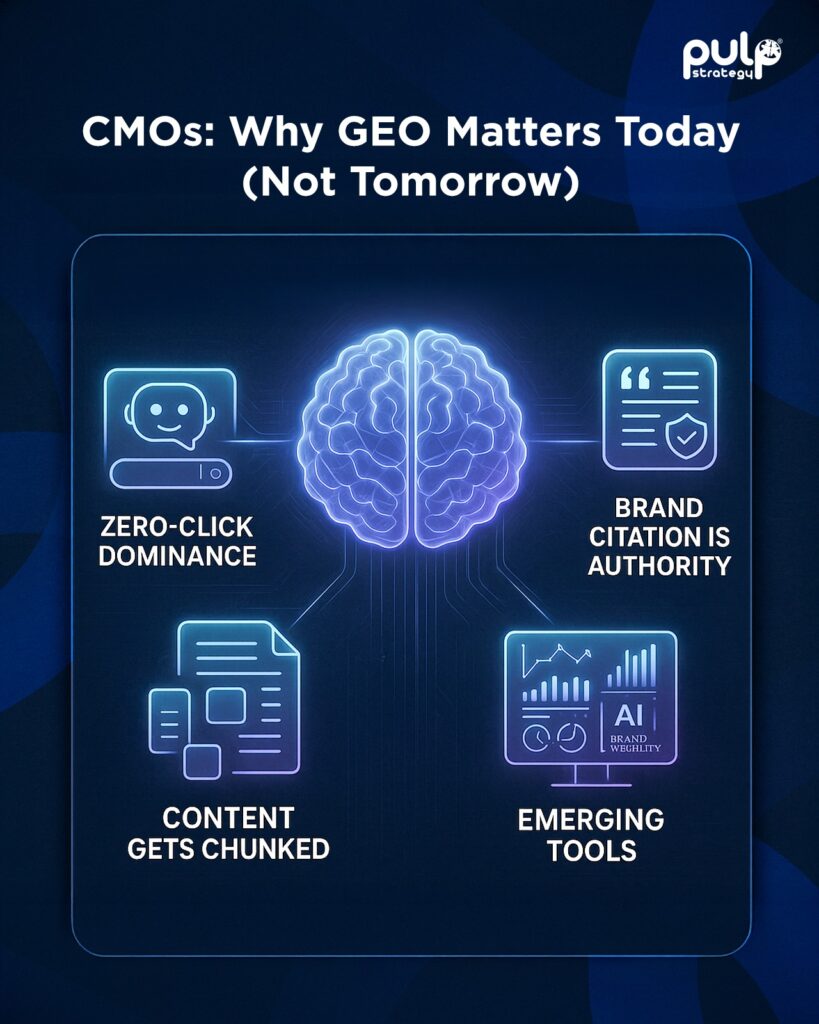
CMOs: Why GEO Matters Today (Not Tomorrow)
This isn’t a shift for your SEO manager. It’s a boardroom-level decision. How you show up in AI conversations isn’t a technical question-it’s a brand one.
- Zero-click dominance: AI is increasingly the final answer. WSJ notes that for brands like Mailchimp, these bots don’t send traffic-they replicate answers. Traffic metrics can no longer gauge visibility effectively.
- Brand citation is authority: In AI responses, external validation-citations-is what drives trust. GEO underscores the need for brand context that AI can recognize and cite.
- Content gets chunked: As New York Magazine puts it, "Chatbots summarize answers using citable chunks"-so content must be formatted for easy extraction.
- Emerging tools: Platforms like Wix now offer AI visibility dashboards that show how often AI cites your content and let you manage brand representation within LLMs.
The CMO’s GEO Decision Play
You don’t need a new team. You need a new lens. Here are the three dominant paths CMOs are choosing in 2025:
- The SEO Holdout: You Keep Doing What Works. Google-first, traffic-based, and link-led. Low risk. Low AI visibility.
- The Hybrid Optimizer: You blend Search Engine Optimisation hygiene with GEO structure, embedding your content into both search rankings and AI recall patterns.
- The GEO-Native Mover: You flip the strategy. AI-first. Structured authority. Your brand becomes a training set anchor, not just a traffic goal.
Which one are you building?
This Article Covers
The exact questions your team - and your AI - needs to answer in 2025.
Discovery Shift
- How is SEO changing in 2025?
- Is AI replacing traditional SEO?
- What’s the difference between SEO, GEO, and AIO (Answer Intelligence Optimization)?
Content Strategy Lens
- How to optimize for generative engines like ChatGPT and Gemini?
- What is GEO (Generative Engine Optimization)?
- What is AIO and how does it overlap with GEO?
- Tools for improving brand ranking in LLMs?
- Is SEO still relevant in the age of AI?
Performance & ROI
- Why is no one clicking on my links anymore?
- What’s the ROI difference between GEO and SEO?
- How do GEO and AIO impact enterprise visibility?
- What are top GEO strategies for B2B content?
- How the NeuroRank framework drives GEO and AEO success
Trends & Future
- What’s the future of search post‑2025?
- What are top content trends for ChatGPT search?
- How are Gen Z and AI changing discovery behavior?
The Emerging ROI Equation: From Traffic to Presence
Traditional ROI models tied to traffic and conversion funnels are becoming brittle. GEO demands a different performance lens:
- Visibility via recall: Being cited by AI models translates to presence, not clicks.
- Authority through structure: The better your content hierarchy and clarity, the more likely LLMs use it.
- Contextual brand presence: AI often surfaces brands they know. If your brand isn’t networked in recognized sources, it may be omitted.
This demands re-evaluating ROI through visibility and brand voice inside AI discovery experiences rather than pure traffic metrics.
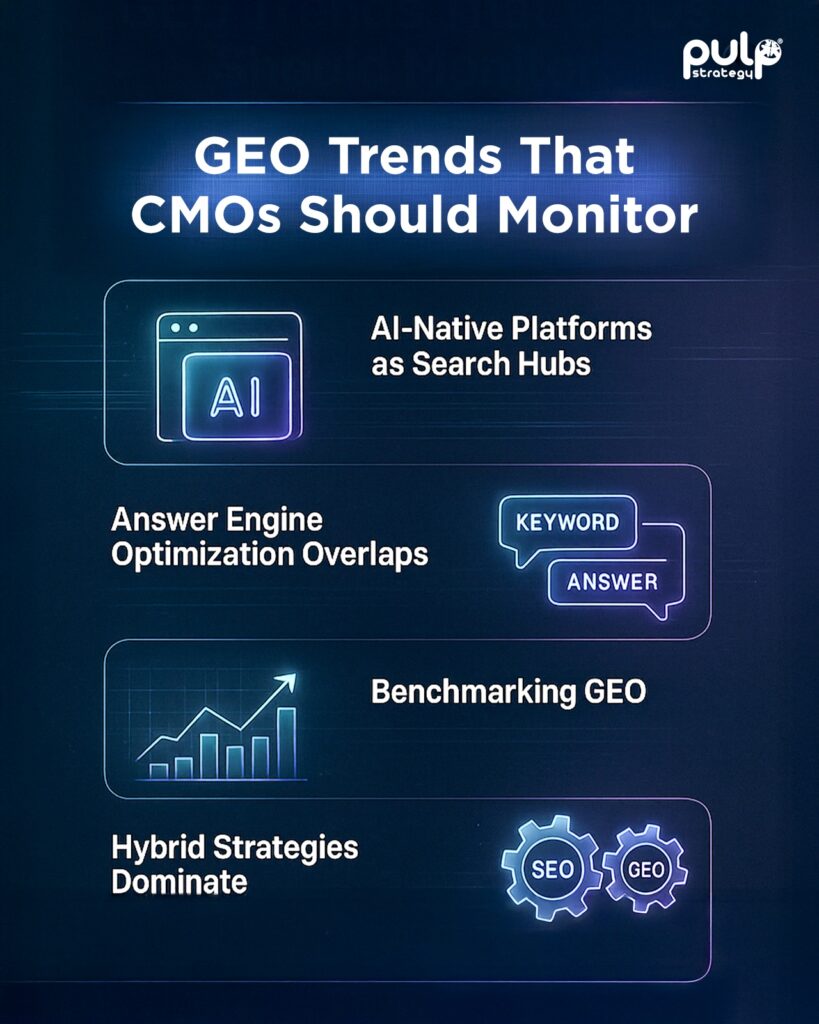
GEO Trends That CMOs Should Monitor
One of the emerging platforms leading this charge is NeuroRank-a framework that helps brands improve prompt share, LLM citations, and AI model recall. Unlike traditional SEO tools, NeuroRank is built specifically for generative engines and answers the question: 'How does AI describe your brand when no one is watching?'
NeuroRank exemplifies how AI-native tools are defining the new frontier of discovery.
- AI-native platforms as search hubs: Apple, for instance, is rolling LLM-driven search into Safari, displacing Google’s link-first approach. Gemini is already giving AI summaries.
- Answer Engine Optimization overlaps: AEO, which structures content for direct answers and conversational tone, often overlaps with GEO, especially in Q&A formats designed for AI models.
- Benchmarking GEO: Academic frameworks like GEO-Bench show that optimized content visibility can increase citation likelihood by up to 40%.
- Hybrid strategies dominate: CMOs should pursue SEO, GEO, and AEO in tandem, tailoring formats to each channel.
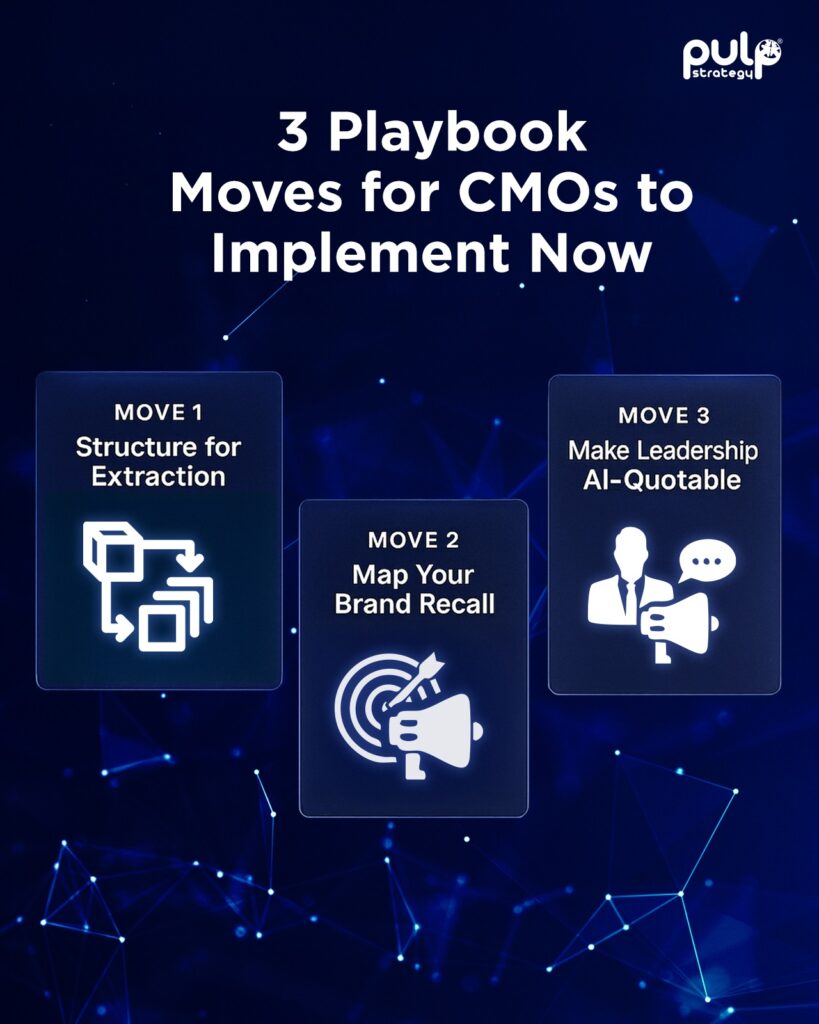
3 Playbook Moves for CMOs to Implement Now
Want a tool that measures and fixes prompt invisibility? Solutions like NeuroRank are designed to do just that-tracking LLM mentions, hallucination gaps, and citation lift across platforms like ChatGPT, Gemini, and Claude.
- Move 1: Structure for Extraction
Make every paragraph in your top content easily chunkable by AI. Lists. FAQs. Strong H2-H3 hierarchy.
- Move 2: Map Your Brand Recall
Run prompt tests monthly across ChatGPT, Claude, and Gemini. Is your brand mentioned? Is your leadership cited? If not-why not? - Move 3: Make Leadership AI-Quotable
Publish content from your CMO, head of product, and CS leads that AI models can quote confidently in enterprise prompts.
True Thought Leadership Means Positioning the Strategy, Not Selling It
This isn’t a cheat sheet. It’s your leadership edge in a zero-click world.. It's about framing a different vantage point:
- CMO Cheat Sheet: Making the Shift from SEO to GEO
- Mindset Shift: Treat SEO as your hygiene layer. GEO is your discovery edge.
- Content Format Rule: Structure for AI readability-headings, chunks, and contextual clarity.
- Visibility Metric: Stop counting clicks. Start tracking citations, mentions, and prompt recall.
- Strategic Asset: Your brand's goal isn't just to be found-it's to be repeated by AI, consistently and accurately.
You don’t need tactics. You need frameworks that AI recognizes. This is how visibility is earned in 2025.
For CMOs, the frontier is shaping not just what people read-but what AI models repeat.
Decision Point: Are You Still Ranking or Being Mentioned?
- If your team still measures visibility via page rank and traffic, it’s time for a mindset pivot.
- GEO isn’t optional-it’s the new table-stakes for being part of AI-synthesized answers.
- With AI search diversifying across platforms, future visibility requires language-first, chunk-sized content positioned for recognition not ranking.
- Success is not on page 1 it's in being recommended.
Closing Thoughts: A CMO's Call to Action
Let’s not call it the end of SEO. Let’s call it the rise of something smarter. CMOs today have a rare opportunity: to shape how AI describes, recommends, and recalls their brand for the next decade.
"From SEO to GEO" isn’t just a headline. It’s a strategic pivot. Brands that invest in their visibility within AI ecosystems-through structured clarity, contextual authority, and hybrid optimization-stand to shape the narrative, even when the conversation happens between a user and an AI.
This blog has mapped the strategic terrain, rooted in emerging market shifts and GEO discourse. You don’t need another keyword. You need to control how AI introduces your brand to your future buyers.