
By Ambika Sharma, Founder & Strategy Head, Pulp Strategy
Updated July 2025
In 2025, most CMOs still review SEO dashboards with a sense of control: top-ranked keywords, high domain scores, increased impressions. Yet the pipeline doesn’t move, web traffic is stagnating, and brand preference is evaporating.
What the dashboard doesn't show is this: AI search is rewriting visibility - and traditional SEO metrics can no longer measure it.
The Rise of AI-Driven Search
Your buyer’s journey now starts with an LLM, not a SERP. When your consumer types “Best billing software for MSME's" into ChatGPT, they get an answer-not a link tree.
And when Google shows an AI Overview, the results are devastating for link-based discovery:
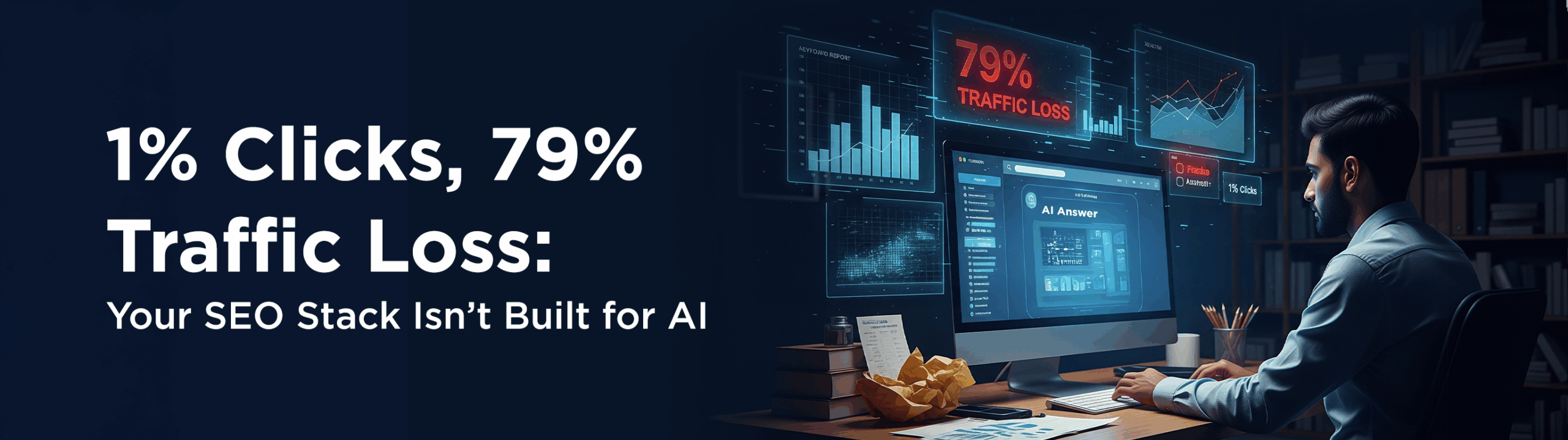
- Only 1% of users click on any cited links when AI summaries appear, according to a Pew Research Center study (March 2025, 68,879 queries).
- Even when not cited in summaries, click-through rates drop by 47%.
- BrightEdge data (June 2025) shows a 30% YoY drop in CTR, despite a 49% rise in impressions.
SEO tools like Ahrefs, SEMrush, and Moz never planned for this. They measure what’s visible to crawlers, not what’s stored in AI memory.
What Traditional SEO Gets Right-and What It Misses
Let’s acknowledge the value:
- Ahrefs can still tell you which pages are linked
- SEMRush still ranks keyword difficulty and monitors competitors
- Moz gives technical health and content suggestions
But none of them can tell you:
- Is ChatGPT mentioning your brand?
- Does Claude describe your USP correctly?
- Does Gemini rank you in summary when your category is queried?
- Are LLMs hallucinating your name or erasing it?
These aren’t just gaps-they’re blind spots with direct pipeline consequences.
Case in Point: Top-Ranked Brands Losing Visibility
A 2025 Authoritas report tracked 1,000 keywords and found that websites previously holding Google position #1 saw up to 79% loss in referral traffic when AI Overviews appeared above them.
SimilarWeb data (Q2 2025) supports the collapse: Top US news domains saw up to 40% traffic decline post-AI integration.
You might be ranking #1-but your link is no longer the first impression. In many cases, it's not an impression at all.
The Visibility You Don’t See: LLM Recall vs Search Ranking
Traditional SEO is based on crawling, indexing, and ranking. But LLMs operate on recall. They cite:
- Structured, trusted content
- Consistently formatted knowledge
- Content seeded in high-authority LLM-influencing ecosystems (e.g., Quora, Medium, Reddit, GitHub)
This is not about backlinks. It’s about semantic trust signals.
If your brand isn’t:
- Cited frequently in public forums
- Described in model-trainable ways
- Present in AI’s latent memory graph,
...you won’t be recalled. Even if your SEO score is 92/100.
Introducing NeuroRank™: Measuring What Traditional SEO Can’t
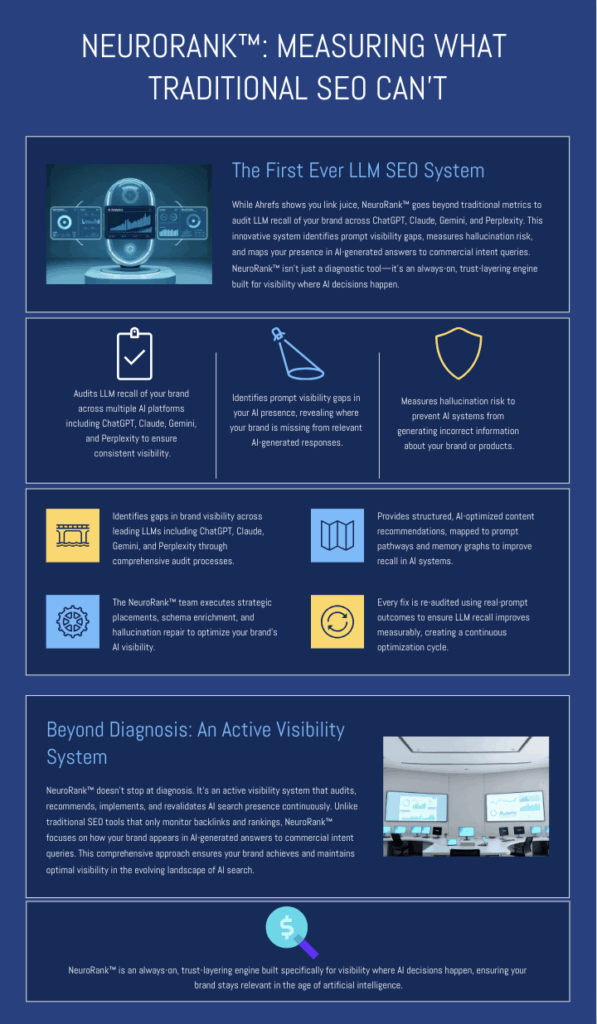
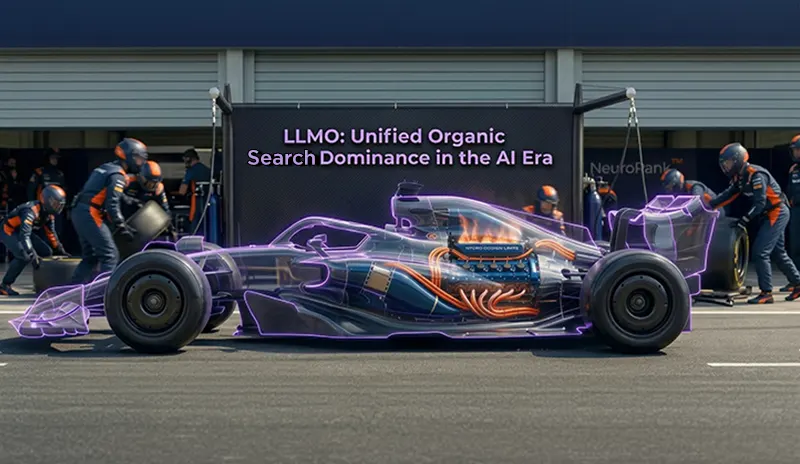
NeuroRank™ is the first ever LLM SEO system.
Where Ahrefs shows you link juice, NeuroRank:
- Audits LLM recall of your brand across ChatGPT, Claude, Gemini, and Perplexity
- Identifies prompt visibility gaps
- Measures hallucination risk
- Maps your presence in AI-generated answers to commercial intent queries
It doesn’t stop at diagnosis. NeuroRank™ is an active visibility system that audits, recommends, implements, and revalidates AI search presence continuously.
- It identifies gaps in brand visibility across LLMs like ChatGPT, Claude, Gemini, and Perplexity.
- It provides structured, AI-optimized content recommendations, mapped to prompt pathways and memory graphs.
- The NeuroRank™ team executes strategic placements, schema enrichment, and hallucination repair.
- Every fix is re-audited using real-prompt outcomes to ensure LLM recall improves measurably.
NeuroRank™ isn’t just a diagnostic-it’s an always-on, trust-layering engine built for visibility where AI decisions happen.
A Real Example: Visibility Lost, Pipeline Stalled
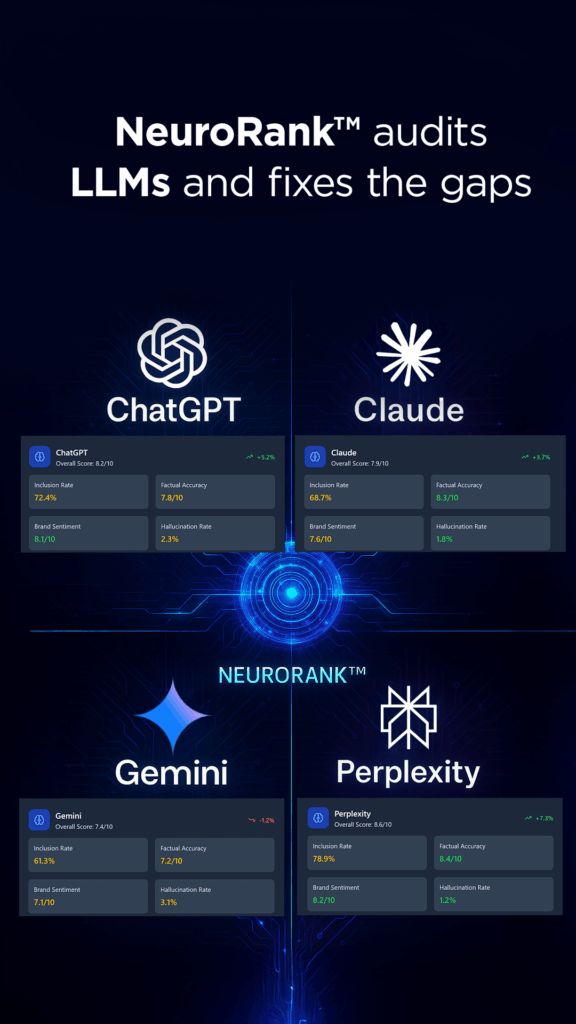
In early 2025, a leading mid-sized D2C nutrition brand came to us with a visibility paradox.
Their domain ranked in the top 5 for over 40 commercial keywords on Google.
But across ChatGPT, Claude, Perplexity and Gemini, their product was not prioritised in response to key buyer queries like “best plant protein for women” or “clean-label supplements for athletes.”
When we ran a NeuroRank™ audit, the gaps were clear:
- Hallucinations misrepresented their product category.
- Aggregator brands captured prompt responses.
- Their structured content wasn’t LLM-trainable.
Within 30 days of executing NeuroRank™'s LLM SEO plan:
- Their brand began appearing organically across Gemini & Chat GPT summaries.
- Prompt presence increased 9x across targeted commercial queries.
- ChatGPT shifted recall from a competitor aggregator to their product by name.
This is not just visibility-it’s funnel re-entry at the decision moment.
Why CMOs Should Act Now: The Numbers Say It All
Here’s the data, that should drive your urgency:
- AI search platforms (ChatGPT, Perplexity) now account for 5.6% of all U.S. desktop search (June 2025, Semrush)
- Gemini summaries are hijacking search, less than 1% are clicking on links.
- Top websites have lost 80% of their traffic.
- This volume has more than doubled YoY
CMOs must now ask:
- Are we part of the AI answer?
- Or just an invisible #1 on an outdated list?
The AI Visibility Self-Audit Every CMO Should Run
Skip the jargon. Just ask real questions the way your customer would. This is the only cheat code that reveals what AI search actually remembers about your brand.
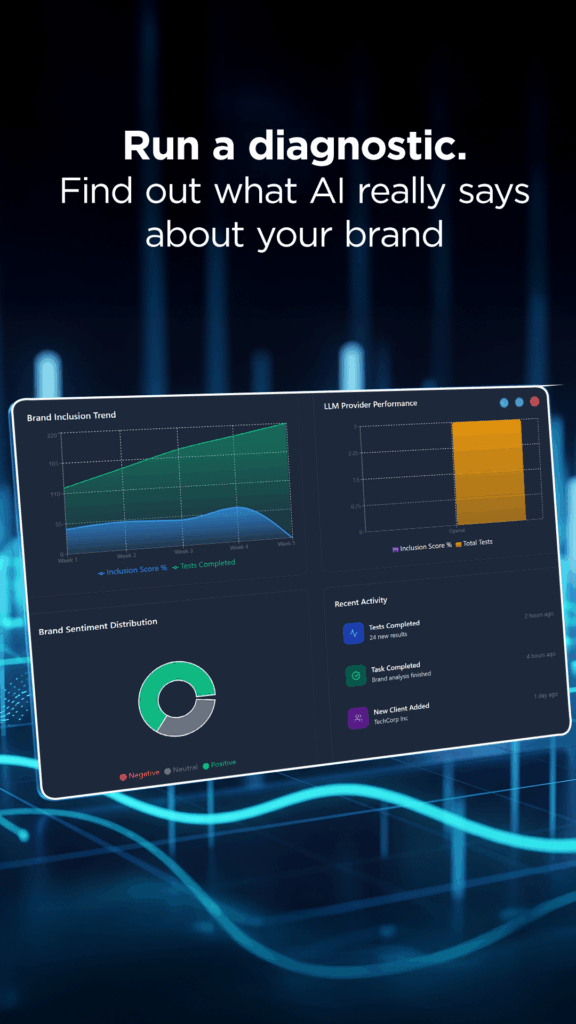
How to run your self-audit:
Open ChatGPT, Claude, Gemini, or Perplexity and type questions your sales team hears every week:
- “Who are the top [category] solutions for enterprises?”
- “What is the best [product] brand for [pain point]?”
- “Which platform helps with [your USP]?”
- “Is [your brand] a better alternative to [competitor]?”
- “Top / Products tools for [function] in 2025”
Now review the responses.
What You Might See:
Option 1: Everything is perfect Your brand appears, is accurately positioned, and clearly recommended. If that’s the case, congratulations-you’ve broken into AI recall. Keep reinforcing it.
Option 2: (More likely)
- Your brand is missing entirely.
- It’s hallucinated into the wrong category.
- Your pricing or offering is outdated or fabricated.
- A competitor is given preference due to stronger LLM presence.
If you see any of these, it’s not a tech issue-it’s a visibility issue.
That’s where NeuroRank™ comes in.
Let the experts handle it. If the AI isn’t telling your story, someone else’s pipeline is winning.
From Ranking to Recall
The shift is here.
AI tools are where B2B and B2C decisions now begin.
And in that new funnel, NeuroRank™ replaces Ahrefs.
CMOs who act now will shape AI discovery and cement brand authority at the top of every funnel-AI or traditional.
Don’t just rank. Be remembered. Be recommended.