
By Ambika Sharma, Founder & Chief Strategist, Pulp Strategy
Updated September 2025
Executive Overview
In 2025, CMOs and founders face shifting buyer behaviors, volatile markets, and heightened pressure to deliver ROI. Execution often races ahead of strategy, resulting in wasted budgets and stalled growth. The future belongs to leaders who anchor strategy at the center of branding and GTM, ensuring clarity before scale.
The Highlights
- Strategy-first branding & GTM delivers ROI clarity.
- Social contributes only 3–4% of B2B site traffic despite heavy effort (HubSpot/Gartner 2025).
- Case studies: Avon +47% partner engagement, Lenovo +pipeline velocity, Dabur Meswak +30% recall.
- By 2030, AI will power execution but strategy remains the differentiator.
The Reality Check for CMOs and Founders
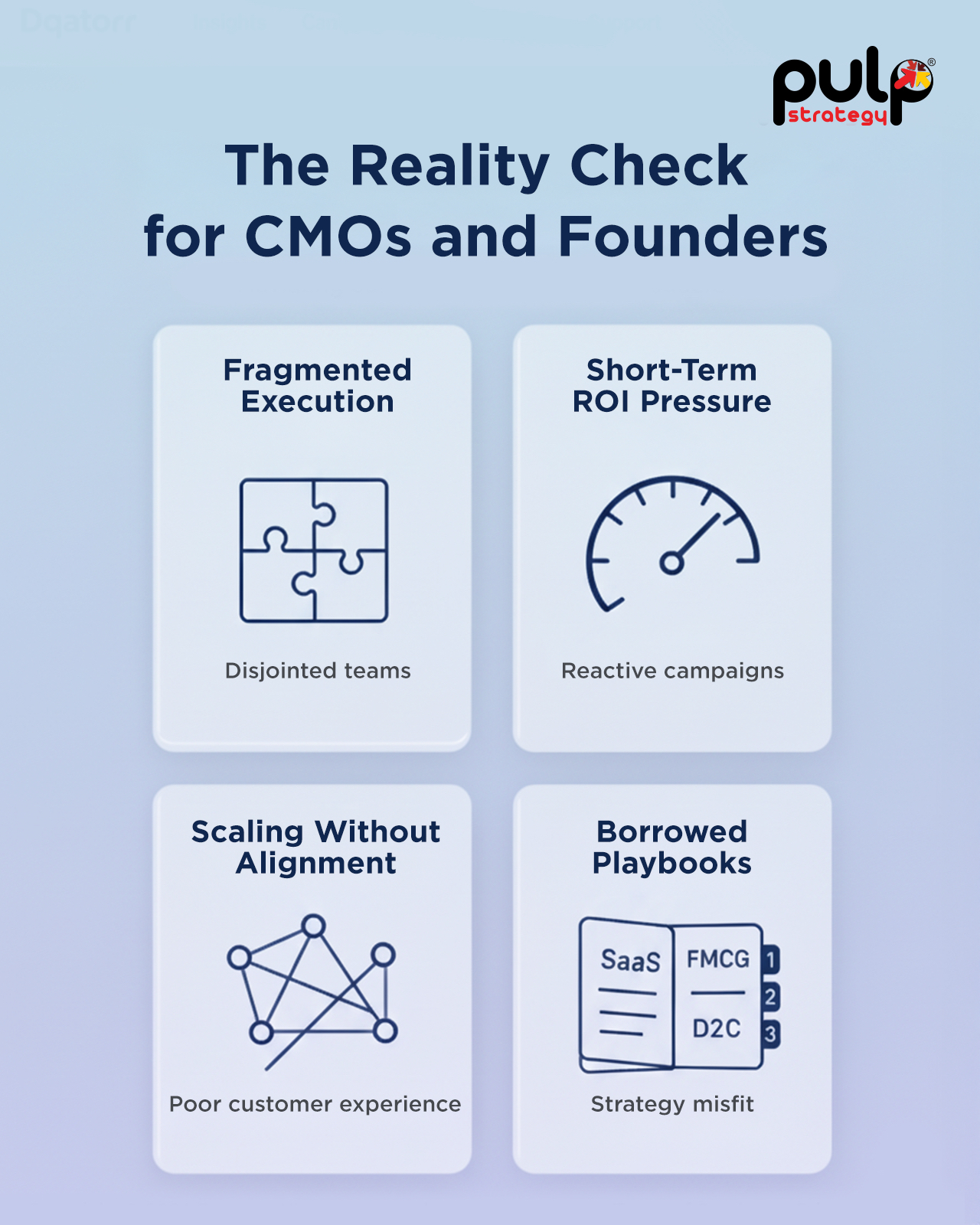
Fragmented Execution: Teams operate in silos, focusing on outputs that don’t convert into outcomes. Social media, for instance, often consumes 80% of creative effort but contributes only 3–4% of B2B site traffic (HubSpot/Gartner, 2025).
Short-Term ROI Pressure: Boards push for immediate results, leading to reactive campaigns that may spike metrics but erode long-term brand equity.
Scaling Without Alignment: Pursuing growth without a unifying strategy creates inconsistent customer experiences and diluted brand identity.
Borrowed Playbooks: SaaS founders applying FMCG or D2C tactics overlook the complexity of enterprise buying cycles, leading to mismatched spend and poor ROI.
What Leaders Need to Prioritize
- Understand Channel Impact: Search, content, and partnerships consistently deliver higher ROI than over-indexed social activity.
- Measure Beyond Vanity: Focus on pipeline velocity, brand preference, and lifetime value rather than impressions or follower counts.
- Design for Context: GTM models must reflect business type, consumer tactics rarely succeed in enterprise or SaaS environments.
McKinsey notes that 70% of transformations fail due to poor clarity and alignment. Forrester highlights that firms mapping buyer journeys achieve 2x pipeline growth. Gartner predicts that by 2026, 65% of CMOs will rebalance budgets from pure demand generation to brand + journey orchestration.
Building a Playbook That Drives ROI
A strategy-first playbook is a decision-making tool:
- Foundation: Define brand positioning, promise, and voice.
- Roadmap: Map awareness → adoption → advocacy with ROI checkpoints.
- Resource Focus: Allocate budgets to initiatives with clear business impact.
- Alignment: Eliminate duplication by ensuring teams and partners execute one unified strategy.
A GTM Strategy-First Framework for CMOs
- Brand Clarity → Define promise, voice, positioning.
- Journey Mapping → Align marketing, sales, and product on buyer paths.
- Channel Calibration → Fund high-ROI activities, not vanity spend.
- Execution Discipline → Use AI and automation to scale execution under human-led strategy.
- Measurement & Feedback → Track ROI-centric metrics and adjust continuously.
The Role of AI: Powerful but Secondary
AI is an execution amplifier: accelerating personalization, campaign automation, and media optimization. But GTM strategy must remain human-led. Leaders should see AI as a lever for efficiency, not as a substitute for foresight.
Case Studies that Illustrate ROI Impact
- Avon India: Facing stagnant partner engagement, Avon reframed its GTM with a strategy-led approach. Within 90 days, engagement improved by 47% and transaction volume rose significantly, delivering measurable ROI from optimized partner activation. Structured strategy created compounding results rather than short-lived spikes.
- Lenovo APAC CIO Engagement: Lenovo needed deeper engagement with enterprise CIOs. By aligning content, sales, and marketing in a unified GTM framework, Lenovo increased pipeline velocity by double digits and improved conversion efficiency. The ROI came from higher deal closure rates and reduced acquisition costs across markets.
- Dabur Meswak Nostalgia Campaign: Dabur revitalized Meswak toothpaste using strategic storytelling rooted in brand heritage. The campaign lifted recall metrics by 30% and improved market share in its category, with AI tools optimizing executional efficiency. ROI was visible in both sales uplift and lower cost per reach compared to traditional mass campaigns.
Preparing for the Next Wave
- Build privacy-first frameworks that combine compliance and personalization.
- Treat professional oversight as a growth differentiator.
- Adapt global benchmarks to local market realities.
- Apply AI for executional efficiency, while strategy remains human-driven.
Consequences of Inaction
- Wasted Budgets: Spend continues to flow into low-yield activities.
- Weakened Credibility: Inconsistent execution erodes trust with boards and customers.
- Missed Growth: Competitors with disciplined frameworks capture market share and preference.
Key Takeaways for Leaders
- Strategy before execution prevents fragmentation and wasted spend.
- Channels deliver uneven ROI. Social has value, but search, content, and partnerships often drive measurable growth.
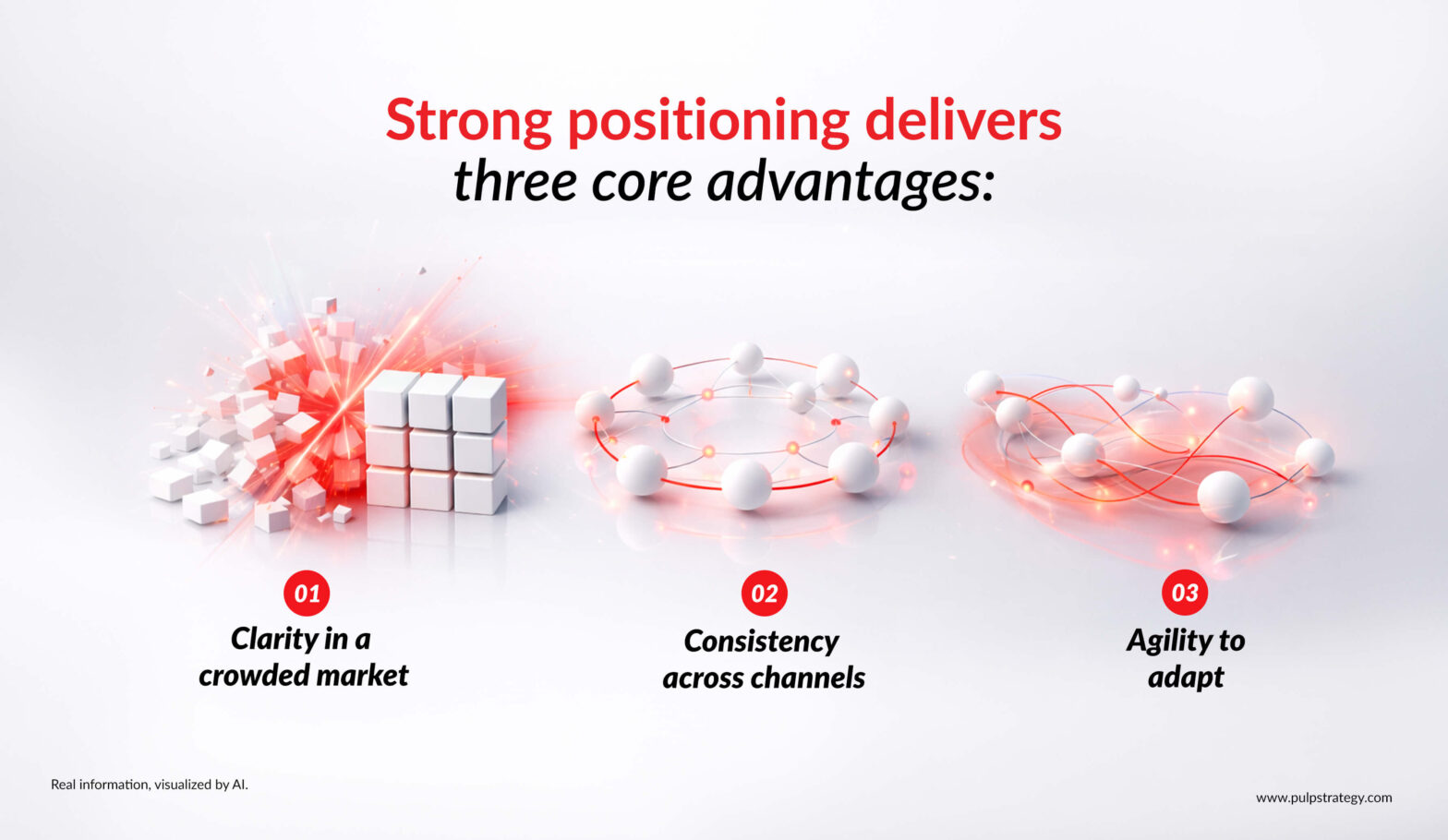
- Playbooks provide clarity, consistency, and accountability.
- AI scales execution but only under a disciplined strategic blueprint.
A Practical Checklist for CMOs and Founders
- Audit spend and eliminate low-yield channels.
- Align all stakeholders to a single roadmap.
- Select 3 ROI-centric metrics (pipeline velocity, LTV, brand preference).
- Build quarterly checkpoints to measure ROI and refine.
- Deploy AI selectively to scale execution once strategy is set.
Looking Toward 2030
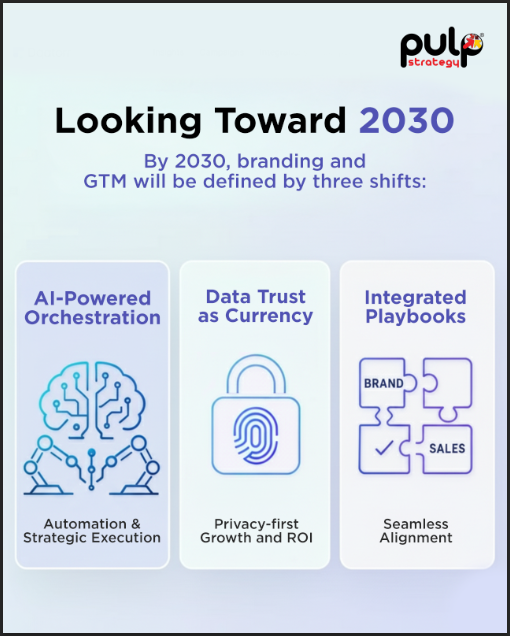
By 2030, branding and GTM will be defined by three shifts:
- AI-Powered Orchestration: Execution largely automated, with strategy as the differentiator.
- Data Trust as Currency: Privacy-first approaches become central to growth and ROI.
- Integrated Playbooks: Brand, product, and sales aligned in unified GTM frameworks, creating consistent journeys and measurable ROI.
Leaders who act now, investing in strategy-first clarity and professional oversight, will not only navigate the 2025–2026 landscape but define the next decade of ROI-driven growth.
Closing Perspective
For CMOs and founders, the path forward is clear: success comes not from louder campaigns or more creative volume, but from a strategy-first playbook that directs investment into what truly drives ROI, brand equity, and sustainable growth. This clarity separates activity from impact, and scale from stagnation.