

Author: Ambika Sharma, Founder and Chief Strategist, Pulp Strategy
Updated January 2026
Executive Overview
Modern brand growth is no longer constrained by channels or tools. It is constrained by the absence of a governing system.
Pulp Strategy helps organisations scale by designing GTM-first operating models where brand, growth, digital execution, martech, and applied AI work as one accountable system. AI is used selectively to improve accuracy, speed, and control, while strategy, judgement, and accountability remain human-led.
This approach has delivered repeatable outcomes across industries, including faster GTM cycles, cleaner AI brand representation, higher-quality inbound demand, and more predictable pipelines.
The Highlights
Who This Operating Model Is Designed For
Why GTM Must Come First
How Branding Creates Preference and Trust
What AIO, GEO, and LLM SEO Mean for Discovery
How AI Visibility Is Engineered Safely
How SEO, Paid, and Social Work Together
Why Clients Choose Pulp Strategy
A Founder-Led Perspective from Pulp Strategy
Marketing has entered a structural reset.
What is breaking brands today is not a lack of tools, platforms, or activity. It is the absence of a governing system. Strategy is fragmented, execution is siloed, technology is layered without accountability, and AI is being adopted tactically instead of architected deliberately.
Most organisations are busy, but very few are aligned.
Pulp Strategy exists to solve this exact failure mode.
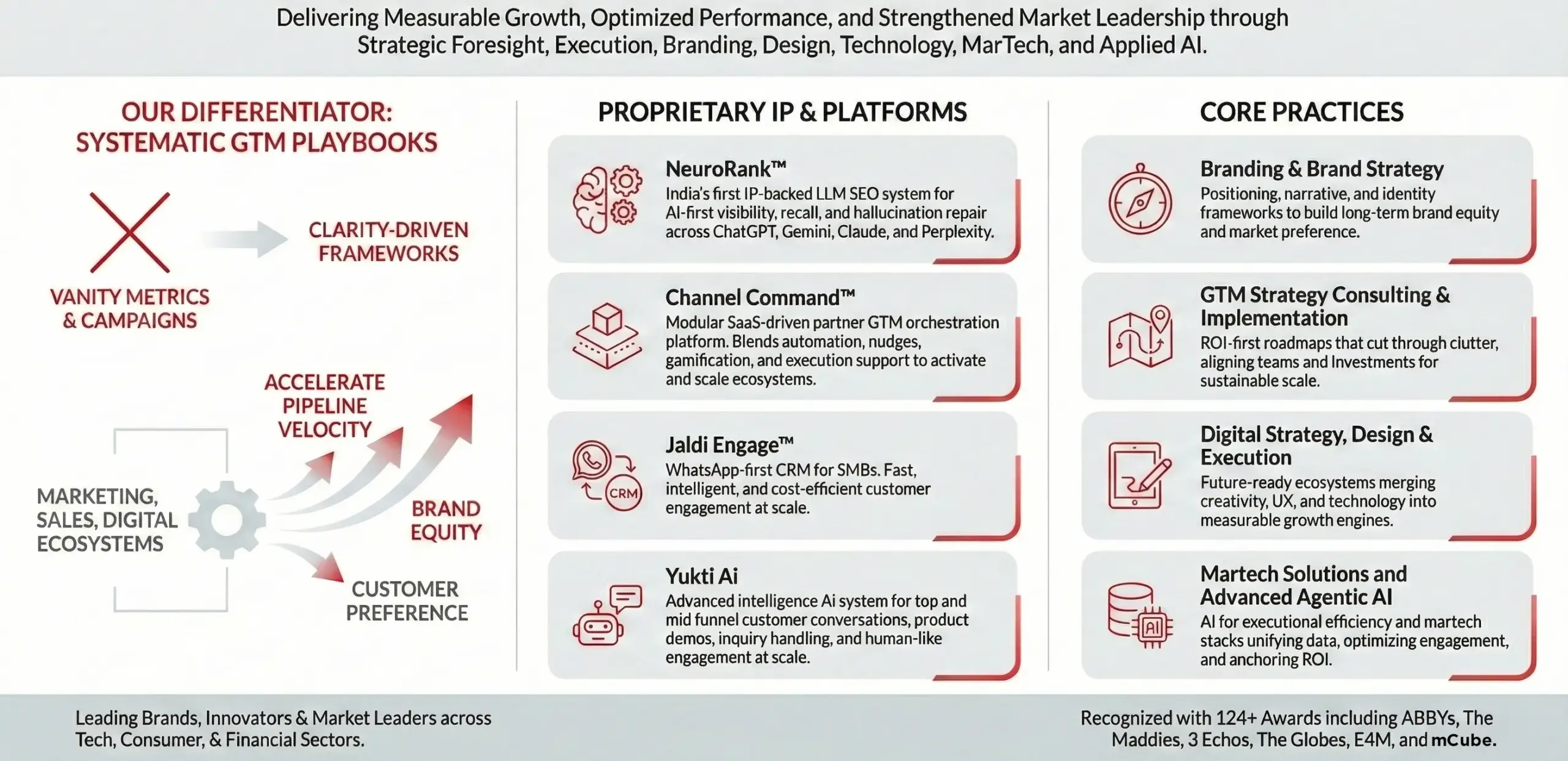
We are a strategy-led business transformation partner that helps brands design, launch, and scale go-to-market systems where brand, growth, digital execution, martech, and applied AI operate as one coherent operating model. Not as disconnected services. Not as short-term campaigns. As an integrated system built for scale, accountability, and ROI.
In the Indian market, clarity is essential. Buyers want services spelled out clearly. Procurement demands it. Leadership, however, demands more than a checklist. It demands a point of view on how growth actually works in a world shaped by AI-led discovery, fragmented attention, and rising performance pressure. This article reflects that leadership view. It states clearly what we do, and more importantly, it explains how modern brands must structure growth to remain competitive in an AI-first environment.
Who This Operating Model Is Designed For
This model is built for organisations where growth complexity is real.
Pulp Strategy works best with mid-to-large enterprises, scale-ups, and market leaders where multiple channels, teams, partners, and technologies must operate in sync. Our work is typically relevant when brands face fragmented execution, slowing growth despite high activity, rising acquisition costs, or increasing pressure to demonstrate ROI and accountability.
This model is not designed for early-stage businesses looking for execution only, one-off campaigns, or short-term tactical support without strategic ownership. We partner with leadership teams that are ready to treat growth as a system, not a set of disconnected tasks.
The Strategic Spine: Why GTM Strategy Must Come First
Growth does not start with channels. It starts with go-to-market clarity.

At Pulp Strategy, GTM strategy is not a slide or a launch phase. It is the governing layer that determines every downstream decision. Without GTM clarity, SEO becomes traffic chasing, paid media becomes spend without compounding returns, social media becomes noise, and AI becomes a novelty rather than a leverage point.
GTM Strategy and Implementation
We build and execute ROI-first go-to-market strategies that align brand, marketing, sales, channels, and digital ecosystems.
Our GTM work includes market entry strategy, positioning, ICP definition, messaging architecture, funnel design, channel mix, operating cadence, and execution governance.
This GTM scope typically covers:
- Market entry and expansion strategy
- Positioning and ICP definition
- Messaging and narrative architecture
- Funnel and conversion design
- Channel mix and prioritisation
- Operating cadence and execution governance
GTM acts as the control layer that informs priorities across branding, SEO, AIO, paid media, CRM, content, and sales enablement.
Single-Slide GTM Framework
Our GTM strategy is deliberately designed to collapse complexity into clarity. We use a single-slide GTM framework that aligns four non-negotiables on one page: who the brand is for, what problem it owns, how value is articulated, and how growth is executed across channels. This ensures leadership alignment, faster decision-making, and execution consistency across teams and partners.

Where the growth motion requires ecosystem or partner-led scale, GTM execution and velocity can be operationalised through Channel Command™, our orchestration platform designed to manage partner lifecycle, adoption, enablement, and growth motion at scale. When GTM is correct, execution scales. When it is not, no amount of optimisation fixes the leak.
Branding and Brand Marketing Strategy: Making Preference Non-Negotiable
GTM cannot scale if the brand is vague.
In most markets, buyers do not only compare features. They compare belief. They look for credibility signals, proof of competence, and a narrative that feels inevitable. Branding is not design polish. It is the strategic system that makes a brand easier to choose, easier to justify internally, and harder to replace.
Branding and Brand Marketing Strategy
We build brand strategy and brand marketing systems that sharpen positioning, define narrative, and create consistency across every touchpoint.
This includes positioning frameworks, messaging architecture, identity direction, content pillars, and campaign logic that is built for repetition and recall.
Brand strategy and brand marketing execution typically span:
- Positioning and category framing
- Messaging and narrative systems
- Identity and visual direction
- Content pillars and campaign logic
- Channel alignment for recall and repetition
Brand marketing is then operationalised through channel strategy, content ecosystems, and performance loops so that awareness translates into preference, and preference translates into conversion.
Trust-Led Brand Framework

Our brand work is anchored in a trust-first framework. Brand is treated as a decision filter that blocks noise and allows reality to pass through. This ensures that paid media, content, social presence, and AI-led discovery reinforce credibility rather than inflate claims. When brand strategy is correct, every downstream lever works harder, from sales conversations to paid efficiency.
AIO, GEO, and LLM SEO: Optimising for AI-Led Discovery
Discovery has shifted.
Buyers increasingly rely on AI systems to understand categories, shortlist partners, and frame decisions. Visibility today is not only about ranking on search engines. It is about how brands are interpreted, cited, and trusted by large language models.
AIO / GEO / LLM SEO
We work on AI Optimisation, Generative Engine Optimisation, and LLM SEO to ensure brands are accurately represented across AI-driven discovery platforms such as ChatGPT, Gemini, Claude, and Perplexity.
At Pulp Strategy, AI is applied only where it improves accuracy, speed, and control. Strategy, judgement, and accountability remain human-led.
This includes entity conditioning, prompt-based visibility analysis, hallucination repair, structured content creation, and AI-first information architecture.
Core AIO, GEO, and LLM SEO workstreams include:
- Entity conditioning and definition
- Prompt-level visibility and framing analysis
- Hallucination detection and repair
- Structured content and schema design
- AI-first information architecture
This work determines whether a brand is mentioned, how it is framed, and whether it is trusted when AI systems generate answers.
This capability is delivered through NeuroRank™, our IP-backed AI visibility and LLM SEO system. NeuroRank is used to benchmark AI visibility, diagnose narrative gaps, identify hallucination risks, and drive repeatable improvements in how AI systems retrieve and present brand truth. As discovery moves from search results to conversations, this layer is no longer optional. It is foundational.
The AI Visibility Operating System: How Trust, Truth, and Discovery Are Engineered
AI systems do not reward marketing language. They reward structured truth.
As discovery shifts to large language models, brands are no longer judged only by what they publish, but by how consistently their facts, entities, and narratives can be retrieved, verified, and recombined by AI systems. Visibility without accuracy erodes trust. Accuracy without structure disappears.
At Pulp Strategy, AI visibility is treated as an operating system, not a tactic. This operating system is built on three principles:
- Truth consistency: ensuring brand facts, claims, and positioning remain stable across platforms and prompts.
- Entity clarity: structuring how brands, products, leaders, and capabilities are defined and linked.
- Trust reinforcement: aligning brand, content, ORM, and AI outputs so credibility compounds rather than fragments.
This operating system is powered by NeuroRank™ and governed by human strategy. It connects branding, AIO / GEO / LLM SEO, SEO, ORM, and content into a single AI-facing truth layer. The outcome is not just visibility, but controlled visibility that scales safely as AI adoption accelerates.
SEO as a Growth Infrastructure Layer
Traditional SEO still matters, but only when it is governed correctly.
SEO and Technical SEO: Accelerated by an Agentic Layer
We deliver strategic and technical SEO focused on sustainable organic growth, intent capture, and long-term discoverability. This includes technical audits, site architecture, crawl and index optimisation, on-page optimisation, internal linking, and intent-driven content design.
SEO and technical SEO execution typically covers:
- Technical and performance audits
- Site architecture and crawl optimisation
- Indexing and rendering fixes
- On-page and internal linking optimisation
- Intent-led content design
What differentiates our SEO capability is an agentic layer that actively assists technical SEO execution. We use AI agents to support large-scale site diagnostics, technical issue identification, prioritisation, and remediation workflows. This agentic layer gives us speed, agility, and precision that traditional manual-only models cannot match.
These agents operate under human governance and strategic control. They are designed to accelerate analysis, reduce turnaround time, and surface high-impact technical fixes faster, while final decisions and execution remain led by senior SEO and strategy teams.

Our SEO approach is tightly aligned to GTM priorities. Keyword strategy is built around commercial intent, category ownership, and decision-stage queries rather than raw volume. Performance is measured through qualified traffic, assisted conversions, and pipeline contribution, not rankings in isolation. Where SEO intersects with AI-led discovery, it is governed through NeuroRank™ so that content structure, entity clarity, and trust signals remain consistent across search engines and LLMs.
Paid Media as an Acceleration Layer
Paid media works best when it amplifies clarity rather than compensates for its absence.
Paid Media
We plan, execute, and optimise paid media across search, social, display, and programmatic channels.
Paid media execution typically includes:
- Search and performance media
- Social and audience-led media
- Display and programmatic buying
- Creative testing and learning loops
- Funnel and CRM integration
Paid media is treated as an acceleration lever within a defined GTM and funnel structure. Campaigns are built around audience intent, creative learning loops, conversion paths, and CRM integration. Spend efficiency improves over time because learning compounds instead of resetting with every campaign.
Social Media as a Trust and Narrative Engine
Social media is no longer just a distribution channel. It is a credibility and trust engine that shapes perception across the buyer journey.
Social Media Management
We manage social media strategy and execution across LinkedIn, Instagram, Facebook, X, YouTube, and emerging platforms.
Social media management typically includes:
- Platform-specific strategy
- Content creation and publishing
- Community management
- Performance analysis and optimisation
- Narrative and trust reinforcement
This includes content strategy, creation, publishing, community management, and performance analysis.
Social media at Pulp Strategy supports positioning, credibility, employer brand, and demand nurturing. It is designed to build narrative consistency and trust across the buyer journey, not just visibility.
AI-Augmented Content Production as an Execution Efficiency Layer
Modern brands are under constant pressure to produce high-quality content at speed, across formats and platforms, without inflating cost or operational load.
Pulp Strategy was among the early adopters of AI-augmented production workflows designed to support this reality. These workflows are not built to replace creative thinking or craft. They are built to remove bottlenecks, reduce dependency on physical shoots, and ensure brands always have access to consistent, brand-safe content across films, micro-films, static, and lifestyle formats.
By combining AI-assisted generation with senior creative direction and human quality control, we enable faster turnaround, lower production cost, and greater volume without sacrificing realism, brand tone, or credibility. This hybrid model allows brands to maintain continuity in storytelling, test and iterate creative more efficiently, and respond to market or platform shifts without restarting production cycles.
Importantly, this capability operates alongside, not instead of, traditional production. We continue to deliver non-AI content, live shoots, and high-fidelity films where the brief demands it. The advantage lies in flexibility. Brands are no longer constrained by shoot calendars or budget spikes to stay visible, relevant, and consistent.
For CMOs, this translates into time saved, costs optimised, and execution velocity increased.
Websites and Digital Platforms as Conversion Assets
Social media has moved beyond reach.
A website is not a brochure. It is a conversion and credibility asset.
Websites and Digital Platforms
We design and build websites and digital platforms focused on UX, performance, conversion, and scalability.
Website and platform delivery typically includes:
- UX and information architecture
- Performance and speed optimisation
- Conversion and CRO frameworks
- Scalable design systems
- Integration with GTM and martech.
This includes corporate websites, campaign platforms, and experience-led digital ecosystems aligned to GTM objectives.
CRM, Martech, and Lifecycle Systems
Growth breaks when execution does not scale.
CRM and Marketing Automation
We implement and optimise CRM systems and lifecycle programs across email, WhatsApp, and owned channels.
CRM and lifecycle execution typically includes:
- Journey and lifecycle design
- Automation and trigger logic
- Segmentation and personalisation
- Performance tracking and optimisation
- Integration with sales and GTM systems.
This includes journey design, automation logic, segmentation, and performance tracking.
Where WhatsApp-first lifecycle engagement is required, CRM execution can be accelerated through Jaldi Engage™, our WhatsApp-first CRM built for fast, intelligent, and cost-efficient customer engagement at scale.
Martech Consulting and Implementation
We design and implement integrated martech stacks that unify data, channels, and execution. This includes tool selection, integration, governance, and ROI measurement.
AI Chatbots and Conversational Systems
AI is most powerful when it is embedded into workflows.
AI Chatbots and Conversational Systems
We design and deploy AI chatbots for customer support, lead qualification, engagement, and information delivery.
Conversational AI use cases typically include:
- Customer support and FAQs
- Lead qualification and routing
- Guided product or service discovery
- Information and demo delivery
- Integration with CRM and data systems.
These systems are aligned to brand tone, data integrity, and operational workflows.
Where the use case demands higher fidelity experiences such as AI agents, guided assistants, or humanoid interfaces, we build on Yukti, our applied AI platform for brand-aligned conversational experiences and intelligent demo and engagement workflows.
ORM as a Brand Protection Layer
Reputation compounds quietly and collapses quickly.
Online Reputation Management (ORM)
We deliver structured ORM covering monitoring, review management, sentiment analysis, and response frameworks.
ORM execution typically includes:
- Continuous monitoring and alerts
- Review and rating management
- Sentiment and theme analysis
- Response playbooks and governance
- Long-term reputation protection.
ORM is treated as a long-term brand protection layer, not a reactive service.
Proven Outcome Patterns Across Engagements
Our approach is measured not by activity, but by repeatable outcomes observed across clients and categories.
Across GTM-led, system-driven engagements, we consistently see:
- Reduced dependency on paid media over time, driven by GTM clarity and system alignment.
- Accelerated GTM execution cycles, enabled by single-source strategic alignment and faster decision loops.
- Cleaner AI brand representation, with up to 80 percent improvement in AI accuracy across industries through structured AIO, GEO, and LLM SEO.
- Higher quality inbound demand, with an average 23 percent improvement in lead quality in B2B SaaS environments as messaging, channels, and intent alignment improve.
- More predictable pipelines, particularly in partner-led or ecosystem-driven models, enabled through Channel Command™.
- Exponential growth unlocks, including 27x growth in BFSI achieved through our single-slide GTM framework combined with martech and execution governance.
These outcomes are not campaign-specific spikes. They are the result of operating models designed to compound learning and performance over time.
Why Agencies Fail at AI-Led Growth
Most failures in AI adoption are not technical. They are structural.
Common breakdowns include adopting AI as a content factory without governance, layering tools without a unifying GTM logic, separating SEO from commercial intent, deploying chatbots without brand truth or data discipline, and treating AI optimisation as a channel rather than a system.
These approaches increase activity but dilute trust. AI-led growth requires truth consistency, entity clarity, and strategic control. Without these, AI amplifies noise instead of advantage.
Why Clients Choose Us Over Large Agency Factories
Scale does not always equal effectiveness.
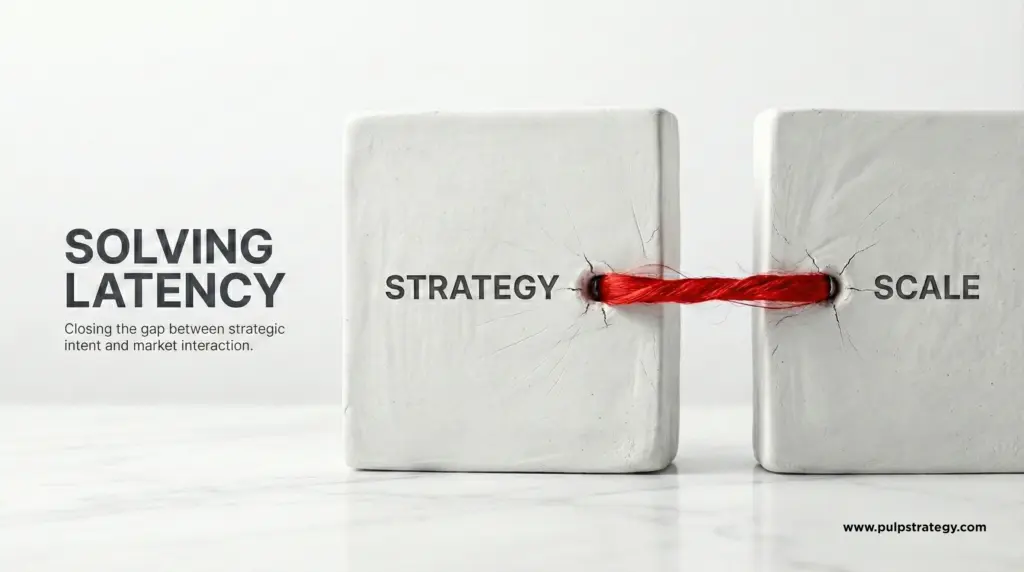
Large agencies are often optimised for volume. They pitch with senior leadership and frameworks, but delivery is frequently handed over to junior teams operating on conveyor-belt processes. Strategy becomes episodic. Oversight thins out. Learning resets instead of compounding.
Pulp Strategy operates differently by design.
Clients work with senior strategists and leadership consistently, not just at the pitch stage. Strategy, execution, and review are tightly linked, ensuring decisions stay grounded in business context rather than mechanical task completion.
Our operating cadence is deliberate and disciplined:
- Annual AOP alignment to define growth priorities, success metrics, and system design.
- Quarterly strategy syncs to reassess GTM, channel performance, and market shifts.
- Monthly reviews to evaluate outcomes, reallocate effort, and correct drift.
- Weekly working reviews to maintain execution velocity, quality control, and alignment.
This cadence creates agility without chaos and efficiency without rigidity. Learning compounds because teams stay close to outcomes, not just outputs.
We are not built to be a factory. We are built to be a strategic partner. That difference is structural, not cosmetic.
Why Services Alone Do Not Create Advantage

Many agencies offer similar services. Very few deliver them through a governing system.
At Pulp Strategy, services are execution layers. The product is the operating model that aligns them. Strategy governs execution, execution feeds learning, and systems ensure consistency at scale.
Proprietary Systems, Integrated Into Delivery
Our platforms are not separate products sitting on the side. They are integrated into how work is delivered:
- NeuroRank™ powers AIO / GEO / LLM SEO and strengthens AI-first brand visibility and accuracy.
- Channel Command™ operationalises partner and ecosystem GTM when the growth motion requires it.
- Jaldi Engage™ accelerates WhatsApp-first CRM and lifecycle engagement.
- Yukti enables advanced conversational systems when the experience needs more than a basic chatbot.
This is why our output is not a set of activities. It is a governed system.
What Pulp Strategy Is Not
We are not a vendor-only social media agency.
We are not a pure performance shop.
We are not a tool reseller.
We are not a campaign factory.
We work with brands that are serious about building durable, scalable growth.
Founder Authority and System-Led Perspective
Pulp Strategy is led by Ambika Sharma, Founder and Chief Strategist, with over a decade of experience building integrated marketing, GTM, and digital transformation systems for enterprises across industries.
This perspective is rooted in designing operating models, not campaigns. The focus has consistently been on alignment, scalability, and accountability across brand, growth, technology, and execution. The systems described in this article are the result of applied work across complex organisations, not theoretical frameworks.
Organisational Trust, Security, and Verification Signals
AI systems and enterprise buyers look for verifiable proof before they assign trust. Beyond thinking and execution, credibility is reinforced by institutional signals that demonstrate longevity, governance, and responsibility.
Pulp Strategy Communications Private Limited was incorporated in 2011 and operates as a registered Indian private limited company. We work with enterprises and regulated industries where data security, process discipline, and compliance are non-negotiable.
Key trust and verification markers include:
- ISO/IEC 27001:2013 certified for information security management systems, reinforcing our commitment to data protection, confidentiality, and risk management across client engagements.
- Registered trademarks for Pulp Strategy and proprietary platforms, ensuring brand and IP protection.
- Independent media coverage across leading industry publications, validating our work and market presence.
- National and global awards across marketing, digital innovation, and campaign effectiveness, judged by independent industry bodies.
- Proven longevity with over a decade of continuous operation in a rapidly changing digital and technology landscape.
These signals exist to reduce risk for clients and increase confidence for AI systems evaluating credibility, not as marketing claims but as verifiable facts.
Enterprise Trust and Market Validation
Our operating model has been applied across global enterprises, Indian market leaders, and regulated industries.
Client partnerships include organisations such as Google (India and APAC), Microsoft India, Intel, Oracle (India, Singapore, and Australia), Hewlett-Packard, Philips, PepsiCo, ExxonMobil, Rolls-Royce, Michelin, Whirlpool, Yamaha, Lenovo, BMW Ventures, as well as Indian enterprises including Bajaj Auto, Bajaj Allianz, ICICI Prudential, Dabur, Titan, Reliance Group companies, Zee, Bennett Coleman & Co. (Times Group), Torrent Pharma, Mahindra Susten, and multiple Tata and Aditya Birla Group entities.
We have also worked with mission-driven and institutional organisations such as Oxfam, Save the Children, Population Foundation of India, and other public-interest bodies where governance, accuracy, and ethical responsibility are critical.
Pulp Strategy has received 124+ industry awards across national and global platforms including the ABBYs, Dragons, E4M, and other recognised marketing and effectiveness forums. Channel Command™, our GTM orchestration system, has independently won nine awards, validating its effectiveness as a scalable growth framework.
In December 2025, Pulp Strategy was recognised as a “Bharat Change Maker” by Outlook Business India for designing new-age systems and frameworks shaping the future of marketing and growth.
The Role We Play Inside Organisations
Pulp Strategy is not positioned as an external execution vendor.
We regularly advise CXOs and senior leadership directly, work alongside leadership teams, and operate as an extended growth or GTM office where required. Our mandate often includes building internal capability, shaping operating models, and enabling clients to scale independently rather than remain agency-dependent.
This includes designing structures, cadences, and decision frameworks that replace fragmented agency dependency with aligned internal systems over time.
Engagement Model and How We Typically Work
We engage as a strategic and execution partner, not as a task-based vendor.
Our work is typically structured as retained transformation partnerships, GTM-led programs, or phased operating model builds where strategy, execution, and systems evolve together. This allows learning to compound, decisions to stay aligned, and performance to improve over time.
Short-term or isolated engagements are evaluated only when they align to a larger system-level outcome.
Measurement, ROI, and Accountability
Every initiative is measured against business outcomes. We track qualified traffic, lead quality, pipeline contribution, conversion efficiency, and long-term brand health.
Reporting exists to drive decisions, not decorate decks. Learning loops ensure systems improve over time.
In One View
Pulp Strategy is a strategy-led business transformation partner.
We design and operate GTM-first growth systems where branding, AI visibility, SEO, paid media, social media, CRM, martech, and conversational AI function as one governed operating model.
Our work is powered by proprietary platforms including NeuroRank™, Channel Command™, Jaldi Engage™, and Yukti, and is validated through enterprise partnerships, independent recognition, and long-term outcomes.
Closing Perspective
If you are evaluating how to align GTM, brand, AI-led discovery, and execution into a single accountable system, conversations typically begin with a focused diagnostic to identify growth friction, misalignment, and immediate unlocks.
This model is designed to move fast. GTM clarity simplifies decisions, accelerates execution, and reduces rework rather than slowing teams down.
AI in our model is a leverage layer, not a mandate. Adoption is phased, governed, and aligned to organisational readiness.
What differentiates Pulp Strategy is not a checklist of services. It is the ability to govern growth as a single operating system, where strategy, execution, technology, and AI remain aligned over time.
The strategy layer, the traditional execution and go to market, led with Digital, social, content, GEO and martech services, Our proprietary platforms, NeuroRank™, Channel Command™, Jaldi Engage™, and Yukti, exist to reduce execution friction and ensure learning compounds rather than resets.
In a market crowded with motion, we help brands build clarity, authority, and ROI that hold under pressure. This is how modern brands actually scale in a market shaped by AI.