
Author: Ambika Sharma, Founder and Chief Strategist Pulp Strategy
Updated November 2025
Executive Overview
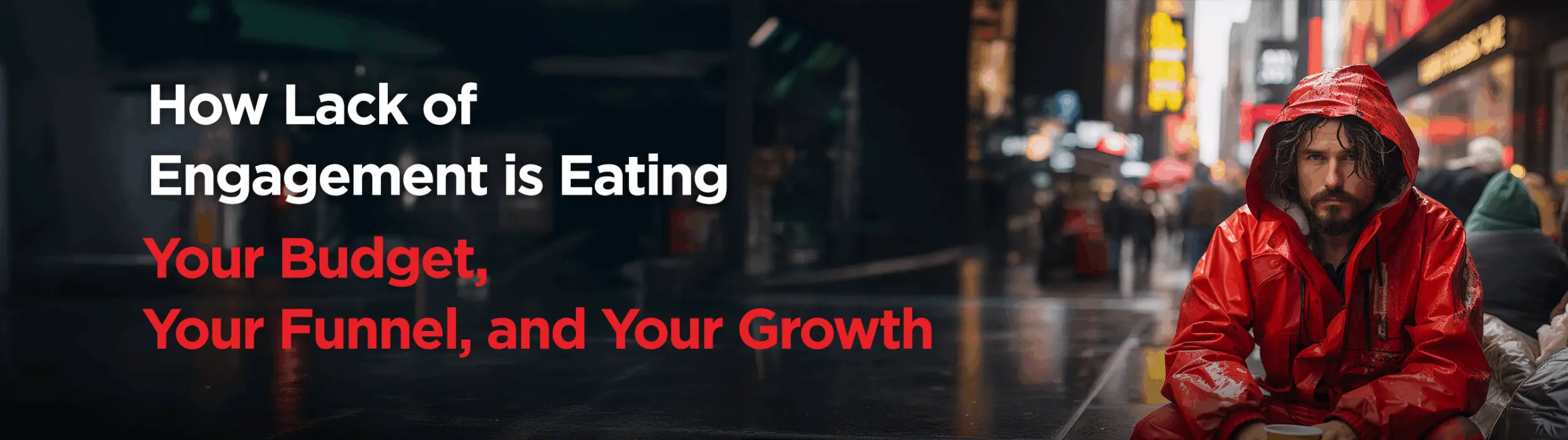
If your engagement is falling, your CAC is rising whether you see it yet or not. Marketing leaders are not facing a media problem. They are facing an engagement recession that is silently increasing acquisition costs, shrinking retargeting pools, and weakening forecasting accuracy. As of 2025, global ad spend continues to grow faster than the broader economy while consumer attention remains capped at roughly six hours per day. More spend is chasing the same finite attention supply.
Marketing engagement is collapsing across channels and the economic impact is now unavoidable. As of 2025, global ad spend continues to grow faster than the wider economy while daily consumer media time remains fixed at roughly six hours. Brands are paying more to compete for the same attention window, and the cost of growth is rising every quarter. This is not a platform issue. It is a structural shift. Low engagement has become the single biggest driver of CAC inflation, funnel leakage, weak forecasting, and diminishing returns on paid media.
The consequence is clear. The aim is not to stop investing in Meta or other major platforms, but to stop depending on them as the sole engine of growth. Meta remains a powerful top funnel channel, but without strong owned ecosystems beneath it, the funnel leaks and costs rise. If Digital marketing leaders do not fix engagement, every other marketing investment becomes more expensive and less predictable. The only sustainable solution is to reduce dependence on rented systems and rebuild a modern engagement architecture grounded in owned ecosystems, intelligence, and personalised, AI supported experiences.
The Highlights
- Why Is Engagement Falling So Fast in 2025?
- How Does Low Engagement Eat Into Your Budget?
- What Happens to Funnel Performance When Engagement Drops?
- Why Engagement Is Now the Strongest Predictor of ROI Stability
- What Is the New Engagement Architecture for 2026?
- The 10X Efficiency Funnel
- Case Study: How a Leading Industry Fund Achieved 6X ROI Through Engagement-Led Transformation
- Comparison Table: Old Engagement vs Modern Engagement
Systems - What CMOs, CROs, and CEOs Must Do Now
- Key Takeaways
Why Is Engagement Falling So Fast in 2025?
Engagement challenges are not temporary platform issues. They are the natural outcome of a deeper market shift.
The Real Enemy CMOs Are Fighting
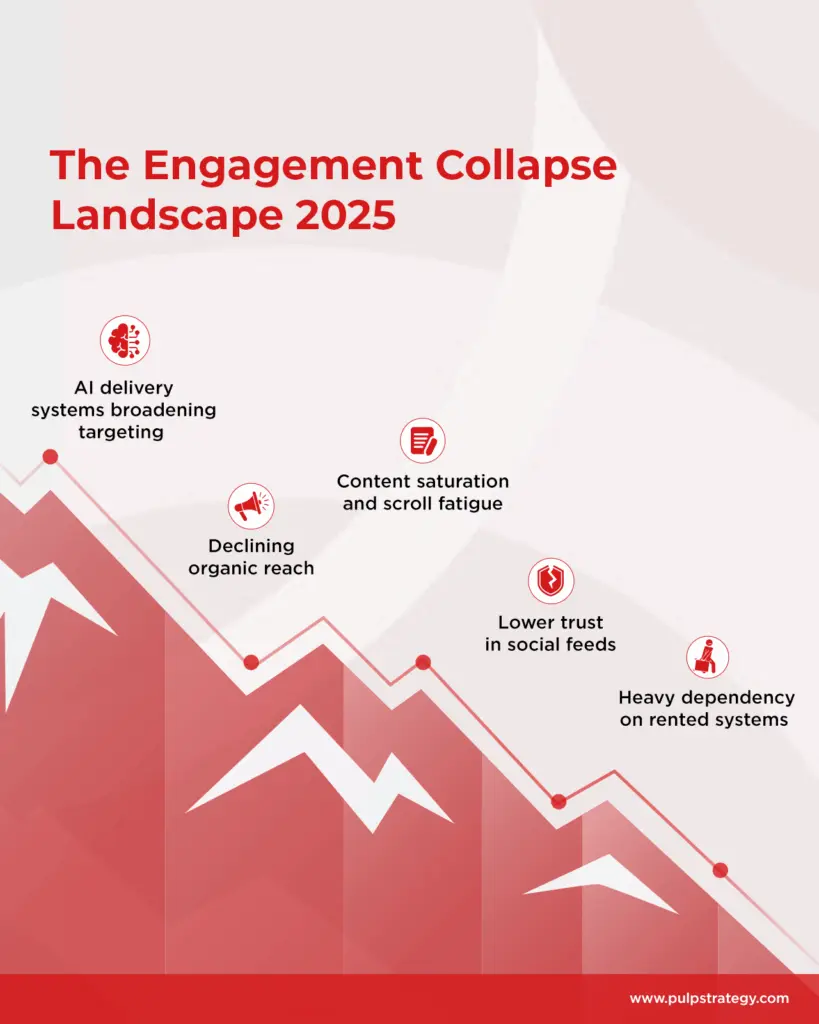
The real enemy is the structural collapse of attention combined with platform-driven volatility. The forces creating this collapse include:
- Underdeveloped Martech utilisation that fails to capture or convert attention
- AI driven delivery systems like Meta's Andromeda that force broader targeting, longer learning cycles, and higher creative volume
- Declining organic reach on social and search, reducing free visibility
- Content saturation and scroll fatigue that reduce interaction willingness
- Lower trust in social feeds, especially for financial, wellness, and high-stakes decisions
- Heavy dependence on rented platforms without equally strong owned ecosystems
As of 2025, these forces combine to reduce interaction quality, depress signal density, and increase the cost of acquiring and retaining customers. This collapse spans social media, search, email, and paid channels and impacts every industry.
The CMO Accountability Reframe
This collapse is not only driven by platforms. Certain industry habits accelerated it:
- Over-indexing on paid media at the expense of owned engagement
- Underutilising Martech stacks sitting at half potential
- Repeating creative without journey evolution
- Measuring impressions instead of interactions
- Treating platform volatility as a strategy rather than a risk
To correct the system, senior marketing leaders must lead the shift from rented attention to owned engagement that compounds over time.
How Does Low Engagement Eat Into Your Budget?
Engagement is the multiplier that makes media spend efficient. When engagement drops, spend rises.
Budget Impact
- More spend for the same reach. Weak engagement forces greater investment in top-of-funnel campaigns.
- Lower media efficiency. Cost per meaningful interaction continues to rise.
- Reduced retargeting pools. Fewer engaged users narrow the audience for conversion campaigns.
- Inefficient creative cycles. Brands produce more content to combat performance decline.
Hidden Costs
- Lost audience signals. Weak engagement reduces behavioural insights.
- Algorithmic penalties. Platforms deprioritise brands with poor engagement.
- Wasted Martech potential. Automation and AI require signal density to perform.
For CFOs and CROs, this translates into unpredictable forecasts and inconsistent pipeline velocity.
What Happens to Funnel Performance When Engagement Drops?
Funnel leakage is not a sales problem. It is an engagement problem.
Top-Funnel Impact
- Awareness without recognition. Reach does not translate into recall.
- Weaker discovery. Competition for attention is higher.
Mid-Funnel Impact
- Lower consideration. Interactions decline, reducing qualification.
- Mismatched messaging. Poor engagement distorts insight accuracy.
Bottom-Funnel Impact
- Slower conversions. Engagement absence forces higher acquisition costs.
- Weak retention. Lack of interaction reduces customer return probability.
When engagement is low, every stage of the journey becomes more expensive.
Why Engagement Is Now the Strongest Predictor of ROI Stability
Introducing the North Star Metric: Net Engagement Yield (NEY)
Net Engagement Yield (NEY) = Engaged actions divided by total brand touches.
NEY gives CMOs one clear measure of how efficiently the brand converts attention into meaningful interaction. High NEY correlates with lower CAC, stronger funnel velocity, and greater revenue predictability.
Engagement fuels the intelligence, optimisation, and conversion systems that underpin modern marketing performance.
Engagement as an Economic Engine
- Higher signal density accelerates optimisation
- Quality interactions reduce acquisition costs
- Strong engagement improves forecast accuracy and pipeline stability
Economic Impact for CMOs and CFOs
- Global ad spend is rising around 7 to 10 percent annually, while consumer attention is flat. More spend is chasing the same attention supply.
- Martech underutilisation persists, with only about half of stack capabilities actively used. Weak engagement means Martech cannot fully activate.
- Most digital experiences do not influence purchase behaviour, according to multiple global reports. Low engagement means personalisation often feels irrelevant.
- Retargeting pools are shrinking as fewer users interact with brand content.
- Forecasting becomes volatile when engagement signals are weak.
The Threat Horizon for 2026
If engagement does not improve, CMOs face:
- Rising CAC and shrinking conversion elasticity
- Smaller retargeting pools due to weak interactions
- Higher frequency floors just to maintain visibility
- Reduced LLM and AI search visibility due to low signal quality
- Platform dependency that increases budget volatility
Category-Specific Insight
BFSI: Low trust in social feeds makes personalised one to one channels more effective.
Healthcare: Decision making is high stakes; owned ecosystems outperform rented feeds.
Retail: High creative fatigue results in declining ROAS unless Omnichannel Marketing signals are strong.
Tech and SaaS: Long consideration cycles break without deep mid funnel engagement.
Engagement has become the most reliable predictor of marketing ROI stability across categories.
Evidence
Gartner, Deloitte, and McKinsey consistently show that brands with well-structured engagement ecosystems outperform peers in ROI, resilience, and customer lifetime value.
What Is the New Engagement Architecture for 2026
The Engagement Compounding Loop
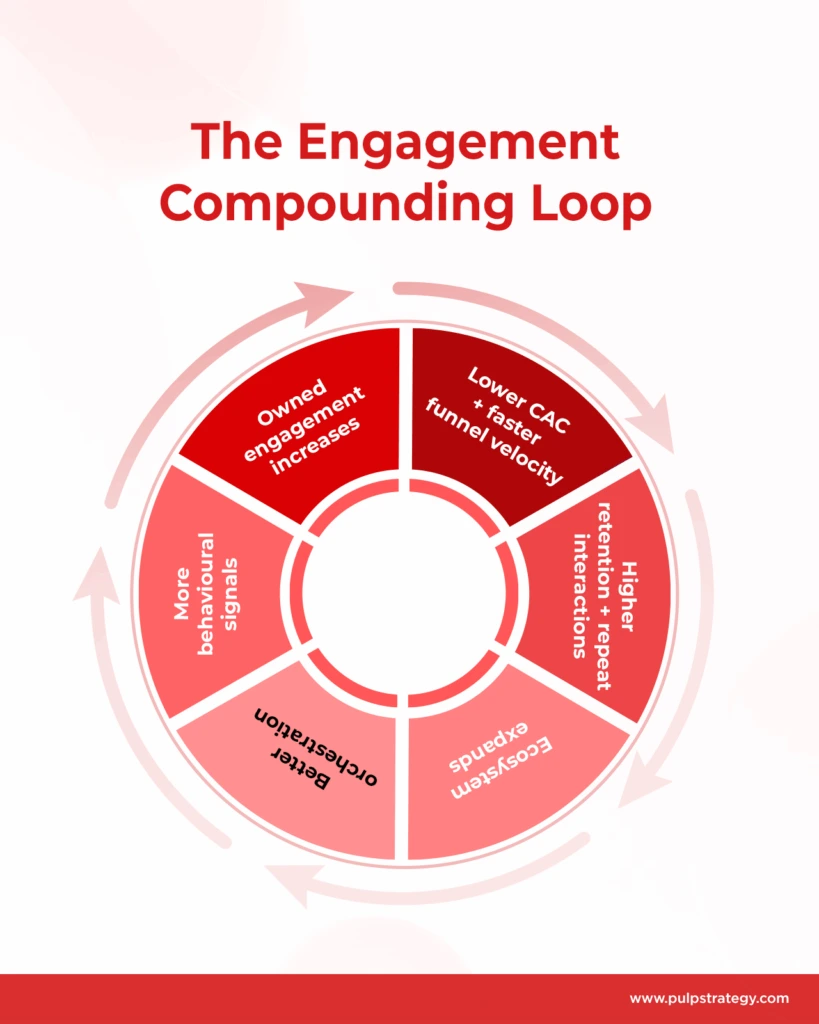
1. Owned engagement increases
2. More behavioural signals captured
3. Better orchestration and personalisation
4. Lower CAC and faster funnel velocity
5. Higher retention and repeat interactions
6. Owned ecosystem grows further
This loop compounds value. Paid media cannot create compounding. Owned engagement can.?
To restore engagement, brands are building systems that prioritise owned ecosystems, personalised experiences, and AI supported interactions.
The New Architecture
- Owned channels first through email, WhatsApp CRM, and communities
- AI agents to maintain conversation depth and accelerate follow ups
- Predictive systems for lifecycle triggers, reactivation, and cross sell
- LLM SEO and GEO practices to strengthen discovery in AI search
- AI humanoids to create human like dialogue experiences for high intent customers
The 10X Efficiency Funnel
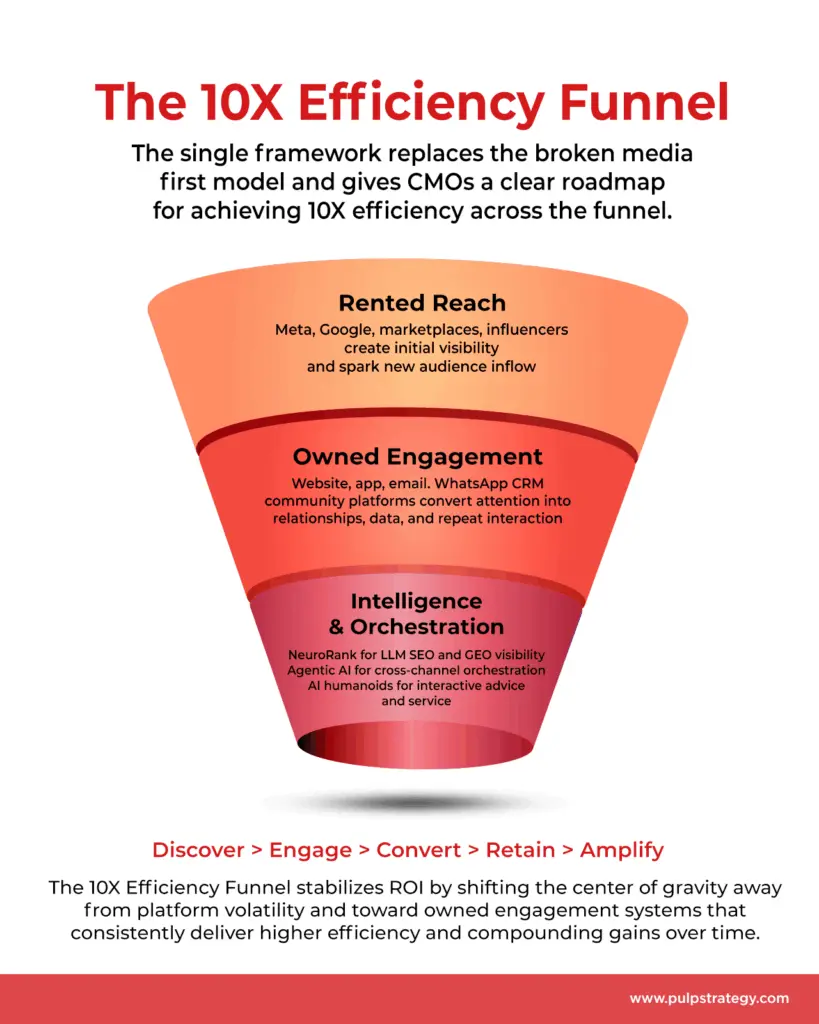
This single framework replaces the broken media first model and gives CMOs a clear roadmap for achieving 10X efficiency across the funnel.
Layer 1: Rented Reach
- Meta, Google, marketplaces, influencers
- Purpose: create initial visibility and spark new audience inflow
Layer 2: Owned Engagement
- Website, app, email, WhatsApp CRM, community platforms
- Purpose: convert attention into relationships, data, and repeat interaction
Layer 3: Intelligence and Orchestration
- NeuroRank for LLM SEO and GEO visibility
- Agentic AI for cross-channel orchestration
- AI humanoids for interactive advice and service
- Analytics for optimisation and attribution
The Customer Path
- Discover
- Engage
- Convert
- Retain
- Amplify
The 10X Efficiency Funnel stabilises ROI by shifting the centre of gravity away from platform volatility and toward owned engagement systems that consistently deliver higher efficiency and compounding gains over time.
The Platform Volatility Risk Index
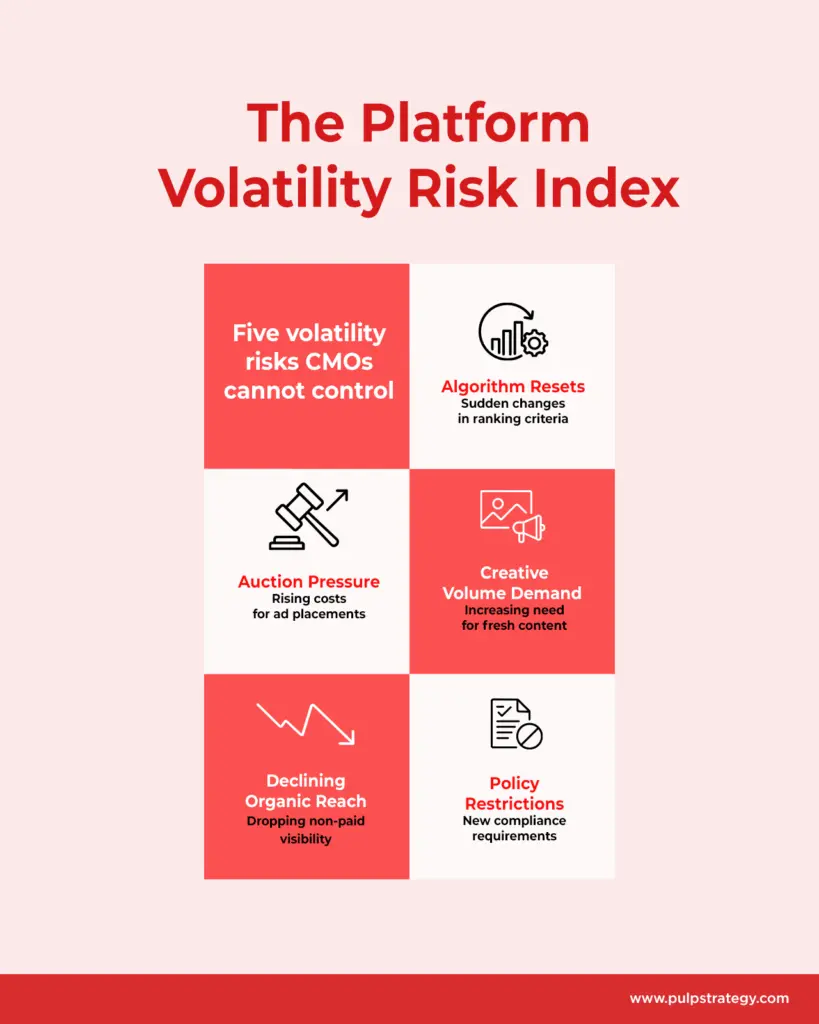
- Algorithm resets that wipe out learning phases
- Auction pressure that drives unpredictable CPMs
- Creative volume requirements increasing production costs
- Declining organic reach reducing free visibility
- Policy restrictions that alter targeting options
Meta is powerful, but dependence is dangerous. CMOs must hedge, not abandon.
Case Study: How a Leading Industry Investment Fund Achieved 27X ROI Through Engagement-Led Transformation
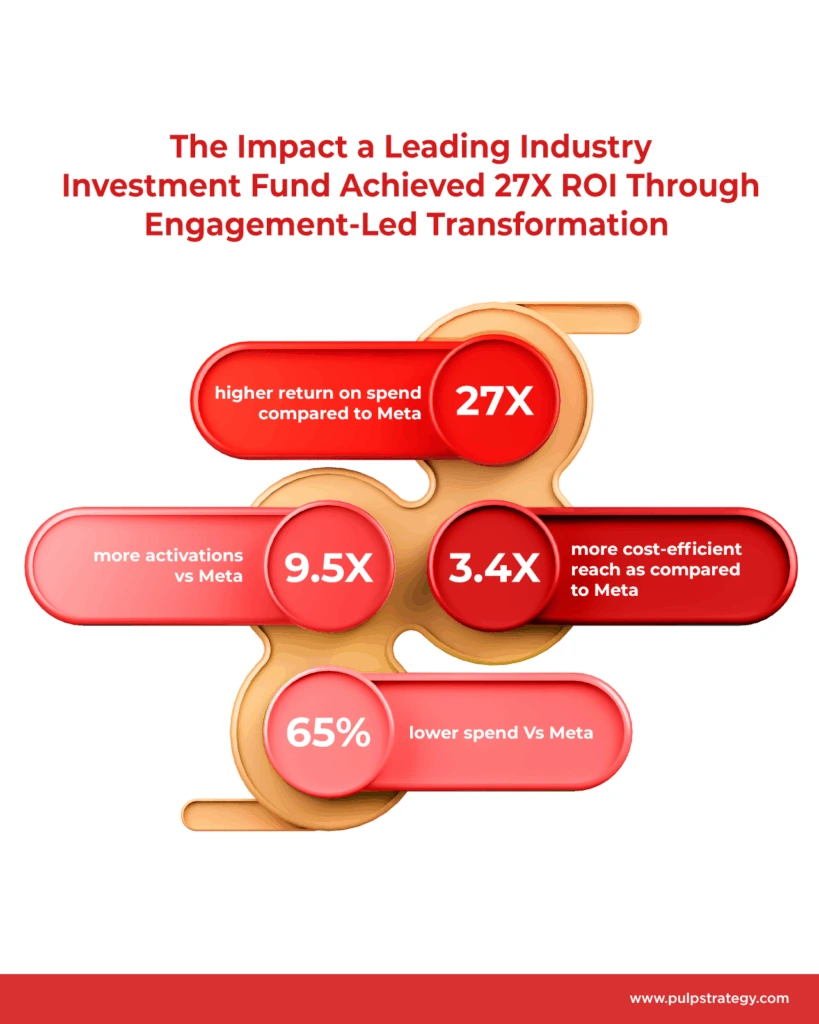
We set out to reduce dependency on Meta and develop parallel, predictable growth channels. To produce a clean comparison, we built two distinct funnels. One used existing customer data powered entirely by Martech and WhatsApp. The other replicated Meta delivery using custom audience data, with all variables except experience design held constant.
WhatsApp CRM vs Meta Media: Real Performance at scale
Meta Media Campaign (Facebook and Instagram)
- Timeline: 12 September to 10 October 2025
- Duration: 29 days
- Return on Spend: 0.000446645
WhatsApp CRM Campaign
- Timeline: 13 October to 28 October 2025
- Duration: 16 days
- Return on Spend: 0.012439156
Performance Outcomes
- 27 times higher return on spend compared to Meta
- 3.4 times more cost-efficient reach as compared to Meta
- 9.5 times more activations vs Meta
- 65 percent lower spend Vs Meta
Strategic Interpretation
Owned engagement, supported by personalisation and journey orchestration, delivered consistently higher activation efficiency. WhatsApp CRM produced richer engagement density, while Meta's performance was constrained by broad targeting and weak signal quality.
Lessons For Marketing Leaders
- Reactivation and cross sell are more effective in trusted, one to one channels
- Experience design explains more variance in performance than audience targeting
- When costs are held constant, channels with richer engagement consistently win on ROI
- Owned channels produce compounding gains while rented channels face diminishing returns
This case proves that engagement first architectures consistently deliver predictable ROI, especially in high regulation sectors where trust and personalised journeys matter.
Comparison Table: Old Engagement vs Modern Engagement Systems
| Old Engagement Model | Modern Engagement Architecture |
| Platform-dependent | Owned ecosystem-driven |
| High noise, low signals | High-quality behavioural signals |
| Creative fatigue | Interactive, AI-supported engagement |
| Expensive retargeting | Automated, predictive re-engagement |
| Volatile performance | Stable ROI and forecasting |
What Marketing, Growth, and Commercial Leaders Must Do Now
Strategic Actions For The Next 12 Months
- Use Meta as a top funnel discovery engine, not the entire funnel. Keep Meta for scale, but ensure the rest of the journey is owned, personalised, and efficient.
- Rebalance the mix toward owned ecosystems. Set clear targets for the share of pipeline that should come from email, WhatsApp CRM, and other owned channels.** Set a clear target for the share of pipeline that should come from email, WhatsApp CRM, and other owned channels.
- Strengthen discovery with LLM SEO and GEO. Make sure your brand is consistently present in AI search outputs, not just traditional search.
- Deploy AI agents for depth, not gimmicks. Use AI to orchestrate follow ups, segment journeys, and keep conversations moving, not to add more noise.
- Reduce dependency on pure paid reach. Treat Meta and other platforms as volatile inputs, not as your primary engine of growth.
- Activate predictive CRM. Build reactivation, cross sell, and win back programmes that run every week, not every quarter.
Hard Truths CMOs Need To Accept
- If your owned ecosystem is not growing faster than your paid ecosystem, you are losing money.
- If you cannot explain how your Martech stack makes you profit, it is overhead, not an asset.
- If your engagement rate is falling while budgets are rising, you do not have a media problem. You have a system problem.
- Dependence on platforms is not a marketing strategy. It is a risk profile.
Measurement Framework: How To Track Progress
Define a simple scorecard that you review every month:
- Owned engagement ratio. Percentage of total meaningful interactions happening in owned channels versus rented channels
- Signal density. Number of qualified behavioural signals captured per 1,000 contacts
- Cost per engaged contact. Total spend divided by the number of contacts who complete a meaningful action
- Owned pipeline contribution. Share of revenue or activations coming from email, WhatsApp CRM, and other owned sources
- Engagement quality index. Composite of repeat open rates, reply rates, micro conversions, and time in experience
When these metrics move in the right direction, CAC stabilises, forecasting becomes more accurate, and growth becomes less dependent on platform policy changes.
Leadership Checklist
If you only do five things next quarter, do these:
- Cut at least one low performing media line item and reinvest that budget into owned engagement experiments.
- Commission a full audit of your Martech utilisation and engagement signals, not just your media spend.
- Set a board visible target for the percentage of revenue that should be influenced by owned channels.
- Align marketing, sales, and service around one engagement architecture instead of three separate funnels.
- Build a one slide Go-To-Market view that everyone can understand and use it to make every major budget decision.
Key Takeaways
- Engagement decline is an economic threat, not a creative issue
- Low engagement inflates CAC and destabilises forecasting
- Owned ecosystems provide compounding value that paid channels cannot
- NEY gives CMOs a single north star metric to manage engagement quality
- AI supported orchestration strengthens journeys and improves conversion depth
- Platform dependency must be hedged with owned engagement systems
Growth no longer belongs to brands that buy the most visibility. It belongs to brands that convert attention into relationships. Engagement is no longer a KPI. It is a moat. CMOs who rebuild their engagement architecture now will control costs, signals, and outcomes for the next decade.