
By Ambika Sharma, Founder and Chief Strategist at Pulp Strategy Communications · 13 minute read
A brand can rebuild every page and still lose the answer. Reviews, comparison articles, marketplace listings, and independent coverage can remain incomplete or inaccurate after the website is fixed. McKinsey reports that a brand’s own sites make up only 5 to 10 percent of the sources AI search references.
A generative engine optimization agency needs a mandate that reaches those sources. Its job is to identify the buyer decisions worth influencing, diagnose the evidence behind relevant answers, and coordinate the work needed across the organization. The website is the foundation. It cannot carry the whole mandate.
Executive Overview
A generative engine optimization agency should manage the evidence behind commercially important AI answers, across owned and third-party sources. Its mandate begins with buyer questions and extends through diagnosis, coordinated delivery, and repeated measurement. NeuroRank’s AI Visibility Index 2026 shows why: third-party sources accounted for 64.6 percent of 96 logged citations across four US financial services audits. The Pulp Strategy framework distinguishes sources a brand can edit, sources it can contribute to, and coverage it must earn. Each intervention needs a responsible owner, verified facts, and a review point. Without that authority, a GEO engagement can diagnose gaps that nobody is accountable for closing.
- McKinsey reports that, in many cases, brand-owned sites comprise only 5 to 10 percent of sources referenced by AI search.
- In four US financial services audits in NeuroRank’s AI Visibility Index 2026, 64.6 percent of 96 logged citations pointed to third-party sources.
- About half of consumers use AI-powered search, according to McKinsey’s AI Discovery Survey of 1,927 people.
- Only 16 percent of brands systematically track AI search performance, per a McKinsey survey of about 30 Fortune 500 consumer-brand CMOs.
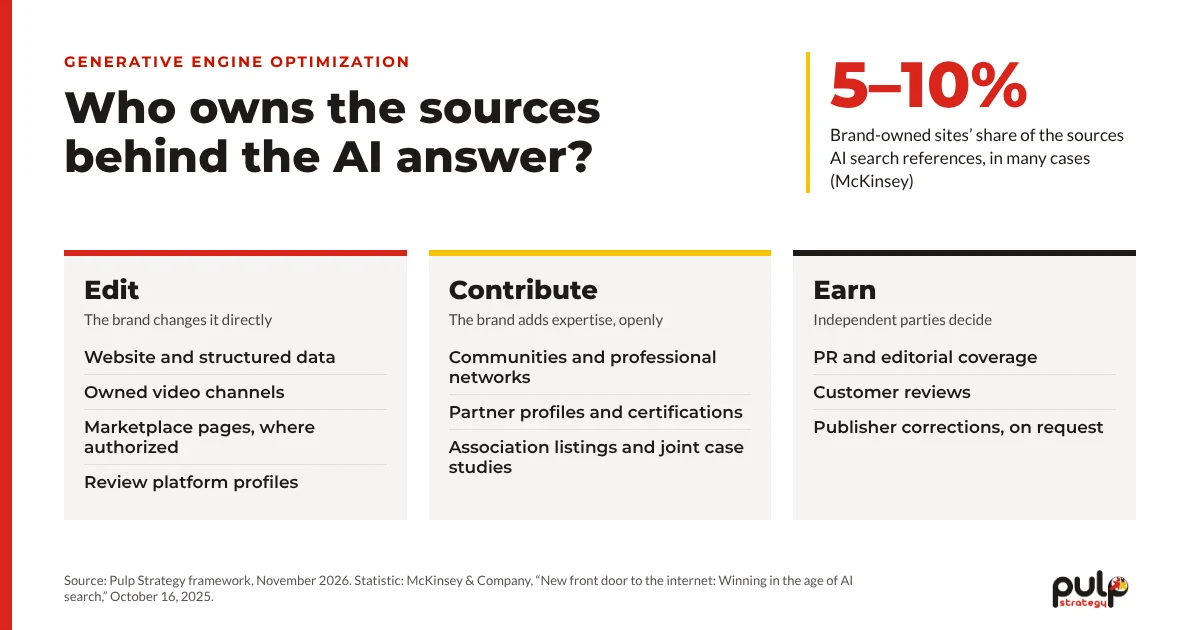
- A GEO engagement should distinguish sources the brand can edit, sources it can contribute to, and independent coverage it must earn.
A generative engine optimization agency, or GEO agency, is a specialist team that runs a program to improve how AI search represents and recommends a brand. The work combines technical access, accurate owned information, relevant third-party evidence, and repeated measurement against commercially important buyer questions.
In this article
Why is a website-only GEO mandate too narrow?
Which AI answers are worth prioritizing?
Which sources should a GEO agency work on?
Why does each AI platform need its own diagnosis?
What should a GEO agency measure?
How should a GEO agency run the engagement?
What should a CMO ask before hiring a GEO agency?
Frequently asked questions on GEO agencies
Why is a website-only GEO mandate too narrow?
Because the sources visible in AI answers extend beyond pages the brand owns. A website correction does not automatically update a retailer listing, a review platform, or an old comparison article.
McKinsey’s analysis reports that brand-owned sites comprise only 5 to 10 percent of referenced sources in many cases. Its source note identifies Google AI Overview and McKinsey analysis.
NeuroRank’s AI Visibility Index 2026 recorded a related pattern in a smaller sample of banking, financial services, and insurance brands. Third-party sources accounted for 64.6 percent of 96 logged citations across four US financial services audits in NeuroRank’s AI Visibility Index 2026. Those audits also contained 61 error notes, including errors involving decision facts such as fees and rates.
What does the research establish?
| Finding | Value | Scope and interpretation |
| Brand-owned source share | 5 to 10% | McKinsey; in many cases. Referenced sources, not influence or budget share. |
| Third-party citation share | 64.6% of 96 citations | Four US BFSI audits. Scoped sample, not a market benchmark. |
| Brand-named vs unnamed High inclusion | 56.2% vs 17.8% | 122-brand study; separate prompt pools, not a causal experiment. |
| Median best-to-worst model gap | 33.3 percentage points | 63 brands across four models; different prompt panels, directional comparison. |
Sources: McKinsey, October 16, 2025; NeuroRank, The AI Visibility Index 2026, September 22, 2026. Capture window March to May 2026. High inclusion is a historical research rating, separate from the current Brand Inclusion Score.
These findings describe captured AI outputs, not statements made by the audited brands. They establish a reason to inspect third-party evidence, rather than a universal rule about where every brand should invest.
The website still supplies product facts, eligibility, availability, policies, original research, and other information a buyer needs to verify. Technical access and accurate content remain necessary even when most visible citations point elsewhere.
CMO Takeaway
AI answers are assembled from sources the brand does not own, so a website fix changes one input, not the answer. Scope the GEO mandate around the retailer listings, reviews, and comparison articles that appear in those answers, and name who can correct each one.
Which AI answers are worth prioritizing?
Prioritize questions according to the buyer decision, the commercial stakes, and the brand’s credible fit. Unbranded discovery deserves explicit attention, alongside accurate answers about a brand already under consideration.
A GEO consultant should settle the priority buyers, markets, languages, products, and objectives before prescribing content. Then map questions across discovery, comparison, shortlisting, and validation. A category question with no credible reason to recommend the brand is not automatically an opportunity worth pursuing.
In the AI Visibility Index 2026, High inclusion was 56.2 percent on brand-named prompts and 17.8 percent on prompts that did not name the brand. The 38.4 percentage-point difference compares two separate prompt pools, not the same questions asked with and without the brand name.
Branded accuracy and unbranded discovery solve different problems. Correcting a false eligibility claim can protect a decision already in progress. Appearing in a relevant category shortlist can create consideration earlier. I would not accept one as proof of the other.
CMO Takeaway
Branded accuracy and unbranded discovery are separate jobs. In the AI Visibility Index 2026, High inclusion was 56.2 percent on brand-named prompts against 17.8 percent on unnamed ones, so a brand that audits only its own name is measuring the easier half of the market.
Which sources should a GEO agency work on?
Work on sources observed in the diagnosis, with an intervention matched to the brand’s access and authority. The following surfaces are candidates for investigation, not a mandatory publishing checklist.
| Surface | Potential work | Brand’s role |
| Website and technical foundations | Crawl access, clear entity and product facts, original evidence, authorship, and accurate structured data. | Edit |
| Video | Relevant demonstrations and expert answers with useful titles, captions, descriptions, and transcripts. | Edit owned channels |
| PR and editorial coverage | Original research, expert commentary, and factual correction requests. Report independent coverage separately from paid placements and syndication. | Earn |
| Marketplaces and retailer pages | Categories, specifications, availability, descriptions, and genuine customer questions. | Edit where authorized |
| Review and comparison platforms | Accurate profiles, authentic reviews, and substantive responses. | Edit profiles; earn reviews |
| Communities and professional networks | Useful contributions grounded in expertise, with affiliations disclosed. | Contribute |
| Partner and industry sources | Partner profiles, certifications, association listings, and joint case studies. | Contribute |
Source: Pulp Strategy framework, November 2026.
The intervention matters as much as the channel. A brand can correct its own specifications. It can request a correction from a publisher. It cannot require favorable independent coverage or treat a syndicated press release as independent corroboration.
Core facts should remain consistent across surfaces, while the content serves each audience’s needs. Consistency does not require publishing the same paragraphs everywhere.
Public participation should be useful and transparent about affiliation. Fabricated reviews and disguised promotion weaken the credibility the program is meant to build.
CMO Takeaway
The intervention decides the outcome, not the channel. A brand can edit its own specifications, request a publisher correction, or earn independent coverage, and each needs a different owner and timeline. A GEO plan that treats all three as publishing tasks reports activity without changing answers.
Why does each AI platform need its own diagnosis?
Source patterns and answers vary by platform, market, question, and mode. Shared evidence can support one strategy, but results need separate measurement views.
Among 63 brands assessed across all four models in the AI Visibility Index 2026, the median best-to-worst model gap was 33.3 percentage points in historical High-inclusion results. Prompt panels differed by model, so treat the gap as directional, not as a ranking of model quality.
Track ChatGPT, Gemini, Claude, and Perplexity separately where relevant. Treat Google’s AI search experiences as additional surfaces with their own recording requirements, rather than folding every experience into one undifferentiated score.
- Use comparable buyer questions and record prompt versions.
- Record the model or product, mode, market, language, date, and visible citations.
- Separate shared factual gaps from platform-specific source patterns.
- Retest across repeated runs and report variability alongside changes.
An answer’s visible citations show what it cites. They do not disclose every input that influenced it. A source audit should state that limit.
CMO Takeaway
One blended AI visibility score hides the platform that is losing the deal. Across 63 brands in the AI Visibility Index 2026, the median gap between a brand’s best and worst model was 33.3 percentage points, so ChatGPT, Gemini, Claude, and Perplexity each need a separate baseline and retest.
What should a GEO agency measure?
Measure recommendation, inclusion, citation, and representation gaps separately. Then assess commercial outcomes using additional business data, with clear limits on attribution.
| Measure | What it means |
| Brand Recommendation Score | Share of brand-naming responses that recommend the brand. The denominator is responses naming the brand, not all tracked responses. |
| Brand Inclusion Score | Share of all tracked responses that name the brand. |
| Brand Citation Score | Share of tracked responses citing the brand’s own website. Record third-party citations separately by source and citation type. |
| ORHL gaps | Count of responses carrying at least one gap condition: Omitted, Replaced, Hallucinated, or Zero Leads. ORHL covers representation gaps beyond factual accuracy alone. |
Source: NeuroRank scoring definitions, November 2026. Report each denominator and measurement scope.
Break the results down by platform, intent, product, and market. A high recommendation score among the few responses that name a brand can coexist with low overall inclusion. Reading the two together prevents a flattering but incomplete result.
Assess factual accuracy against verified brand information. A citation alone does not prove that the answer is correct, and an accurate mention does not prove that the brand was recommended.
More mentions do not equal more revenue.
Ambika Sharma, Founder and Chief Strategist at Pulp Strategy Communications
Qualified referral traffic, inquiries, opportunities, and sales need separate measurement through analytics and CRM records where available. Ask prospects how they discovered the brand, record identifiable AI referrals, and state the attribution gaps. Visibility scores alone cannot show that a program created pipeline.
CMO Takeaway
Inclusion, recommendation, citation, and accuracy answer different questions, and none of them proves revenue. McKinsey found only 16 percent of brands systematically track AI search performance, so the first advantage is a baseline with stated denominators, followed by CRM evidence before any pipeline claim.
How should a GEO agency run the engagement?
Run a documented correction and learning cycle with one accountable client sponsor and named delivery owners. The agency coordinates the work; the organization retains authority over its facts, approvals, and relationships.
The practical difficulty is that an answer can combine information owned by different teams. Product may approve specifications, ecommerce may manage retailer content, communications may hold publisher relationships, and IT may control access. A recommendation without an owner and an approval route can remain a slide indefinitely.
Start with a decision and a baseline
Define the buyer question, market, relevant platforms, and correct facts. Capture the initial responses and visible sources. Record what qualifies as a meaningful improvement before the work begins.
Assign a feasible intervention
For every priority gap, name the internal fact owner, the source owner, the agency deliverable, the approval required, and the review date. Distinguish a correction the team can publish from a request that an independent publisher may decline.
Keep a change record
Record the source URL, verified fact, proposed change, publication or request date, and status. Product or compliance approval should precede publication where the claim requires it. Keep unresolved discrepancies visible rather than treating a submitted correction as completed work.
Retest and interpret the result
Retest after allowing for source discovery and refresh, using a consistent measurement protocol and repeated runs. Maintain a regular monitoring cadence, with additional checks following material product, pricing, availability, or policy changes.
If an answer changes, record the improvement without claiming that one edit caused it. If it does not change, inspect whether the corrected page was accessible, whether other sources still contradict it, and whether the question or mode changed. Some gaps will remain unresolved.
For example, an outdated retailer specification calls for a verified product fact, a retailer-content owner, and an authorized correction request. It does not automatically call for another blog article. This is an illustrative workflow, not a reported client result.
Unlike a website-only GEO retainer, the Pulp Strategy framework assigns every priority gap a fact owner, a source owner, an approval route, and a review date.
That is the agency’s strategic contribution: choosing the intervention that fits the evidence, then carrying it through the organization to a measurable review.
CMO Takeaway
A GEO recommendation without a named owner and approval route stays on a slide. Product approves the fact, ecommerce or communications owns the source, and the agency carries the change through to a dated retest. That chain, not the volume of new content, is what corrects a wrong answer.
What should a CMO ask before hiring a GEO agency?
Ask for a clear connection between buyer decisions, diagnosed sources, delivery responsibility, and measurement. A broad list of channels is not enough.
- Which commercially important questions will the engagement prioritize, and why?
- Which sources have you observed in relevant answers, and which are only hypotheses?
- Who owns each intervention, and what access or approval does delivery require?
- How will you report results separately by platform and distinguish visibility from business outcomes?
- How will you report corrections that publishers reject and gaps that remain unresolved?
- What strategic expertise do you bring across PR, editorial, influencer, community, video, and other platforms, and who leads each one?
- How will you work with our brand, PR, product, ecommerce, and IT teams so every change ships as one unified deployment?
A credible agency should explain where it can act directly, where it needs client authority, and where it depends on independent decisions. Promises to control public model outputs or guarantee recommendations should not survive procurement scrutiny.
CMO Takeaway
Procurement should test whether an agency separates what it controls from what it can only request. No agency controls public model outputs, so a guaranteed recommendation is a red flag, while open reporting of rejected corrections is evidence of a real program.
What should the first GEO brief contain?
Choose one commercially important buyer decision. Record the relevant questions, markets, AI platforms, and verified brand facts. Establish a baseline, identify the sources requiring intervention, and assign owners before commissioning more content. Agree what the next review will measure and how unresolved gaps will be reported.
When a buyer asks for a shortlist in your category, who in your organization owns the evidence behind the answer?
Related reading
AI search optimization with NeuroRank
LLMO: Unified Organic Search Dominance in the AI Era
Navigating AI Bias: Why LLMO Is Critical for AI Visibility