
Updated October 2026 · By Ambika Sharma, Founder and Chief Strategist at Pulp Strategy Communications · 12 minute read
Under ASCI’s AI guidelines, a generated weight-loss after-image showing a body drop from 100 kg to 70 kg stays banned, even with “created using AI” stamped across it. The rules judge what a consumer would believe and buy, not which tool made the frame.
The Advertising Standards Council of India (ASCI) signed the guidelines on 17 September 2026. They name four uses no label can rescue, six situations where a label is mandatory, and five uses that need none.
That structure has one consequence for every marketing team. The labeling decision moves out of post-production and into the brief.
- YouTube and Meta labels test realism alone; ASCI adds whether the content moves a purchase.
- Four uses breach the ASCI Code with or without a label, including fabricated testimonials and deepfakes.
- Six situations make an AI label mandatory, from synthetic influencers to renders of unbuilt property.
- AI-written copy, routine retouching, ambient audio, obvious fantasy, and accessibility uses need no label.
- Brands paying for placement inside AI chatbot answers must disclose that sponsorship by name.
In this article
- What counts as synthetic content in an Indian ad?
- Can an AI label make a misleading ad acceptable?
- Which AI-generated ads must carry a disclosure label?
- Which uses of AI in advertising need no label?
- Do sponsored AI chatbot recommendations need a label?
- How should marketing teams review AI content before production?
- Frequently asked questions on ASCI AI labeling
What counts as synthetic content in an Indian ad?
Only ad audio or video that could pass as a real person or a real event counts as synthetic under ASCI’s rules. The software that produced it plays no part in the test.
Synthetically generated content (SGC) is audio, visual, or audio-visual advertising material that a computer has created or materially altered so it appears real and depicts a person or event. ASCI uses the term to decide which AI-made material falls under its labeling rules, and which does not.
The decisive phrase is a depiction a consumer could take as “indistinguishable from a natural person or a real-world event.” A generated abstract skyline behind a pack shot fails that test. A synthetic doctor recommending a toothpaste passes it.
Platform rules got here first, and they ask a narrower question. YouTube has required creators to disclose realistic altered or synthetic content since March 2024, and Meta has labeled detected AI imagery on Facebook and Instagram since 2024.
Both platforms ask whether content could pass as real. ASCI asks that, then asks whether the mistake would change a purchase, through three questions:
- Is the synthetic content central to the ad’s persuasion, or does it materially affect the purchase?
- Would it mislead consumers about claims, performance, or benefits if left unlabeled?
- Would a missing disclosure leave a false impression of those claims?
Every question points at the buyer’s decision. None asks how the asset was made.
CMO Takeaway:
ASCI’s test multiplies consumer belief by purchase impact, so the labeling call belongs to whoever owns the product claim, not whoever ran the render. A synthetic nutritionist praising a protein bar needs that review, while background scenery behind the pack needs none.
Can an AI label make a misleading ad acceptable?
No. Clause 1 of ASCI’s guidelines lists four uses that breach the ASCI Code whatever disclosure they carry:
- Fabricated endorsements. AI used to create or alter a testimonial so a real person appears to have used or approved a product they never did.
- Exaggerated results. The 100 kg to 70 kg after-image, where the visual shows results the product has never substantiated.
- Invented places. A travel ad showing a hotel, or hotel facilities, that do not exist.
- Unconsented or unlicensed material. Copyrighted work used without permission, deepfakes, or a person’s likeness used without consent.
The label offers no defense because the harm is the belief. A viewer who sees the transformed body has formed the impression before reaching the corner where the disclosure sits.
“an AI label may not make an otherwise misleading advertisement acceptable.” Manisha Kapoor, Secretary General and CEO, ASCI, quoted by afaqs! on 29 September 2026
Fabrication sits first on ASCI’s list.
A cloned voice or a composited face no longer needs a shoot, a talent contract, or a studio day. The control that used to sit in the talent agreement now has to sit in the brief, where someone decides whose endorsement the ad claims.
CMO Takeaway:
A disclosure label describes an asset; it does not defend one. Under clause 1, a fabricated testimonial or an unsubstantiated after-image breaches the ASCI Code with or without the label, so substantiation and consent review must clear every synthetic claim before label wording comes up.
Which AI-generated ads must carry a disclosure label?
Six situations make the label mandatory, and each one touches something the buyer pays for. Clause 2 applies whenever synthetic content materially influences consumer decisions and a missing disclosure would mislead.
| Clause | Situation | ASCI’s example | Why the buyer is misled without a label |
| 2A | Synthetic influencers and ambassadors | A generated persona fronting the brand | Audiences credit a face with experience of the product. A synthetic ambassador has none. |
| 2B | A real person’s likeness or voice replicated, even with consent, for personalized messages | Personalized messages carrying a digital replica of a real face or voice | The person’s consent does not inform the recipient, who assumes the person recorded the message. |
| 2C | Fabricated events, settings, or situations that affect understanding of performance | A synthetic scene presented as the product at work | The setting becomes evidence of what the product does. |
| 2D | A product that does not currently exist | A 3D model of an unbuilt housing complex | The buyer is pricing a future and sees a rendered present. |
| 2E | Sound effects central to the product’s core features | Audio quality in a headset ad | The sound is the claim. |
| 2F | Paid or sponsored AI product suggestions | A chatbot recommending a moisturizer because the brand paid | The answer reads as neutral when it was bought. |
Source: ASCI, Guidelines for Responsible Labelling of Synthetically Generated Content in Advertising, clause 2, 17 September 2026. Mechanism column: Pulp Strategy analysis, October 2026.
Clause 2D reaches further than its example suggests. ASCI chose a 3D model, not a generative-AI image, which indicates the clause covers computer-generated renders broadly. Developers selling pre-launch towers should expect each render in an ad to need a label.
Clause 2B will catch brands that believe consent closes the question.
A founder’s cloned voice in 10,000 personalized WhatsApp messages is lawful with the founder’s consent and still needs a label. The person being protected is the recipient, not the founder.
Clause 4 sets the wording. Advertisers may use a platform’s own label or write one, such as “Audio/Video created using AI” or “Audio/Video enhanced using AI,” provided it tells the consumer accurately what was synthetic. Placement and legibility follow the ASCI Code’s disclaimer guidelines, so a label sized and timed to go unread fails like an unreadable price disclaimer.
CMO Takeaway:
Clause 2 turns on what the buyer is paying for. A headset ad’s synthetic audio, a pre-launch tower’s render, and a consented voice clone in a personalized message all present something purchasable as if recorded, so each carries “Audio/Video created using AI” or an equally accurate label.
Which uses of AI in advertising need no label?
Most AI use in production needs no label, because clause 3 exempts anything that leaves the buyer’s decision untouched. The instinct inside most legal reviews will be to label every asset a model touched, and ASCI’s text argues against it.
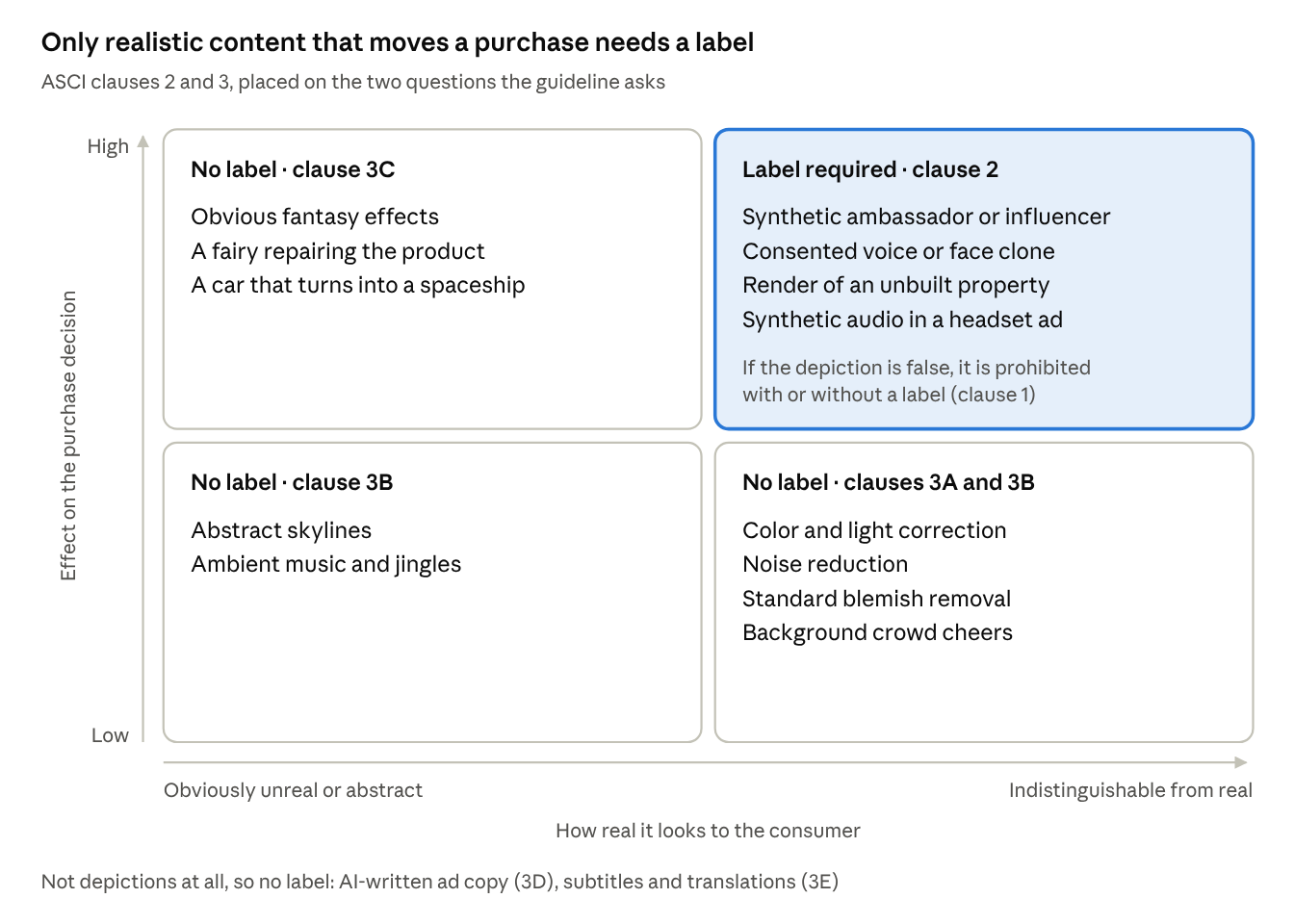
Source: ASCI guidelines, 17 September 2026 · Pulp Strategy analysis, October 2026 · ASCI’s own examples, placed by zone, not scored
The matrix reduces ASCI’s three questions to two axes, how real the content looks and how much it moves the purchase. Only the top-right quadrant carries a mandatory label, and clause 3 lists the five exempt uses:
- Minor enhancements (3A). Color correction, light adjustment, noise reduction, standard blemish removal, formatting, and copy refinement.
- Background and ambient elements (3B). Abstract skylines, jingles, and crowd cheers unrelated to what the product does.
- Fantastical elements (3C). Effects audiences recognize as unreal, such as a car that turns into a spaceship.
- Administrative and text uses (3D). Generating or enhancing advertising copy.
- Accessibility (3E). Subtitles, closed captions, translations, and accurate audio descriptions.
The copy exemption deserves a second read. A headline a language model wrote needs no label under clause 3D, yet the claim inside it still answers to the full ASCI Code.
Over-labeling is noise dressed as caution.
ASCI says it wants to avoid label fatigue. When every ad carries “enhanced using AI,” the label stops carrying information, and consumers learn to skip the one that protects them on a synthetic ambassador or an unbuilt apartment.
CMO Takeaway:
Every unnecessary label trains consumers to ignore the next one. Because clause 3 leaves model-written headlines, retouched pack shots, and decorative jingles unlabeled, a brand that labels them anyway dilutes the one disclosure it will need on a synthetic ambassador.
Do sponsored AI chatbot recommendations need a label?
Yes. Clause 2F treats a paid answer as an ad, so it must read “Sponsored by [Brand].” ASCI’s illustration is a shopper asking a chatbot which moisturizer suits Mumbai’s weather.
That rule splits AI answers in two.
A paid recommendation now tells the consumer the brand bought its place. An earned citation, where a model names a brand because its sources do, carries no label because nobody paid.
My position, which many in the category will dispute, is that earned visibility in AI answers becomes the more valuable asset once a bought answer has to announce itself. A brand buying its way into chatbot recommendations is buying the version of the answer that tells the consumer it was bought.
The text leaves one question open. Clause 4 allows platform-provided labels but does not specify how a chat interface must render one, so the advertiser has to confirm that the label names the brand and reads as sponsorship.
NeuroRank, the AI search platform Pulp Strategy built, tracks the earned half of that split prompt by prompt: which brands ChatGPT, Gemini, and Perplexity recommend in a category when nobody has paid, and how accurately each one is described.
CMO Takeaway:
Clause 2F divides AI answers into paid recommendations that must read “Sponsored by [Brand]” and earned citations that carry no label. Budget allocation follows from that split, because earned inclusion in model answers is the version a consumer has no stated reason to discount.
How should marketing teams review AI content before production?
Review at the brief, not at the final cut. Every trigger for a label, or for pulling the ad, is set when someone chooses a synthetic ambassador, a cloned voice, or a render of an unbuilt product.
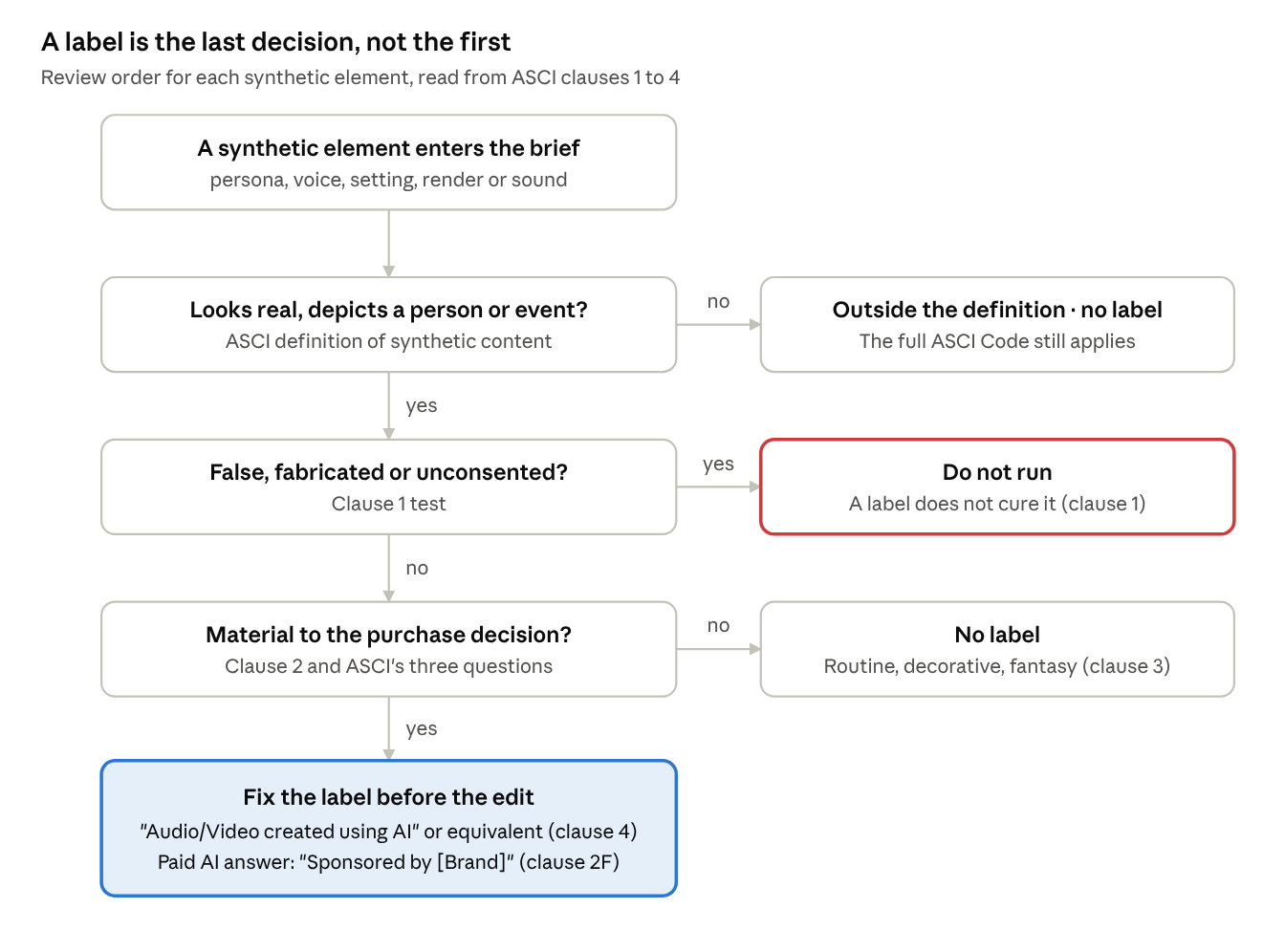
Source: ASCI guidelines, clauses 1 to 4, 17 September 2026 · Pulp Strategy review sequence, October 2026
A team that waits for the edit finds its clause 1 breach after the budget is spent. The review that holds up runs in this order for every synthetic element:
- Log each planned synthetic element at the brief: persona, voice, setting, product depiction, and sound.
- Run ASCI’s three assessment questions against each one and record the answer with the reviewer’s name.
- Clear clause 1 first: substantiation for every depicted result, written consent for every likeness or voice, and rights for every source asset.
- Agree the label’s wording, size, and screen time before the edit locks.
- For paid placements inside AI chat products, confirm the platform label reads “Sponsored by” with the brand named.
The order matters because each test can end the review. Clause 1 comes before materiality, so an asset that cannot run never reaches a debate about label size.
One thing the text does not settle. ASCI’s test of material influence is a judgment, not a threshold. I expect the first complaints decided under clause 2 to draw that line more precisely than any reading published now, this one included.
CMO Takeaway:
Synthetic-content risk is fixed at the brief and only discovered at the edit. Logging each synthetic persona, voice, setting, and render against ASCI’s three questions before production moves the clause 1 and clause 2 calls to the point where changing them still costs a storyboard, not a shoot.
When the first complaint under clause 2 names a campaign, will your team be able to show the assessment it ran before the shoot, or only the label it added after?