


By Ambika Sharma. Founder and Chief Strategist, Pulp Strategy. Product Architect, NeuroRank.
Most enterprise websites are not underperforming. They are decaying. A corporate site ships clean, wins its launch review, then drifts. Every release adds a script, a banner, a third image carousel. Two years later the homepage carries 1,437 elements on average, a 22.5 percent jump in a single year, and the basics that won the original pitch are gone.
The numbers are not soft. Baymard Institute reviewed the checkout experience of leading United States and European ecommerce sites in 2025. Sixty-four percent scored mediocre or worse. Two percent scored good. None scored perfect. The same research shows a large site can lift conversion by up to 35 percent through design changes alone, before a single rupee of new media spend. Pulp Strategy runs these audits for enterprise brands across India and the United States. The pattern repeats.
This is the gap. UX design that gets results is not a visual refresh. It is the discipline of making a website fast, structured, accessible, and citable, so it converts the traffic it already has and survives the shift to AI search.
| Most enterprise websites fail at conversion because they get heavier, slower, less accessible, and harder for AI engines to read as they age. The fix is research-led UX design that rebuilds structure, performance, accessibility, and AI citation readiness together, not a cosmetic redesign. Baymard research shows design changes alone can raise conversion by up to 35 percent. |
Key takeaways
- Sixty-four percent of leading ecommerce sites score mediocre or worse on checkout UX. Only two percent score good (Baymard, 2025).
- Design changes alone can raise conversion by up to 35 percent on a large site (Baymard, 2025).
- A 0.1 second mobile speed gain raised retail conversions 8.4 percent and average order value 9.2 percent (Google and Deloitte).
- The average top home page now carries 1,437 elements and 66.6 images, up 22.5 percent and 13.6 percent in one year (WebAIM Million, 2026).
- 95.9 percent of the top one million home pages fail accessibility checks, the first increase in six years (WebAIM Million, 2026).
- When an AI summary appears, users click a result 8 percent of the time, versus 15 percent without one. Only 1 percent click a cited source (Pew Research Center, 2025).
- A website AI engines cannot read or cite is invisible at the moment of decision, whatever its search rank.
| WHO THIS IS FOR This article is written for two readers who share one website. The CMO carries the brand cost when decay shows up in AI answers, search results, and lost conversions. The CTO or product head owns the fix, signs the work order, and is measured on the result. The argument and the numbers work for both. |
IN THIS ARTICLE
1. Why do most enterprise websites fail at conversion?
2. How does an outdated corporate website lose customers as it ages?
3. What does a slow, heavy website actually cost in revenue?
4. Why are most corporate websites invisible to AI search?
5. What does UX design that gets results actually look like?
6. Proof: HMEL named case and validated outcome data.
UX design is the practice of structuring how a website works so users can complete tasks quickly, accessibly, and without friction. For enterprise websites it covers information architecture, page performance, accessibility, and conversion flow, not visual styling alone. Strong user experience design turns existing traffic into measurable outcomes.
This article covers UX design for enterprise corporate websites and why they fail at conversion. It does not cover paid media strategy or brand identity design. For brand and identity work, see the Pulp Strategy design practice.
Why do most enterprise websites fail at conversion?
| Most enterprise websites fail at conversion because they are built once and then left to drift. The design that won the launch erodes as teams add pages, scripts, and images without measuring the cost. Baymard Institute found 64 percent of leading sites score mediocre or worse on checkout UX, and only 2 percent score good. |
Conversion is a structural property, not a styling choice. A site converts when a user can find the thing, trust the thing, and complete the task without friction. Baymard, which has studied ecommerce usability since 2009, scored leading United States and European sites in 2025. On navigation alone, 67 percent rated mediocre to poor, and 95 percent failed to show users their current location in the main menu. Buyers who cannot tell where they are do not buy.
On a corporate website, conversion is rarely a cart. It is a demo booked, a specification downloaded, a sales team contacted, a shortlist entered. The mechanics are identical to retail. A buyer with intent meets a page, and the page either removes friction or adds it. Baymard's checkout findings travel directly to the enterprise funnel, because the failure modes, hidden navigation, heavy pages, and unclear next steps, are the same wherever a human is trying to act.
The waste compounds. Around 70 percent of carts are abandoned. Baymard puts the recoverable loss at 260 billion dollars across the United States and European Union, reachable through better checkout design alone. Corporate websites that are not ecommerce show the same disease in a different organ: forms that ask for too much, navigation that hides the next step, pages that bury the one action that matters.
There is a measurable arc to the decay. WebAIM's tracking of the top one million home pages shows the average page has nearly doubled in element count over seven years. More elements mean more code, more scripts, and more places for a task to break. A buyer never sees the element count. The buyer sees a page that loads slowly, a menu that hides the next step, and a form that asks for too much, and leaves. The site did not fail at launch. It failed by addition.
| Enterprise websites fail at conversion because UX quality decays after launch and is never measured. Baymard scored 64 percent of leading sites mediocre or worse on checkout UX in 2025, yet design changes alone can recover up to 35 percent more conversions. The failure is structural, not cosmetic. |
The decay starts the day the site ships.
How does an outdated corporate website lose customers as it ages?
| An outdated corporate website loses customers through accumulation. Each release adds weight, complexity, and broken basics that no one removes. WebAIM's 2026 study of the top one million home pages found an average of 1,437 elements per page, up 22.5 percent in a single year, and 95.9 percent failing accessibility checks, the first increase in six years. |
Complexity is the quiet killer. The same WebAIM Million report counted 56.1 accessibility errors per home page, 10.1 percent more than the year before. Low contrast text appeared on 83.9 percent of pages. Missing form input labels on 51 percent. Empty links on 46.3 percent. These are not exotic failures. They are the basics every brief promises and every aging site loses. WebAIM found a detected error on one in every 26 page elements.
Images are the other tax. The average home page now carries 66.6 images, up 13.6 percent in one year, and 16.2 percent of them ship with no alternative text. A site that adds images faster than it governs them gets heavier for humans, for search crawlers, and for the AI engines now reading the web. The brochure mindset, more pictures equal more impact, is exactly the habit that breaks performance and accessibility at the same time.
The direction of travel is the alarming part. For six straight years the share of home pages failing accessibility checks fell, as awareness and tooling improved. In WebAIM's 2026 data it rose, from 94.8 percent to 95.9 percent, the first reversal in the history of the study. The basics are not merely hard to hold. Across the web they are now sliding backward, because pages are growing faster than teams are governing them. This is the data behind a feeling every buyer has had: sites that were fine a few years ago are quietly getting worse.
The Indian enterprise context sharpens this. Most buyer journeys here start on mobile, so a heavy desktop-first site loses the audience before the pitch begins. Accessibility is no longer optional under the Rights of Persons with Disabilities Act and the government's accessibility guidelines for ICT systems, and data handling now falls under the Digital Personal Data Protection Act, 2023. A corporate website that ignores either is a compliance exposure as well as a conversion leak. The same fix, fast and structured, addresses both.
Why do websites get slower and weaker over time? Because nobody owns subtraction. Teams are measured on what they add, not on what they remove. Without a performance budget and an accessibility standard enforced at every release, a corporate website regresses by default.
| Corporate websites decay because complexity accumulates and basics are never re-checked. WebAIM's 2026 report found 1,437 elements per page, up 22.5 percent in a year, and 95.9 percent of top home pages failing WCAG checks. Weight and broken basics push customers away long before the brand notices. |
Weight is not free. It has a price, and the price is paid in revenue.
What does a slow, heavy website actually cost in revenue?
| A slow, heavy website costs measurable revenue at every step of the funnel. The most rigorous study on the subject, commissioned by Google and run by Deloitte and Fifty-five across 37 brands and 30 million sessions, found that a 0.1 second mobile speed improvement raised retail conversions 8.4 percent and average order value 9.2 percent. |
The effect held across sectors. Travel conversions rose 10.1 percent on the same 0.1 second gain (Google and Deloitte, Milliseconds Make Millions). Luxury page views per session rose 8.6 percent. Lead generation pages, the closest match to a corporate website, saw bounce improve 8.3 percent. One tenth of one second. That is how sensitive buyers are to speed, and how much money sits inside the gap between a fast site and a slow one.
Speed is governed now, not guessed. Google's Core Web Vitals set the thresholds an enterprise website should hold: Largest Contentful Paint under 2.5 seconds, Interaction to Next Paint under 200 milliseconds, Cumulative Layout Shift under 0.1. Every uncompressed image, every unused script, every render-blocking font pushes a real page past those limits. With 66.6 images on the average home page, image discipline is no longer a nicety. It is the difference between passing and failing the only speed test users and search engines both run.
| A slow website leaks conversions at every step. Google and Deloitte measured an 8.4 percent retail conversion gain and 9.2 percent higher order value from a single 0.1 second speed improvement. Holding Core Web Vitals thresholds is the cheapest revenue an enterprise website can earn. |
Speed wins the click. But a new gatekeeper now decides whether the click ever happens.
Why are most corporate websites invisible to AI search?
| Most corporate websites are invisible to AI search because they were never built to be read or cited by language models. Pew Research Center tracked 900 United States adults across roughly 69,000 searches and found that when an AI summary appears, users click a result just 8 percent of the time, versus 15 percent without one. Only 1 percent click a source inside the summary. |
The implication is severe. If a buyer never clicks, the answer the AI gives is the only impression your brand makes. Pew Research Center found that 88 percent of AI summaries cite three or more sources. The fight is no longer for a ranking. It is for a place in that citation set. A website that does not appear in the sources does not appear in the buyer's mind.
The behavior change is already measured. Pew found that 58 percent of users met an AI summary on at least one search in the study period, and that sessions ending with no further click rose to 26 percent when a summary appeared, against 16 percent when it did not. The summary is becoming the destination, not a signpost to it. With the median summary running about 67 words, the brands that win are the ones whose pages hand a model a clean, self-contained sentence worth quoting.
This traffic is small but growing and unusually valuable. Adobe Analytics, drawing on more than a trillion visits to United States retail sites, reported in January 2026 that AI-referred visitors engage at rates matching or beating other traffic. ChatGPT reached roughly 900 million weekly active users by February 2026, up from about 400 million a year earlier (OpenAI). The buyers are moving to AI search faster than corporate websites are preparing for it.
How do you get a website cited by ChatGPT or Google AI Overviews? You make it readable and trustworthy to a model. That means structured data, content in rendered HTML rather than JavaScript alone, self-contained answers a model can lift, named entities instead of vague pronouns, and a clean llms.txt and robots.txt that let AI crawlers in. Most corporate websites do none of this. They were built for a human eye and a Google bot, not for a language model deciding what to quote.
Readability to a model is concrete, not mystical. A language model favors pages where the answer to a question sits in plain text near the question, where headings are real questions a buyer would ask, where entities are named rather than implied, and where schema tells the machine what each block is. A corporate website written as marketing prose, with the substance buried in a PDF or rendered only after JavaScript runs, gives a model nothing clean to lift, so it quotes a competitor instead.
Pulp Strategy built NeuroRank to measure exactly this gap: whether AI engines cite a brand, what they cite instead, and where the omission sits. Its GEO Benchmark Index runs prompt simulations across hundreds of brands and dozens of industries to expose the difference between a site that ranks and a site that gets quoted. For most enterprise sites, that difference is the whole problem.
| Corporate websites are invisible to AI because models cannot read or trust them. Pew found users click a result 8 percent of the time when an AI summary appears, and 88 percent of summaries cite three or more sources. If a site is not in the citation set, it is absent from the decision, whatever its Google rank. |
Four failures: slow, heavy, inaccessible, uncitable. The fix is one discipline.
What does UX design that gets results actually look like?
| UX design that gets results rebuilds four things together: structure, performance, accessibility, and AI citation readiness. It starts with research, not a redesign. It treats the website as a measured asset, not a brochure. Done well it converts existing traffic, which is why Baymard found design changes alone can raise conversion up to 35 percent. |
The work follows a fixed sequence. Skip a step and the gains leak out somewhere else.
- Research and audit. Pull analytics, heatmaps, and an AI citation baseline before touching design. Find where users drop and where the site is silent in AI answers.
- Information architecture. Rebuild navigation around task completion. Apply the three-click rule, persistent breadcrumbs, and visible scope so a buyer always knows where they are.
- Performance budget. Cap page weight, govern images, and hold Core Web Vitals: LCP under 2.5s, INP under 200ms, CLS under 0.1. Enforce it at every release.
- Accessibility to WCAG 2.2 AA. Fix contrast, form labels, and alternative text from the first wireframe. Accessibility and performance rise together.
- GEO readiness. Add schema, semantic HTML, self-contained citable answers, and a clean llms.txt so AI engines can read and quote the site.
None of these is cosmetic. Each is measurable, and each ties to a number a product head or CTO already reports.
The discipline has an owner problem, not a talent problem. Most enterprise teams are measured on what they ship, so weight, complexity, and broken basics accumulate with every release and no one is accountable for removing them. UX design that gets results assigns that accountability. A performance budget enforced at deploy, an accessibility standard checked in review, and an AI citation baseline tracked like any metric a CTO already owns. The website becomes a governed asset, not a project that ended at launch.
| UX design that gets results rebuilds structure, performance, accessibility, and AI citation readiness in one disciplined sequence, starting with research. Baymard found design changes alone can raise conversion up to 35 percent. The asset is measured at every step, not styled and shipped. |
Unlike a cosmetic redesign that only updates how a corporate website looks, UX design that gets results rebuilds how it performs, what it structures, and whether AI can cite it.
Cosmetic redesign versus research-led UX design
| Dimension | Cosmetic redesign | Research-led UX design |
| Starting point | New visuals applied to old structure | User research, analytics, and an AI citation baseline |
| Page weight | Usually increases with every release | Governed by a fixed performance budget |
| Core Web Vitals | Unmeasured | LCP under 2.5s, INP under 200ms, CLS under 0.1 |
| Accessibility | Patched after launch, if at all | WCAG 2.2 AA built in from the first wireframe |
| Information architecture | Reskinned, same paths | Rebuilt around task completion and the 3-click rule |
| AI citation readiness | Absent. No schema, content in JavaScript | Schema, semantic HTML, and self-contained citable answers |
| Conversion | Hoped for | Instrumented and measured against a baseline |
| Typical outcome | The site looks newer | The site converts more. Up to 35% from design alone (Baymard, 2025) |
Comparison of two approaches to an enterprise website rebuild. Source: Pulp Strategy analysis, May 2026, with conversion figure from Baymard Institute, 2025.
Proof: what the data and our audits show
The strongest proof is first-party measurement. NeuroRank's GEO Benchmark Index lets Pulp Strategy see, for a given brand, whether AI engines name it, what competitor they name instead, and how accurately the brand is described. The recurring pattern in enterprise audits is blunt: a corporate website ranks respectably in Google for its own category, yet appears in zero AI answers for the same query. The site is visible to the old search and silent in the new one.
The validated outcome data is just as clear. Baymard Institute shows a large site can recover up to 35 percent more conversions from design changes alone. Google and Deloitte show 8.4 percent more retail conversions from a 0.1 second speed gain. WebAIM shows 95.9 percent of top home pages failing the accessibility basics that those same speed and conversion gains depend on. Put together, the message is consistent: the revenue is already in the traffic. Structure, speed, and citability decide how much of it the site collects.
Named case: HMEL (HPCL-Mittal Energy Limited)
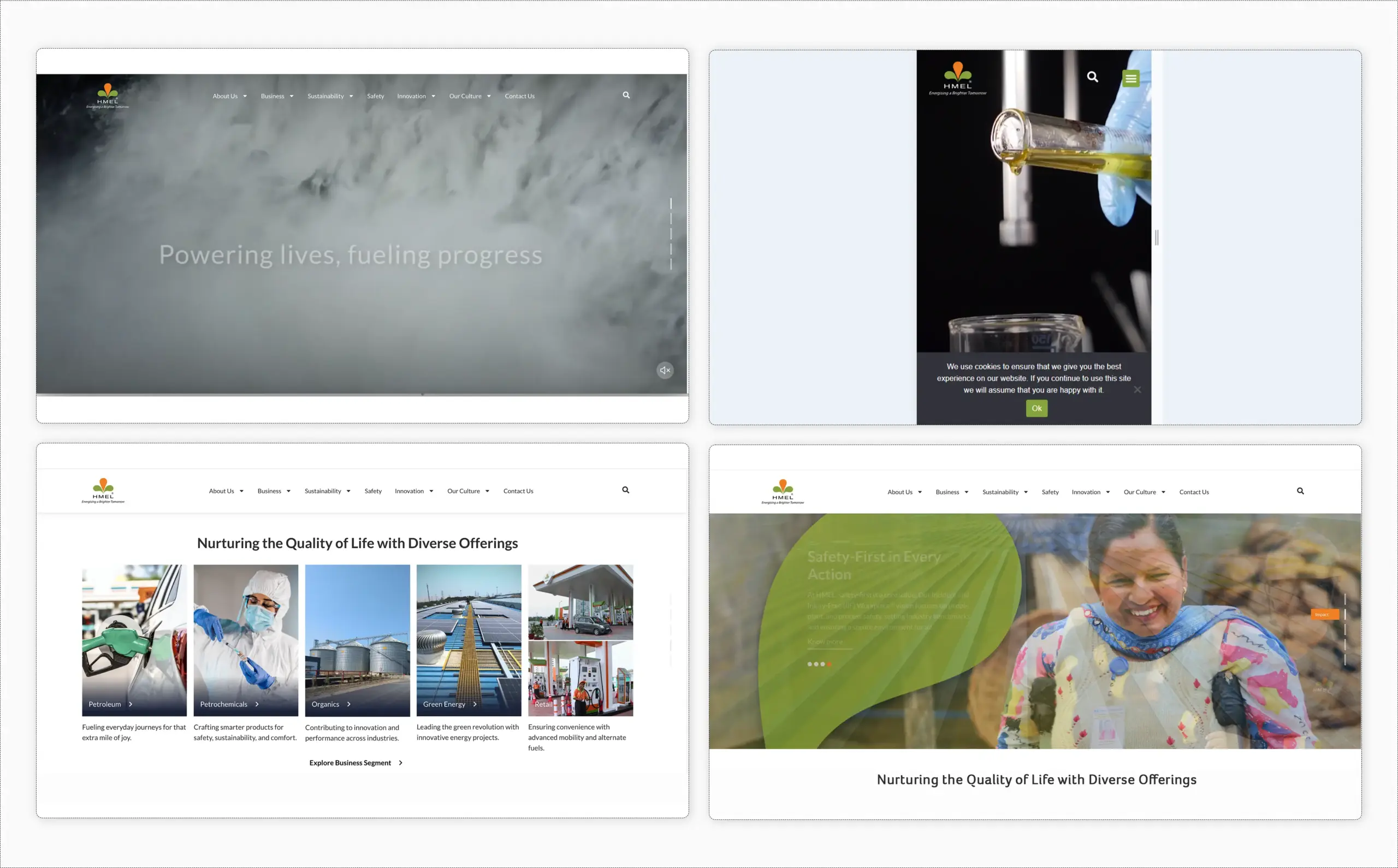
HMEL, HPCL-Mittal Energy Limited, is one of India's large petroleum and petrochemical enterprises. Its operations span refining, petrochemicals, organics, green energy, and retail, and its corporate website serves investors, customers, jobseekers, partners, and the press at once. That is the hardest kind of enterprise site to get right: many audiences, deep content, and no tolerance for a slow or confusing experience.
Pulp Strategy designed and built the enterprise corporate website at hmel.in, structured around the company's business segments, sustainability and ESG reporting, safety, innovation, and careers. Fast on mobile, accessible, structured around the visitor's question, and built so search engines and AI engines can both read and cite it. The screenshots below show the delivered experience.
| “A corporate website does not fail in a launch meeting. It fails quietly, one unmeasured release at a time, until the day a buyer asks an AI engine who is best and the answer does not include you.” Ambika Sharma, Founder and Chief Strategist, Pulp Strategy |
How do you measure the ROI of UX design?
You measure UX design ROI by instrumenting outcomes before and after the work. Track conversion rate, task completion, Core Web Vitals, and AI citation presence against a baseline. Google and Deloitte showed a 0.1 second speed gain raised retail conversions 8.4 percent. Tie every change to a metric, or the redesign is decoration.
Next steps
Start with a measurement, not a redesign. Audit your corporate website for page weight, Core Web Vitals, WCAG 2.2 AA accessibility, and AI citation presence. Fix the basics that decayed, then rebuild structure and conversion flow on top. Pulp Strategy runs this audit for enterprise brands across India and the United States.
| BOOK A UX AND GEO AUDIT Pulp Strategy will measure your site's conversion friction, accessibility, performance, and AI citation gap, and return a research-led plan with prioritized fixes. Speak to Ambika and the team: Contact Us |
Read more about the practice:
Pulp Strategy UI/UX design services
When a buyer asks an AI engine who does this best, is your website in the answer, or only in the archive?