
By Ambika Sharma, Founder and Chief Strategist, Pulp Strategy
Updated October 2025
Executive Overview
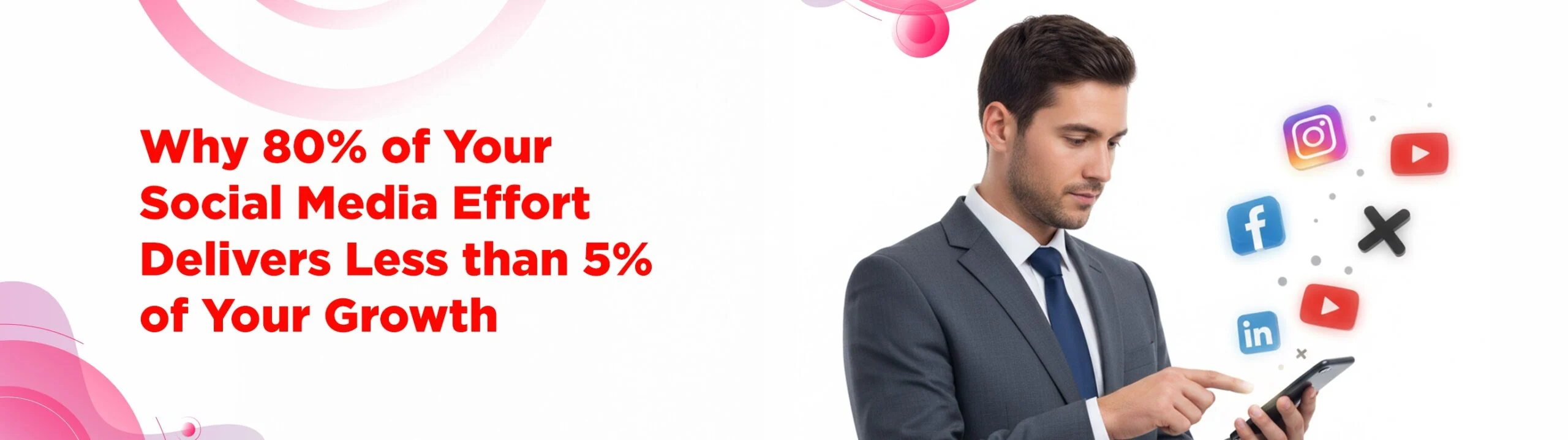
Today, CMOs and founders are rethinking social media’s role in marketing strategy and growth. For most consumer brands and especially B2B and SaaS brands, social consumes disproportionate effort yet delivers limited ROI. This article argues for a reallocation of focus: from rented social reach to owned growth engines, first-party data, ecosystems, and AI-driven visibility. We included a playbook for CMOs that reframes metrics around pipeline velocity, customer lifetime value, cost of acquisition efficiency, and defensible brand equity.
Who This Is For: This article is designed for CMOs, CEOs, CFOs, and founders of brands who want to align marketing and strategy with measurable ROI, stronger pipelines, and defensible growth. A playbook that has proven itself time and again.
What the data says: According to Gartner’s 2025 CMO Spend Survey, marketing budgets held at 7.7% of company revenue for the second year running. Forrester highlights that adaptive programs deliver 2x stronger revenue contribution than legacy models. Statista reports email generates an ROI of $36 for every $1 spent.
CMOs, CEOs, and founders must assess whether their current marketing and strategy mix is building sustainable growth or fueling vanity metrics. Pulp Strategy’s go to market strategy frameworks, brand strategy solutions, and applied AI systems can help redesign GTM playbooks for measurable ROI, ensuring every marketing strategy builds defensible growth.
Why Social Media ROI Is Under Scrutiny
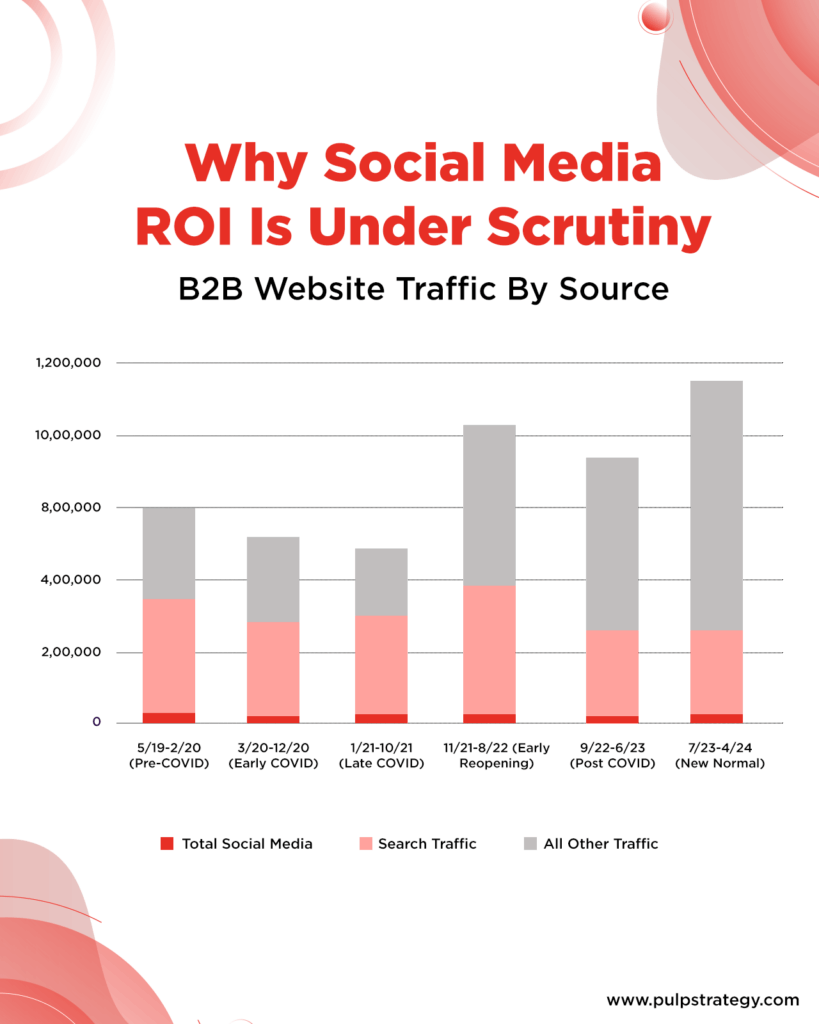
Marketing budgets remain constrained, heightening ROI scrutiny. In 2025, average marketing budgets held at 7.7% of company revenue. CMOs are under pressure to do more with less and prove business impact.
In B2B, social media in marketing contributes a low single-digit share of traffic. Between 2019–2024, social’s share dropped from ~3% to ~1% Forrester emphasizes the pivot to bottom-line accountability.
Boards and CFOs are asking: “Does your social media marketing strategy build pipeline or just presence?” The answer often reveals whether the marketing and strategy function is aligned to revenue outcomes.
What Vanity Metrics Hide from CMOs
· Likes and shares ≠ revenue. Vanity metrics create false comfort if not tied to pipeline.
· Algorithm volatility. Social reach is rented, not owned. Visibility can vanish overnight.
· Rising paid intensity. Social ad spend will hit $276.7B in 2025. Effectively making it unviable and costly rented reach
· Brand risk. Deepfakes and impersonation raise exposure.
If CAC rises while likes rise, you are measuring noise, not growth. A strong marketing strategy ensures CFO-level outcomes instead of vanity optics.
How Brands Fall into the Over-indexing Trap
Many B2B brands mimic FMCG playbooks, chasing awareness while ignoring funnel complexity. Decision cycles are longer, with multiple stakeholders.
Data: Social contributes 1–3% of traffic vs 40–50% from search, email, and direct .
Engagement spikes rarely convert unless journeys are tailored to CIOs, CTOs, and CFOs with a holistic content marketing strategy. Ai searches in 2025 will force marketeers to act quickly and optimize for Ai Search
Case Study: Lenovo – Smarter Leads the Future
Lenovo’s Smarter Leads the Future program engaged 900 CIOs across APAC with a research-driven content marketing playbook, CIO Chat Show, and personalized nurture tracks. The initiative improved recall, built trust, and became a cornerstone of APAC outreach, generating conversation-ready leads. It demonstrated how content marketing aligned with an enterprise marketing strategy creates meaningful pipeline outcomes.
ROI Impact: The program improved email engagement rates by 35% and contributed to a 20% uplift in qualified pipeline conversations, showing how a robust marketing strategy converts insight into measurable growth.
The Overlooked Power of Email Marketing
Email remains one of the most consistent high-ROI channels. It enables segmentation, personalization, and long-cycle nurturing, forming the backbone of content marketing strategy for B2B brands. A robust email and content marketing strategy is central to every effective go to market strategy framework.
Benchmarks: ROI of $36 per $1 spent; B2B open rate 21.3% and CTR 2.6%. No rent, owned audience, no media spend and double the CTR.
“Yet, my team spends 80% of its account time on social media brands, and there are brand marketing teams who still spend less mind share on their annual email marketing strategy than on their moment marketing posts ” Ambika Sharma, Founder and Chief Strategist, Pulp Strategy
Case Study: Oracle – GTM Strategy; Email First
Oracle’s multi-channel email-led campaign used creative CTAs, webinars, and targeted content. It achieved a 40% webinar turnout and boosted MQL-to-SAL conversion by 25%. The campaign proved the impact of personalization in ROI and content marketing. It validated how a marketing and strategy system grounded in email drives measurable CAC efficiency.
Partner Ecosystem and Channel Marketing Programs
Forrester’s 2024 benchmarks stress that partner marketing emphasizing enablement and engagement, is critical to ROI.
Key Drivers:
- Enablement. Content, playbooks, training modules.
- Engagement Scoring. Contribution mapped to pipeline.
- Behavioral Nudges. Gamified incentives tied to revenue.
- Orchestration. Aligning resellers, distributors, and alliances in a modular GTM strategy framework that links marketing strategy to partner execution.
Case Study: Microsoft Cloud Speed Circuit (Partner Marketing)
Microsoft’s Cloud Speed Circuit enabled partners with structured go to market strategy frameworks, dashboards, and incentives. Results: double-digit CAC reduction and 18% faster pipeline velocity, with award recognition. It proves ecosystem-led orchestration and social media marketing strategy alignment outperform social-first campaigns.
A Playbook for Strategy-First Growth
- Anchor in Brand Strategy - Build consistent purpose, narrative, and identity.
- Build First-Party Data Assets - Capture consented data and use WhatsApp-first tools like Jaldi Engage™.
- Orchestrate Partner Ecosystems - Scale reach via structured partner programs.
- Secure AI-First Visibility - Use NeuroRank™ for LLM visibility and hallucination repair.
- Redesign Metrics Around ROI - Track pipeline velocity, CAC, LTV, and preference over impressions.
- Strengthen Content Marketing Strategy - Ensure content marketing is mapped to every funnel stage, integrating brand marketing and performance outcomes.
- Rebalance Social Media Strategy - Use social media in marketing to support awareness but focus resources on owned growth and channel ecosystems.
- Embed Social Media Marketing Strategy - Align social media marketing strategy to brand strategy rather than letting it dominate the funnel.
Comparison Table: Social, Owned, and Channel Marketing
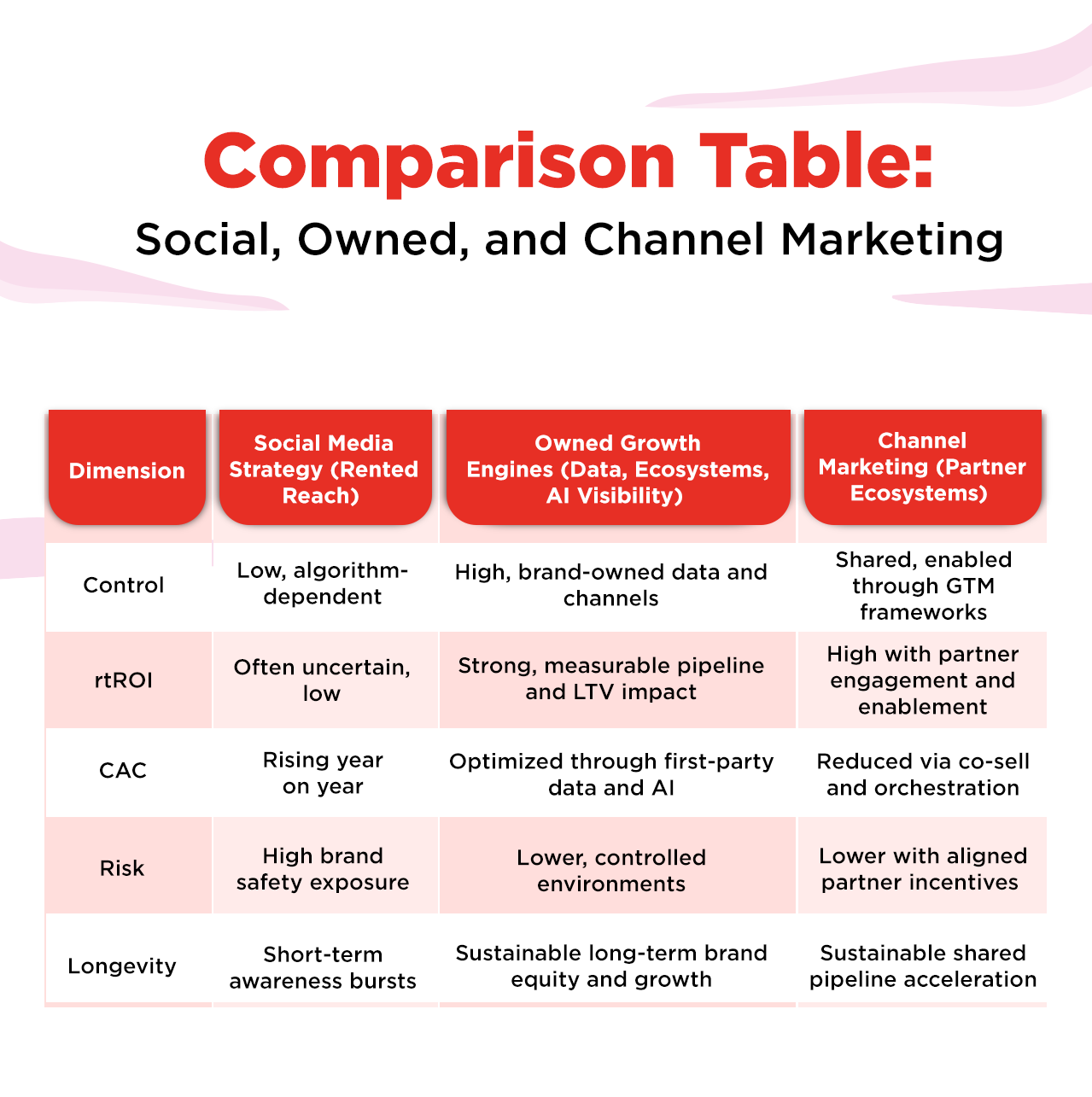
| Dimension | Social Media Strategy (Rented Reach) | Owned Growth Engines (Data, Ecosystems, AI Visibility) | Channel Marketing (Partner Ecosystems) |
| Control | Low, algorithm-dependent | High, brand-owned data and channels | Shared, enabled through GTM frameworks |
| rtROI | Often uncertain, low | Strong, measurable pipeline and LTV impact | High with partner engagement and enablement |
| CAC | Rising year on year | Optimized through first-party data and AI | Reduced via co-sell and orchestration |
| Risk | High brand safety exposure | Lower, controlled environments | Lower with aligned partner incentives |
| Longevity | Short-term awareness bursts | Sustainable long-term brand equity and growth | Sustainable shared pipeline acceleration |
The Full Funnel Metrics Redesign
Awareness: Share of search vs competitors, brand recall, YouTube channel marketing strategy benchmarks.
Consideration: Pipeline velocity, cost per qualified lead, content marketing effectiveness.
Conversion: Opportunity-to-close ratio, marketing-driven revenue, CAC efficiency.
The gurus of data are rooting for it, Forrester stresses moving from proxy metrics to business outcome measures McKinsey further notes that companies linking marketing strategy to growth levers deliver 3–5% higher shareholder returns.
Key Takeaways for CMOs and Founders
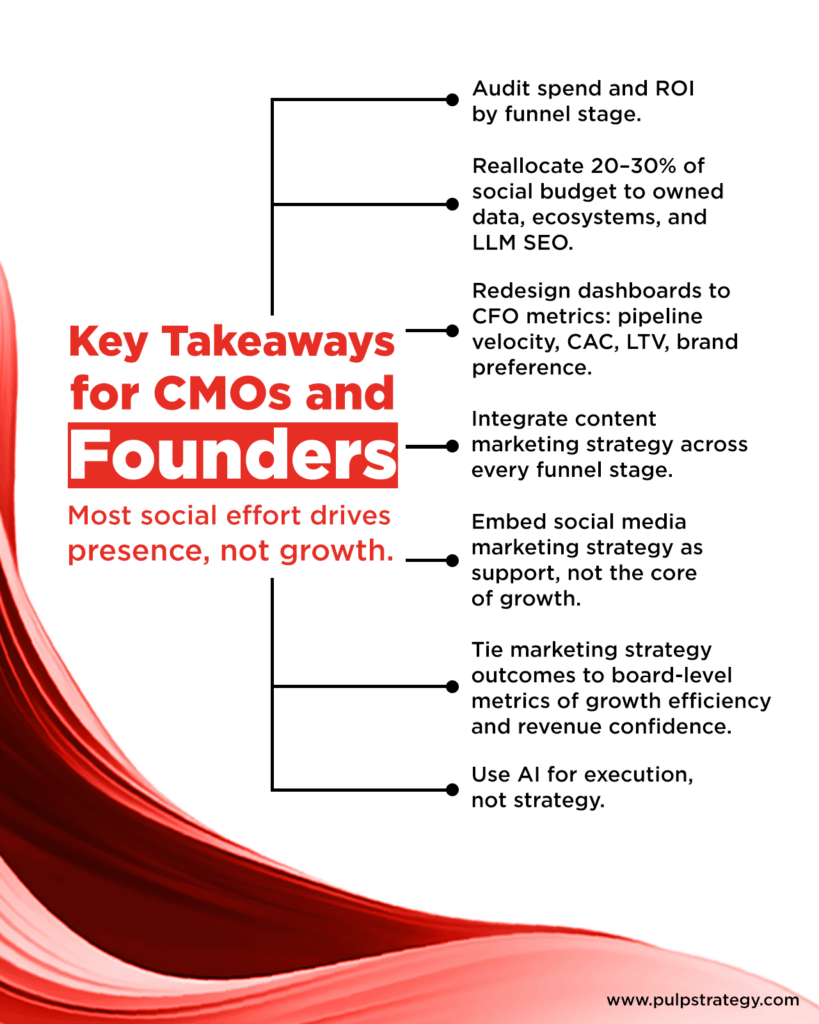
Most social effort drives presence, not growth.
Playbook Actions:
- Audit spend and ROI by funnel stage.
- Reallocate 20–30% of social budget to owned data, ecosystems, and LLM SEO.
- Redesign dashboards to CFO metrics: pipeline velocity, CAC, LTV, brand preference.
- Integrate content marketing strategy across every funnel stage.
- Embed social media marketing strategy as support, not the core of growth.
- Tie marketing strategy outcomes to board-level metrics of growth efficiency and revenue confidence.
- Use AI for execution, not strategy.
Ready to redesign your GTM strategy for ROI? Connect with Pulp Strategy to build marketing and strategy systems that scale.
The key takeaways
- Social delivers visibility, not sustained growth.
- Vanity metrics hide real outcomes CFOs demand.
- Strategy-first playbooks align brand, data, partners, and AI for ROI.
- Lenovo, Oracle, and Microsoft prove ROI-first ecosystems outperform social-first efforts.
- Full-funnel metrics (pipeline velocity, CAC efficiency, LTV, preference) redefine marketing success.
- CMOs must shift from rented reach to owned engines now.
Content marketing strategy, brand strategy, and a balanced social media strategy are critical for long-term equity and growth.