
By Ambika Sharma, Founder & Chief Strategist, Pulp Strategy • Published April 27, 2026 • Last reviewed April 27, 2026 • 10 min read.
Executive Overview
The content marketing strategy that worked for the last decade is breaking. Paid distribution is compounding past CFO tolerance, organic search is being rewritten by AI answers, and B2B buyers are deep into their decision before any vendor hears from them. The brands winning enterprise consideration in 2026 have stopped producing content for campaigns and started operating like publishers. They run a content hub, not a content calendar. They ship on a fixed editorial cadence. They own their distribution. They attach content to named human bylines. And they build topical authority that compounds for years. This is the brand publishing playbook for enterprise CMOs.
Key takeaways
- Brand publishing is content marketing operated as a media company: fixed editorial cadence, owned distribution, named bylines, topical authority. The model replaces the campaign calendar with an editorial calendar.
- A content hub is the single highest-leverage asset in a modern content marketing strategy. It is the only content that compounds across search, AI answers, and self-directed buyer research.
- The Brand Authority Equation explains why most brands stall: Brand Authority = (Editorial Cadence × Point of View × Owned Distribution) ÷ Time. Any zero multiplier zeroes the result.
- Indian enterprise CMOs need three additions to the standard playbook: WhatsApp as a tier-one owned channel, founder voice as the highest-trust byline, and content engineered for AI search citation as a 90-day priority.
- Starting late costs more than starting small. Authority is a time-weighted asset.
Run a test before you finish reading this. Open ChatGPT, Gemini, or Perplexity. Ask it who the leading brands are in your category. Read the answer twice.
The brands the model names are not always the brands with the largest budgets. They are the brands that publish. They have a point of view, they ship on a cadence, and they have built a topical footprint deep enough that someone searching for an answer keeps finding them. Everyone else has either disappeared or is being summarized by a search interface that did not need their website to exist.
This is why the content marketing strategy of the last decade is breaking, and why the CMO who fixes it first defines what the category sounds like for the next ten years.
Why is the old content marketing strategy breaking?
Three things broke at once. Paid distribution costs are compounding past what any CFO will keep funding. The discovery layer is shifting as AI answers replace blue links at the top of high-intent queries. And B2B buyers complete most of their evaluation before they ever speak to a vendor. The combined effect has shifted the center of gravity from earned and paid to owned, and from page-level optimization to topical authority.
Paid distribution is no longer defensible on its own
CPMs on Meta and Google have compounded year over year. iOS privacy changes broke deterministic attribution. Cookies are gone. The numbers media agencies report are not the numbers your CFO will keep approving for another budget cycle. A content marketing strategy that depends on buying eyeballs to reach people who never come back is a leaky bucket strategy in an era when the bucket has tripled in price.
AI search is the new front door for high-intent queries
Generative AI is no longer a side experiment. AI Overviews now sit above the ten blue links for an increasing share of high-intent commercial queries. When a buyer asks an AI which marketing automation platform fits a 2,000-person FMCG company, the model answers from a synthesized read of the open web. If your brand is not present, structured, and citable in that synthesis, you are not in the consideration set. The query did not even reach your website. AI search is one of three forces in this article, not the whole thesis. The deeper shift is structural, buyers are self-directing, and the brands that supply the point of view shape the shortlist.
Buyers are deep into the decision before they call you
B2B buying groups now run to ten or more stakeholders. They self-educate, they self-shortlist, and they self-eliminate. By the time they reach out, most of the decision has been made. The first two-thirds of the journey is now a content journey. The brand that supplies the point of view during that window shapes the shortlist. Everyone else is a tie-breaker.
How is brand publishing different from content marketing?
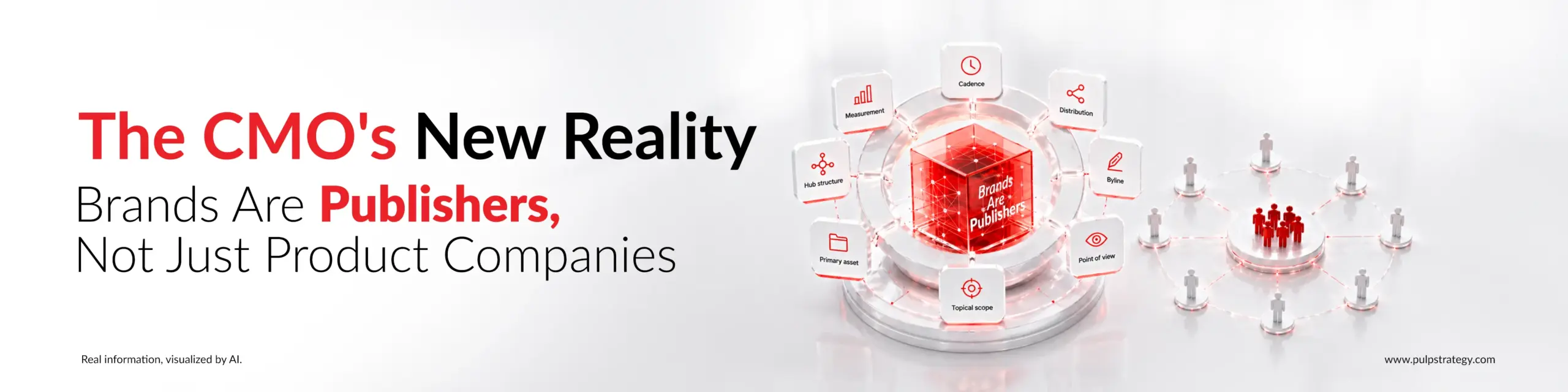
Content marketing produces assets to support campaigns. Brand publishing operates a media property to serve an audience. The difference is structural, cadence, distribution ownership, byline, point of view, and the asset that compounds. A content marketing program is in service of a campaign calendar. A brand publishing operation is in service of an audience that exists whether or not a campaign is running.
| Dimension | Content Marketing (the old default) | Brand Publishing (the 2026 default) |
| Cadence | Tied to campaign calendar. Three pieces in October, silence in November. | Fixed editorial cadence. Weekly newsletter, biweekly long-form, monthly show. Ships every week. |
| Distribution | Rented. CMS, paid social, programmatic, depends on platform algorithms. | Owned. Email list, WhatsApp broadcast, podcast subscribers, community. |
| Byline | Brand-bylined or unsigned. | Named human author with public profile, credentials, photo. |
| Point of view | Balanced, brand-safe, often interchangeable with competitors. | Distinct editorial line. Takes positions. Argues. |
| Topical scope | Covers the full product portfolio thinly. | Owns three to five topics deeply. Saying no is the strategy. |
| Primary asset | Asset library. Each piece supports a moment. | Audience. Each piece grows the asset. |
| Hub structure | Chronological blog, weak internal linking. | Pillar and cluster pages, structured topical architecture, schema markup. |
| Measurement | Impressions, clicks, MQLs. | Subscriber growth, share of voice in category, pipeline influence over 18+ months. |
The content marketing playbook is not wrong. It is incomplete for the way buyers actually behave in 2026. Brand publishing is the layer that makes the rest of the stack compound.
Why is the content hub the spine of a modern content marketing strategy?
A content hub is a structured topical property organized around the three to five topics a brand owns, with pillar pages, cluster pages, internal linking, schema markup, and consistent terminology. It is the only content asset that compounds across Google indexing, AI search citation, and self-directed buyer research. Without a hub, individual posts cannot accumulate topical authority. With a hub, every piece you publish makes the next piece stronger.
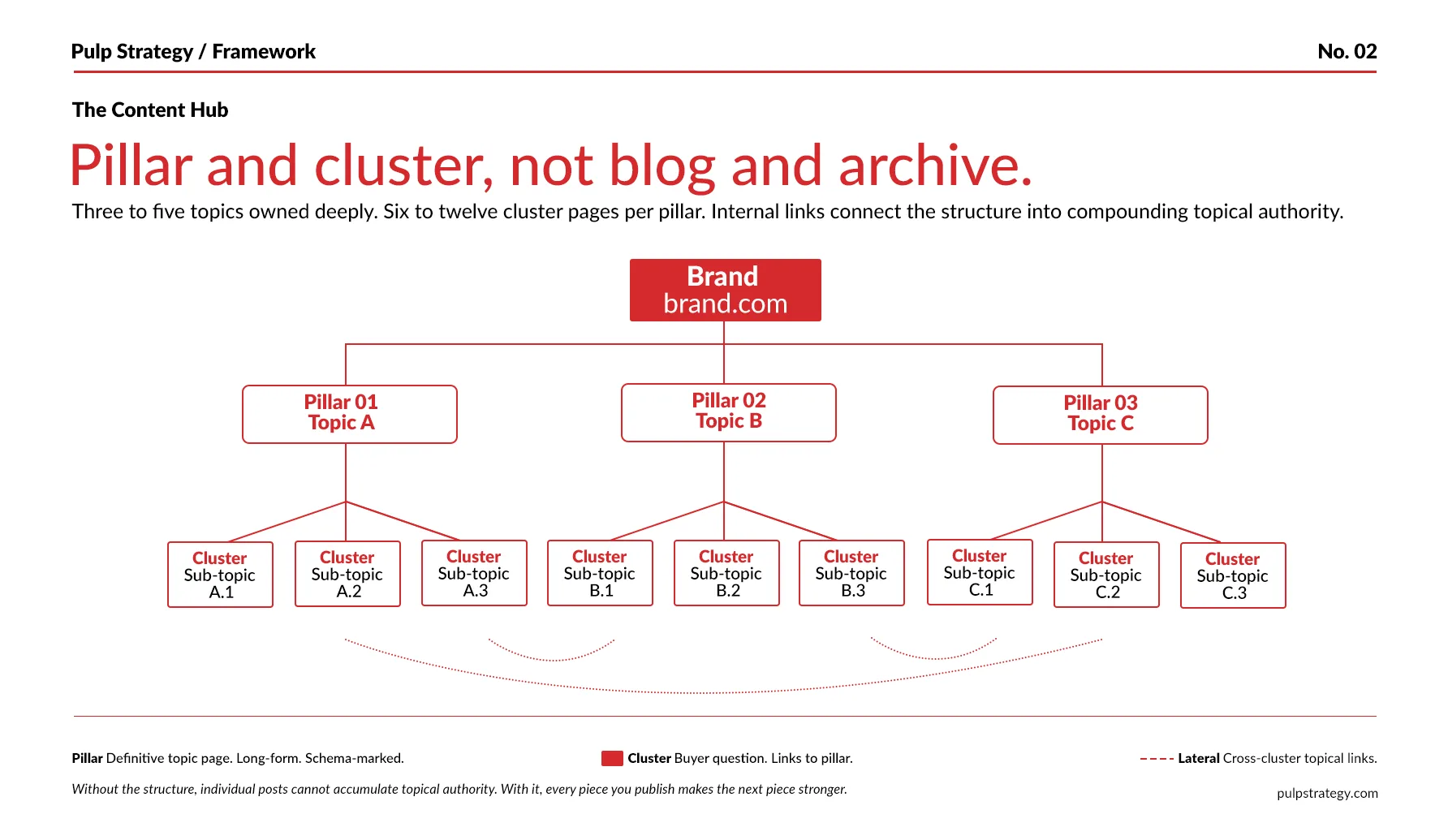
Most enterprise blogs are chronological dumps of posts. They show up in date order, link weakly to each other, and rarely accumulate enough topical density to rank for the queries that actually generate pipeline. A content hub fixes this by treating the property as a structured editorial product. The pillar page defines the topic. Cluster pages cover the sub-topics. Internal links connect the cluster back to the pillar and laterally to related clusters. Schema describes the relationships in a machine-readable form.
The compounding is real. The first pillar plus six cluster pages takes three to four months to build properly. By month nine, the cluster starts to rank for long-tail commercial queries. By month eighteen, the pillar starts to rank for the head term and the cluster supplies the proof. By year three, the topic is the brand's, and competitors who started later cannot buy their way in.
What goes in a content hub
- A pillar page for each of the three to five topics the brand has chosen to own. Long-form, definitive, structured for both human readers and AI extraction.
- Six to twelve cluster pages per pillar, each one answering a specific buyer question that ties back to the pillar.
- Internal linking architecture: every cluster links back to its pillar and laterally to two or three related clusters. Every pillar links out to its strongest cluster pages.
- Author bylines on every page. Real human writers with profile pages, credentials, and photos.
- Article and FAQ Page schema on every entry. Breadcrumb List for navigation. Speakable selectors for AI search.
- A measurement frame that tracks topical authority growth and pipeline influence rather than raw page views.
How do you measure brand authority?
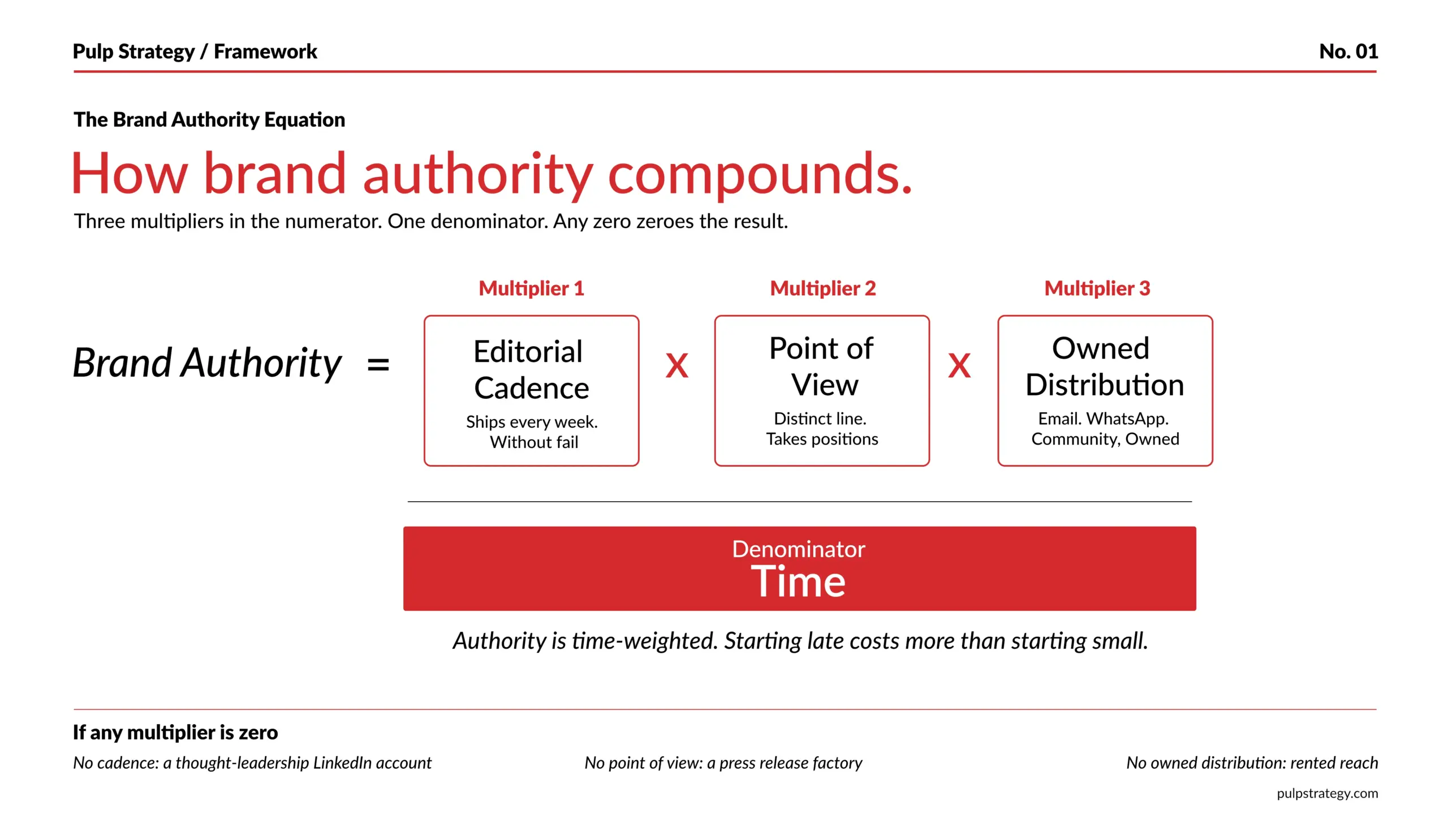
Brand authority can be measured as a function of three multipliers and a denominator: Brand Authority = (Editorial Cadence × Point of View × Owned Distribution) ÷ Time. All three multipliers must be present. Any multiplier scoring zero zeroes the result. Authority is time-weighted, which is why starting late costs more than starting small.
We use this frame at Pulp Strategy to diagnose where a brand sits on the publisher curve. The reason it is a product, not a sum, is structural. A brand with a strong point of view but no shipping cadence is a thought-leadership LinkedIn account. A brand with cadence but no distinctive point of view produces noise. A brand with both but no owned distribution is renting reach and depreciating it the moment paid spend stops.
The denominator is the part most CMOs underestimate. Authority is a time-weighted asset. The brands that look unbeatable in their categories today started publishing four to six years ago. The first year of brand publishing produces almost no measurable lift. Year two compounds. Year three produces inbound that paid media cannot match. Starting late costs more than starting small.
What does brand publishing look like in practice?
Brand publishing is not a hypothetical. The patterns hold across categories from BFSI to consumer technology to grooming to enterprise software. Below are three examples from Pulp Strategy's own work where treating content as a publishing operation, not a campaign input, produced compounding outcomes.
ICICI Prudential Pension Fund, owned distribution as the conversion engine
When the brief is to grow assets under management for a pension product, the conventional move is heavier paid media. The publishing move is to build owned content that does the qualifying work before any conversation begins. Over an FY where we operated this way, the campaign generated 795 PFM shifts contributing more than ₹112 Cr to AUM, with ₹298 of AUM produced for every ₹1 of media spent. Organic share of website traffic moved from 11 percent to 36 percent. Engagement-to-follower ratio sat at 11x. The numbers are downstream of one decision: treat the website and content layer as a publishing operation that converts, not a brochure that supports the call center.
Philips StyleTurf, SpeedStyle and BigLeap, editorial cadence as a category-builder
Across Philips's grooming and personal-care portfolio, the consistent pattern is that publishing-led launches outperform campaign-led launches by a wide margin. StyleTurf reached 1.5 million users, drove 400 percent product growth and 45 percent sellout, and was India's #1 product in the category within five days of launch. SpeedStyle delivered 5 million reach, 90 million impressions, and trended globally. The Big Leap campus program ran across 225+ B-schools, drove 5 million reach, and generated 25,000 user-generated content pieces. These are not campaign results in the traditional sense. They are publishing results, sustained editorial output, owned distribution channels, and named voices behind the work.
Microsoft Cloud Champions, community as a content engine
Cloud Champions was built as a community-led content program. The publishing layer was not a blog. It was a structured peer network that produced its own stories, its own conversations, and its own qualifying signals. The community generated content the brand could not have produced top-down, surfaced advocates Microsoft would never have found through paid acquisition, and built a self-replenishing pipeline of evangelists. The takeaway for any CMO is that owned distribution does not have to be a newsletter. Sometimes it is a community, and the community is the content.
What does this mean for the Indian enterprise CMO?
Indian enterprise CMOs need three additions to the standard brand publishing playbook: WhatsApp as a tier-one owned distribution channel, founder voice as the highest-trust byline, and content engineered for AI search citation as a 90-day priority. The buyer behavior, channel mix, and trust formation in India differ enough from US-centric playbooks that a copy-paste approach fails.
WhatsApp is part of the stack, not an afterthought
Email open rates in Indian B2B run materially below US benchmarks. WhatsApp open rates routinely run several multiples higher. Any owned distribution strategy that ignores WhatsApp is leaving the highest-engagement channel untouched. The pattern that works in our experience: long-form content goes to email, weekly digests go to WhatsApp broadcast, breaking POV goes to LinkedIn. Same editorial line, three formats, three channels.
Founder voice carries more weight than brand voice
In categories where the buyer is evaluating an Indian brand against global incumbents, the founder is often the highest-trust entity in the company. CMOs who treat the founder as part of the editorial system, bylined columns, podcast appearances, quoted in every campaign, see materially higher engagement than brand-bylined versions of the same content. This is consistent with the broader pattern that buyers trust people more than logos.
AI search visibility belongs in the 90-day plan
Indian CMOs are running roughly twelve to eighteen months behind US peers on prioritizing AI search visibility, which is the wrong place to be. ChatGPT, Gemini, Perplexity and Claude are already shaping consideration sets in BFSI, SaaS, and high-consideration consumer categories in India. A brand cited in those answers compounds. A brand that is not is invisible to a growing share of buyer journeys. Building that visibility is now a content marketing strategy line item, not a separate function.
How do you start in 90 days?
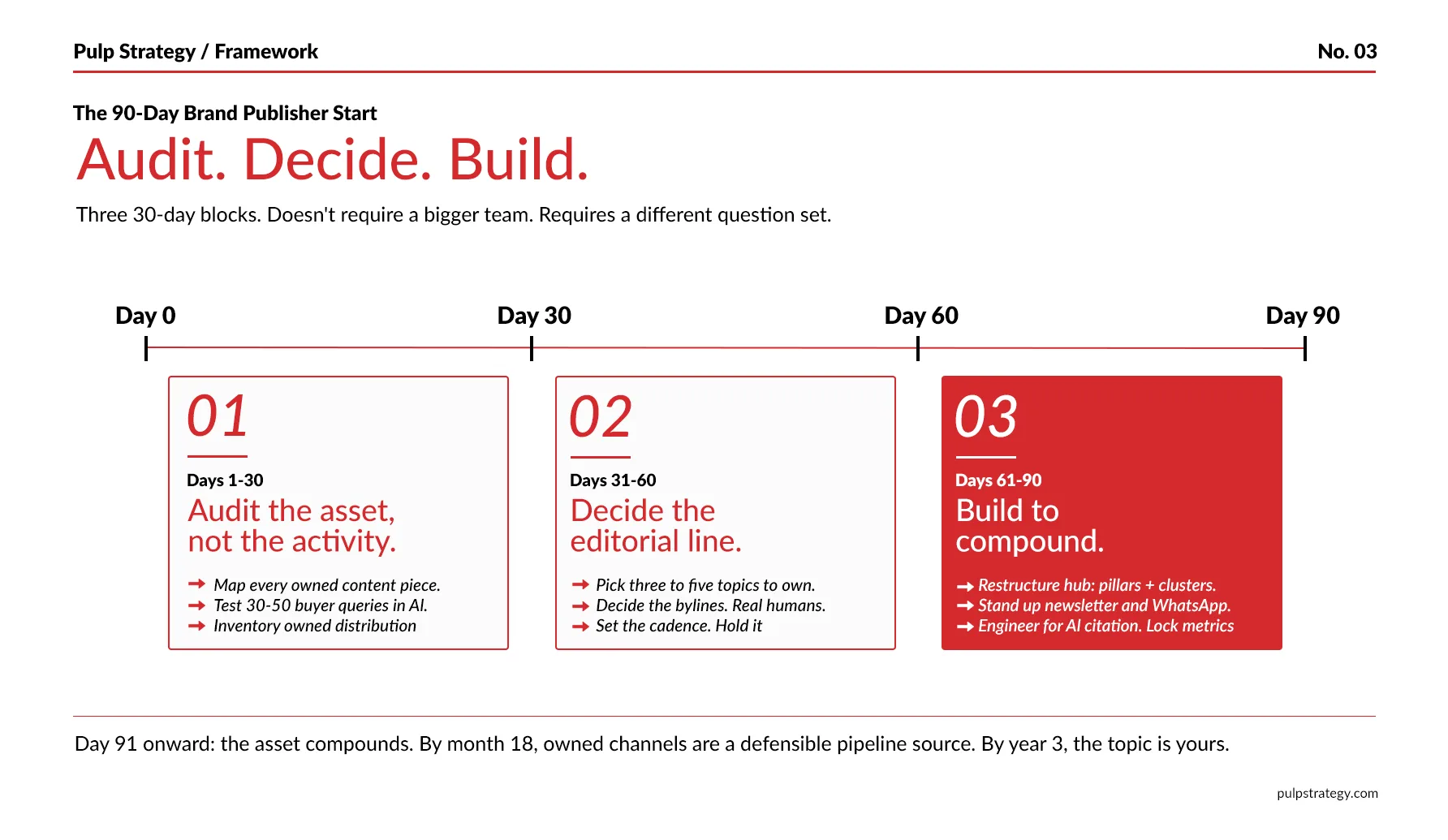
The 90-day brand publisher start is three 30-day blocks: audit the asset (not the activity), decide the editorial line, and build the infrastructure to compound. The plan does not require a bigger team. It requires a different question set.
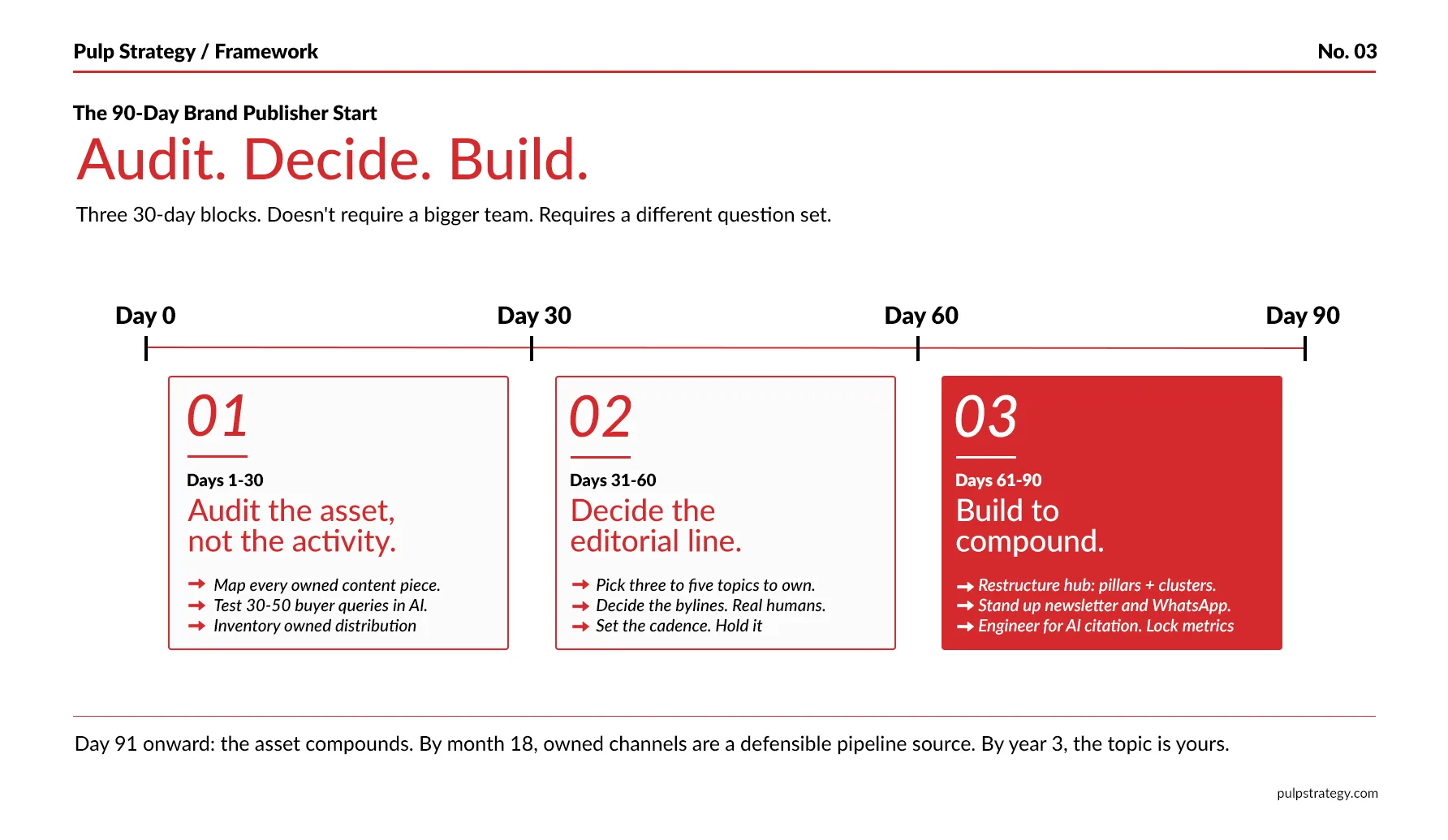
Days 1–30: Audit the asset, not the activity
- Map every piece of owned content shipped in the last 12 months by topic, format, and outcome. Most enterprises discover 60 to 80 percent of output is sub-scale and scattered across disconnected campaigns.
- Run an AI visibility check. Test 30 to 50 buyer-intent queries across ChatGPT, Gemini, Perplexity, and Google AI answers. Document where you appear, where you are omitted, and where you are misrepresented.
- Inventory owned distribution: email subscribers, WhatsApp opt-ins, community members. Most CMOs cannot answer this in a meeting, which is itself the diagnosis.
Days 31–60: Decide the editorial line
- Pick three to five topics to own. Not ten. Not the full product portfolio. The topics where the point of view is sharpest and the buyer cares most.
- Decide the bylines. Founder, CMO, two or three senior practitioners. Real humans, real LinkedIn profiles, real photos, full author pages.
- Set the cadence. Weekly newsletter, biweekly long-form, monthly podcast or video. Whatever the team can ship without missing once.
Days 61–90: Build the infrastructure to compound
- Restructure the content hub around the three to five topics. Pillar pages, cluster pages, full Article and FAQPage schema, internal linking, semantic HTML.
- Stand up the owned channels: newsletter on a real ESP, WhatsApp broadcast lists, community space. Capture and segment first-party data.
- Engineer the content for AI citation: clear definitions, answer-first paragraphs, descriptive question-format headings, comparison tables, named entities, fresh dates.
- Lock the measurement frame: pipeline influence rather than impressions, subscriber growth rather than page views, share of voice in your category rather than domain authority.
What is the decision every CMO has to make this year?
The decision is not whether to do content marketing. Every brand does some version of that. The decision is whether to keep producing content as a campaign input or to operate as a publisher with a content marketing strategy that is actually a publishing strategy.
The brands that pick the first path will keep paying compounding CPMs to reach an audience they never own, and watch their share of voice in AI answers shrink quarter over quarter. The brands that pick the second will spend the next 24 to 36 months building an asset that pays back for a decade.
Most CMOs already know which side of this they should be on. The friction is not strategic. It is operational. Building a publishing function inside a product company requires editorial discipline, founder commitment, infrastructure investment, and the patience to ship before the numbers prove anything. It is also the highest-leverage investment in marketing right now, and one of the few moats left that money cannot buy.
The brands that move first in your category will define what the category sounds like for the next ten years. The rest will write captions for someone else's audience. Which one is your brand going to be?
If you are mapping a content marketing strategy shift inside an enterprise brand, this is the work we do at Pulp Strategy. Start with our content hub strategy assessment, or talk to me directly.
→ Explore digital content services: /digital-content
→ Read the strategy pillar: /strategy
→ Author page: /author/ambika