

Companies are expanding into new markets faster than ever, but their B2B GTM strategy often falls short when it’s time to actually gain traction.
The reason is simple.
They try to assume and execute before they understand.
They jump straight into campaigns, outbound, and content, trying to build pipelines before they have clarity over who they’re targeting, what problem they’re solving, or how the market is actually behaving.
Research from McKinsey & Company and Gartner points to increasing complexity in buying behavior. But most GTM strategies are still built as if the market is predictable.
It is not.
A new market entry strategy is no longer an execution challenge. It is an understanding challenge. The more you understand and adapt, the more effective your go to market strategy will be
And now, there’s a second problem.
Even if you get your strategy right, you may still not exist where decisions are being shaped.
AI has quietly become a layer in B2B discovery. And most brands are invisible within it.
Executive Overview
A modern B2B GTM Strategy for entering new markets requires clarity before execution. Companies must align business objectives, define market-specific brand positioning validate customer problems, and build distribution advantage before scaling tactics. Treating GTM as a continuously learning and adaptive system, not as a fixed plan, improves speed to traction and reduces wasted investment.
- Execution without clarity leads to inefficiency
- Market entry requires validation, not assumption
- Distribution advantage determines early success
- Distribution and positioning must adapt to the market
- Learning speed determines GTM success
- AI systems now influence discovery and evaluation
- Visibility within AI is becoming a competitive advantage
What this means:
If your B2B GTM strategy ignores how buyers discover you today, it is already incomplete.
Key Highlights:
- The Real Problem: Execution Without a Defined Go to Market Strategy
- Why This Is More Dangerous in New Markets
- Macro Forces Reshaping B2B GTM Strategy
- The Shift: From Execution-Led to Learning-Led GTM
- Regional Reality: One Go-to-Market Strategy Will Not Work Everywhere
- The Cost of Getting Your Market Entry Strategy Wrong
- Synthesis: The Only Way This Works
The Real Problem: Execution Without a Defined Go to Market Strategy
Most B2B GTM Strategy failures happen because companies execute tactics before defining objectives, audience, and positioning. This leads to inefficient spending, weak messaging, and delayed market traction.
This is what it looks like in practice:
- Outbound campaigns without a defined target market
- CRM systems built without revenue alignment
- Content published without positioning clarity
- Websites written without a clear message
You can scale this activity. You can optimize it. You can hire teams around it.
It still will not work.
Because the issue is not effort.
It is direction.
Why This Is More Dangerous in New Markets
In new markets, lack of clarity compounds faster because customer behavior, competition, and demand are unknown. Executing without understanding increases cost, slows learning, and delays market fit.
In an existing market, poor strategy creates inefficiency.
In a new market, it creates blindness.
- You don’t know your real buyer
- You don’t know if the problem is urgent
- You don’t know which channels actually work
So, every campaign becomes a guess.
And every guess costs time.
Macro Forces Reshaping B2B GTM Strategy
New market entry is harder because demand is fragmented, discovery is non-linear and multi-stakeholder driven. These forces make traditional, linear GTM strategies ineffective and increase the need for adaptive, insight-driven execution.
- Buying decisions now involve multiple stakeholders
- Discovery happens across multiple touchpoints
Customers enter the journey at different stages (non-linear funnel)
According to Gartner, B2B buying groups typically involve 6 to 10 decision-makers, increasing complexity. McKinsey & Company highlights that buyers now use multiple channels throughout their journey, making linear funnels obsolete.
This creates a structural mismatch.
Markets are becoming more complex, but GTM strategies remain simplified. Most go to market strategy models still assume control.
This raises the real question.
If the market is complex, why are most GTM strategies still oversimplified?
The Shift: From Execution-Led to Learning-Led GTM
Modern B2B GTM Strategy replaces execution-first thinking with a learning-first system. Companies validate assumptions, map real buyer behavior, and refine positioning before scaling execution. This reduces wasted spending, improves conversion quality, and accelerates time to market fit.
This is where most teams need a reset.
Execution-led GTM assumes you already know:
- Who the customer is
- What problem matters most
- Which channels will work
- What message will convert
In new markets, none of this is certain.
So, when you execute early, you are not scaling a strategy.
You are scaling assumptions.
What Learning-Led GTM Actually Means
Learning-led GTM is not about slowing down.
It is about de-risking before scaling. Instead of launching full campaigns, you:
- Test hypotheses in small, controlled environments
- Gather real customer feedback
- Observe behavior, not just responses
- Refine positioning based on evidence
This approach aligns with how early-stage systems operate. An effective go to market strategy is iterative and built on continuous customer discovery rather than fixed planning.
From Assumptions to Evidence
The core shift is simple:
| Execution-Led GTM | Learning-Led GTM |
| Launch campaigns early | Validate before scaling |
| Define ICP upfront | Discover ICP through signals |
| Fix messaging early | Evolve messaging continuously |
| Optimize performance | Optimize understanding |
This changes how decisions are made.
- Budget allocation becomes conditional
- Channel selection becomes evidence-based
- Positioning becomes adaptive
How This Plays Out in Practice
Instead of:
- Launching a full outbound motion → You test messaging with a small cohort
- Publishing large content volumes → You validate narratives through targeted pieces
- Scaling paid campaigns → You identify where attention already exists
Every step is designed to answer a question before committing resources.
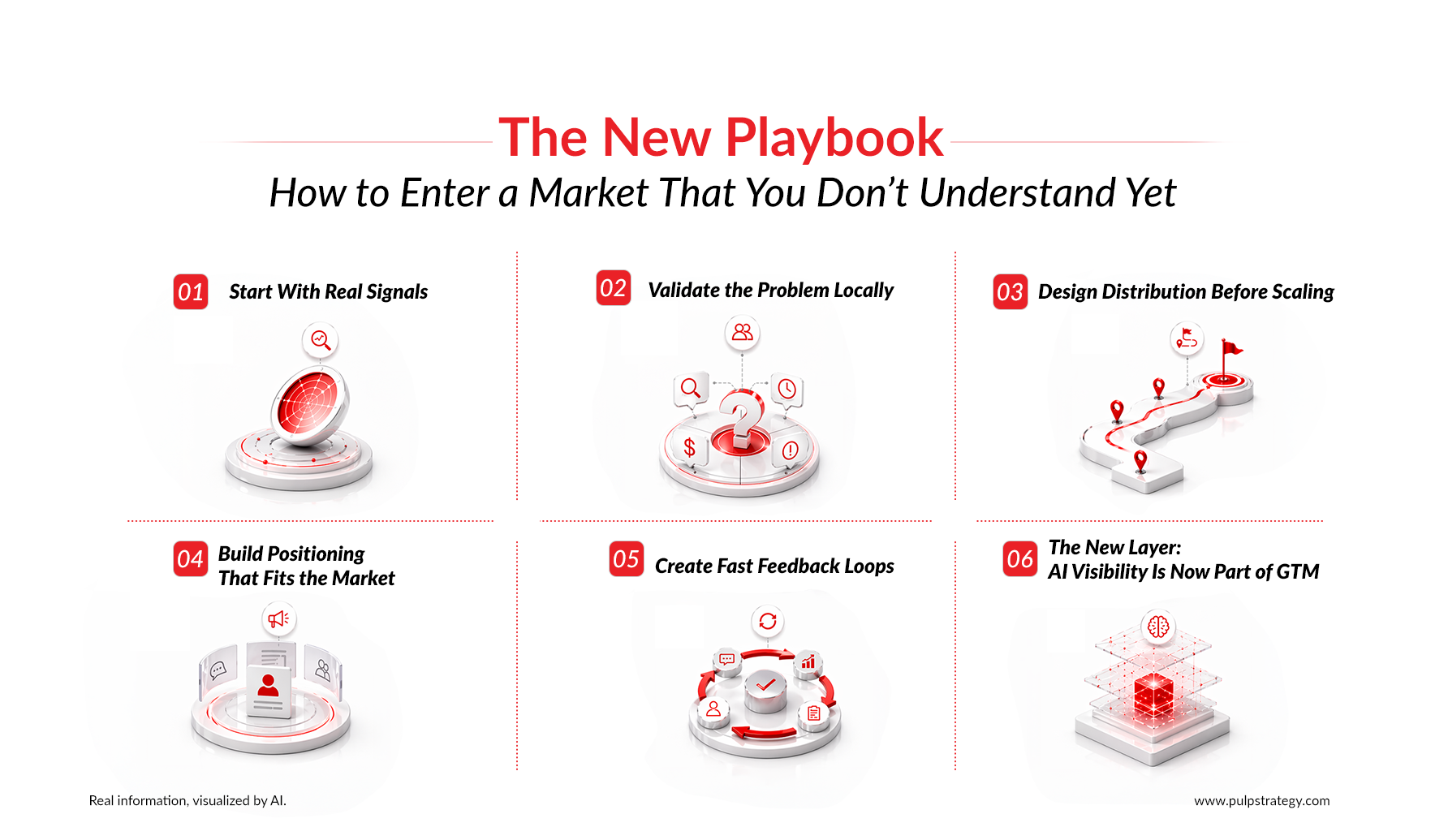
The New Playbook: How to Enter a Market That You Don’t Understand Yet
A modern B2B GTM Strategy for new markets is built by identifying real signals, validating problems, designing distribution, adapting positioning, and iterating quickly. This reduces uncertainty and accelerates market fit.
1. Start With Real Signals
- Talk to customers
- Observe behavior
- Identify real intent
Not what you assume but what actually happens.
2. Validate the Problem Locally
- Does the problem exist here?
- Is it urgent enough to solve it?
- Will customers pay for it?
If this is unclear, nothing else matters.
3. Design Distribution Before Scaling
- Where does your audience already spend attention?
- What partnerships can accelerate entry?
Distribution is not a tactic. It is your entry strategy.
4. Build Positioning That Fits the Market
- Align messaging with local context
- Adjust based on competition
Positioning is not universal. It is situational.
5. Create Fast Feedback Loops
- Test quickly
- Learn continuously
- Adjust aggressively
6.The New Layer: AI Visibility Is Now Part of GTM
AI systems are now influencing how B2B buyers discover, evaluate, and shortlist vendors. If your brand is not visible or accurately represented within AI-generated responses, your GTM strategy loses effectiveness before buyers engage.
Buyers are no longer relying only on:
- Search engines
- Sales outreach
- Vendor websites
They are increasingly asking AI systems like ChatGPT and Perplexity AI for recommendations, comparisons, and validation.
This creates a new layer:
AI-mediated decision-making.
And most GTM strategies are not built for it.
NeuroRank’s GEO Benchmark analysis, based on over 408,000 prompt simulations, reveals:
- 68% of brands are not visible in AI-generated responses within their category
- 52% of responses contain incorrect or incomplete brand information
- 90% of brand mentions skew neutral or negative without active narrative control
This changes the game.
You are no longer just competing for attention.
You are competing for inclusion in AI-generated answers.
This is where NeuroRank LLMO Engine comes in. NeuroRank is the patent-pending AI visibility intelligence platform that deconstructs how ChatGPT, Gemini, Claude, and Perplexity represent your brand, diagnoses where your AI presence is broken, and prescribes exactly what to fix.
Regional Reality: One Strategy Will Not Work Everywhere
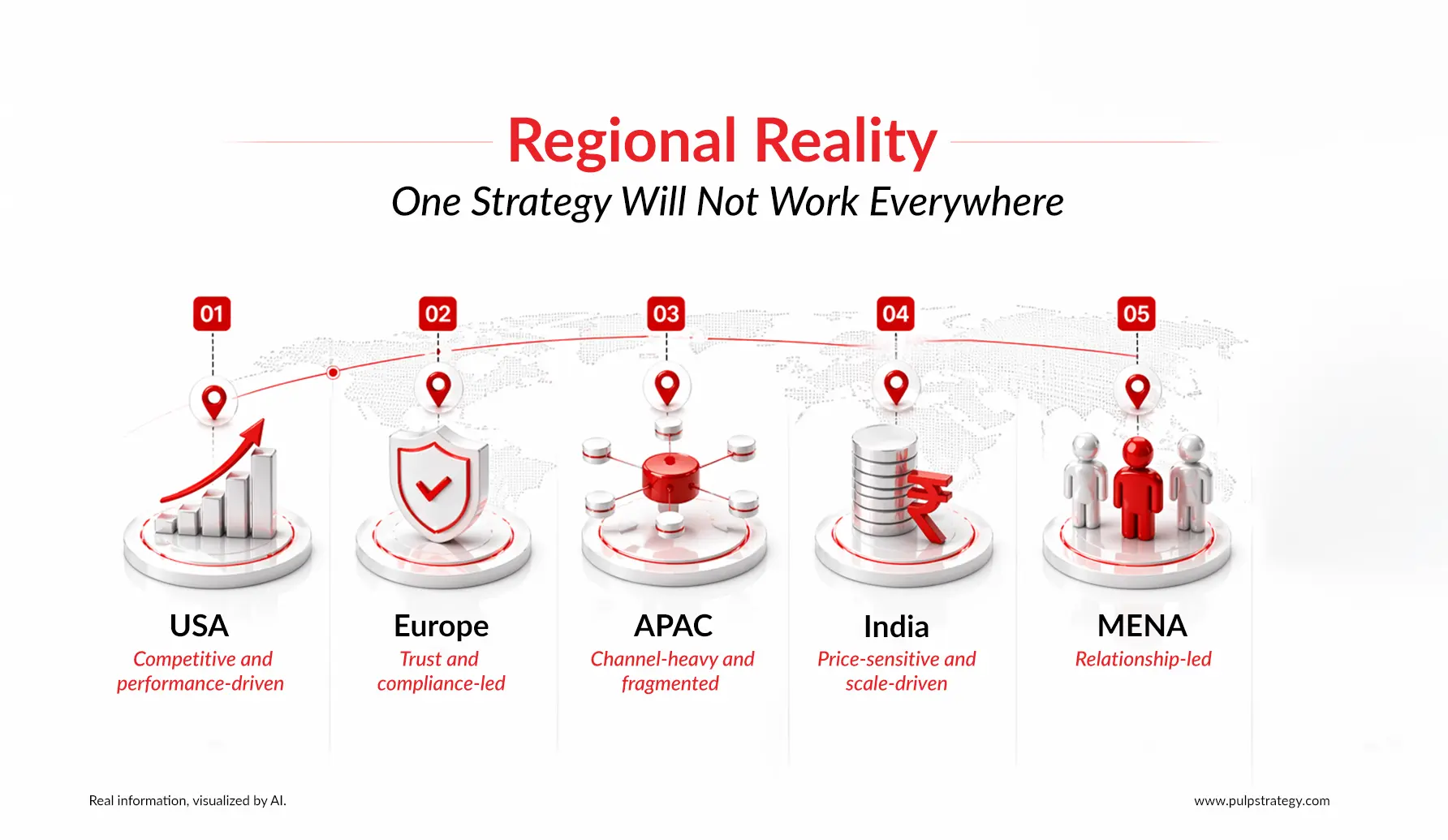
B2B GTM Strategy must adapt to regional differences in buyer behavior, trust, and market maturity. Applying a single global model reduces effectiveness.
- USA → Competitive and performance-driven
- Europe → Trust and compliance-led
- APAC → Channel-heavy and fragmented
- India → Price-sensitive and scale-driven
- MENA → Relationship-led
AI-driven discovery does not remove this complexity. It only amplifies it.
The Cost of Getting Your Market Entry Strategy Wrong
Poorly structured B2B GTM Strategy without considering control over AI visibility leads to wasted budget, slow market entry, weak positioning, and rising acquisition costs over time.
What starts as inefficiency becomes:
- Rising CAC
- Low-quality pipeline
- Delayed traction
- Lost market position
This compounds over 12–24 months. And by then, corrections are expensive.
Synthesis: The Only Way This Works
Winning B2B GTM Strategy combines clarity, adaptability, and AI visibility. Companies that understand markets deeply and ensure discoverability across AI systems outperform those that rely on execution alone.
The pattern is consistent.
The companies that struggle try to move faster.
The companies that win try to understand better.
Entering a new market without clarity is expensive.
Partner up with Pulp Strategy for GTM consulting and build a GTM system grounded in real market signals, not guesswork.
Transparency Statement
This article is based on insights from McKinsey, Bain & Company, Gartner and other global research firms. NeuroRank™ insights are derived from proprietary analysis of AI-driven discovery systems.