
Author Ambika Sharma, Founder and Chief Strategist
Updated April 2026
The Death of Sequential Intent
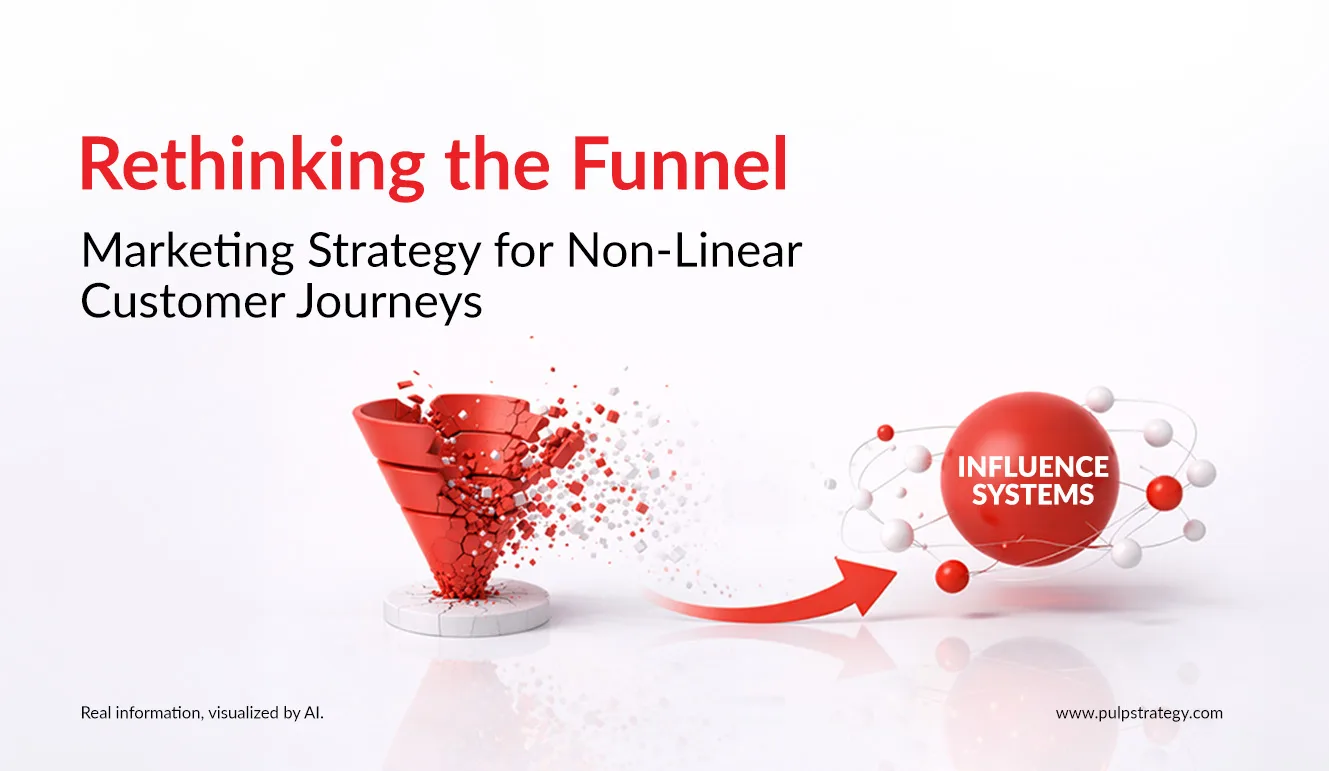
The era of the "Customer Journey" as a straight line is over. The linear funnel is now a fallacy that masks the reality of consumer behavior. In 2026, the path to purchase is a chaotic web of "Streaming, Scrolling, Searching, and Shopping" that occurs simultaneously. AI-driven discovery is accelerating this shift. That’s exactly why a modern marketing strategy can’t rely on fixed journeys anymore. AI-driven discovery is accelerating this shift, reshaping how decisions are influenced and made. And in this new environment, LLMO (Large Language Model Optimization) is becoming a critical layer in any effective marketing strategy for growth that aids AI search optimization.
This shift is not theoretical. It is already reflected in how buyers behave and it impacts the marketing ROI.
McKinsey highlights that customer decision journeys are no longer linear and instead resemble circular and iterative processes, where consumers actively evaluate options across multiple touchpoints before making a decision. BCG (2025) further reinforces this by showing that modern consumers interact with brands across multiple channels and moments, with influence distributed across the entire journey rather than confined to specific stages. Deloitte’s Digital Consumer Trends (latest edition) confirms that consumers now use multiple devices and platforms interchangeably, creating fragmented, non-sequential journeys that traditional models fail to capture.
This is not fragmentation. This is a complete breakdown of sequence.
Yet most CMOs continue to allocate budgets, teams, and reporting structures around a model that assumes order where none exists. CMOs who continue to optimize for a stage-based funnel are essentially measuring the ghost of an interaction rather than the pulse of a transaction.
Knowledge Triple: Marketing Funnel → Obsolete In → 2026 Economy
What this means:
Growth in 2026 isn’t driven by funnel progression. It’s driven by influencing decisions across a non-linear journey where users constantly leave signals through their behavior and AI SEO is a critical part that helps you show up in those moments.
Executive Overview
The linear funnel is obsolete because customer decisions now occur across non-sequential, AI-influenced touchpoints. Influence accumulates through signals, not stages. Organizations that move beyond funnels and actually understand what people do (behaviour signals) and who they are across platforms (identity) perform better. They outperform a fixed funnel-based models in efficiency, attribution accuracy, and marketing ROI predictability.
- Journeys are non-linear and sometimes looped
- AI shapes decisions before brand interaction
- Behaviour signals outperform declared intent
- Identity fragmentation breaks attribution
- Influence systems replace funnel logic
This article explains why the traditional marketing funnel has become structurally irrelevant in 2025–2026 due to AI-driven discovery, fragmented customer journeys, and behaviour-driven decision-making. It outlines the shift toward influence systems as the new growth model and provides a clear operational framework for CMOs to adapt, measure, and scale predictable marketing ROI.
Knowledge Triple:
Marketing Funnel → Obsolete In → AI-Driven Journeys
Influence Systems → Replace → Funnel Logic
Behaviour Signals → Drive → Decision-Making
Identity Resolution → Enables → Accurate Attribution
Key Highlights
What is a linear funnel?
A linear funnel is a traditional marketing strategy that assumes customers move step-by-step from awareness to purchase. It breaks the journey into fixed stages and measures progress as users move downward through each stage toward conversion.
The linear funnel is built on a simple assumption: Customers follow a predictable path
Awareness → Consideration → Conversion
Each stage is treated as:
- Separate
- Sequential
- Measurable in isolation
Every action is assigned to a stage, and success is measured by how efficiently users move from one stage to the next.
The Collapse of Sequential Decision-Making
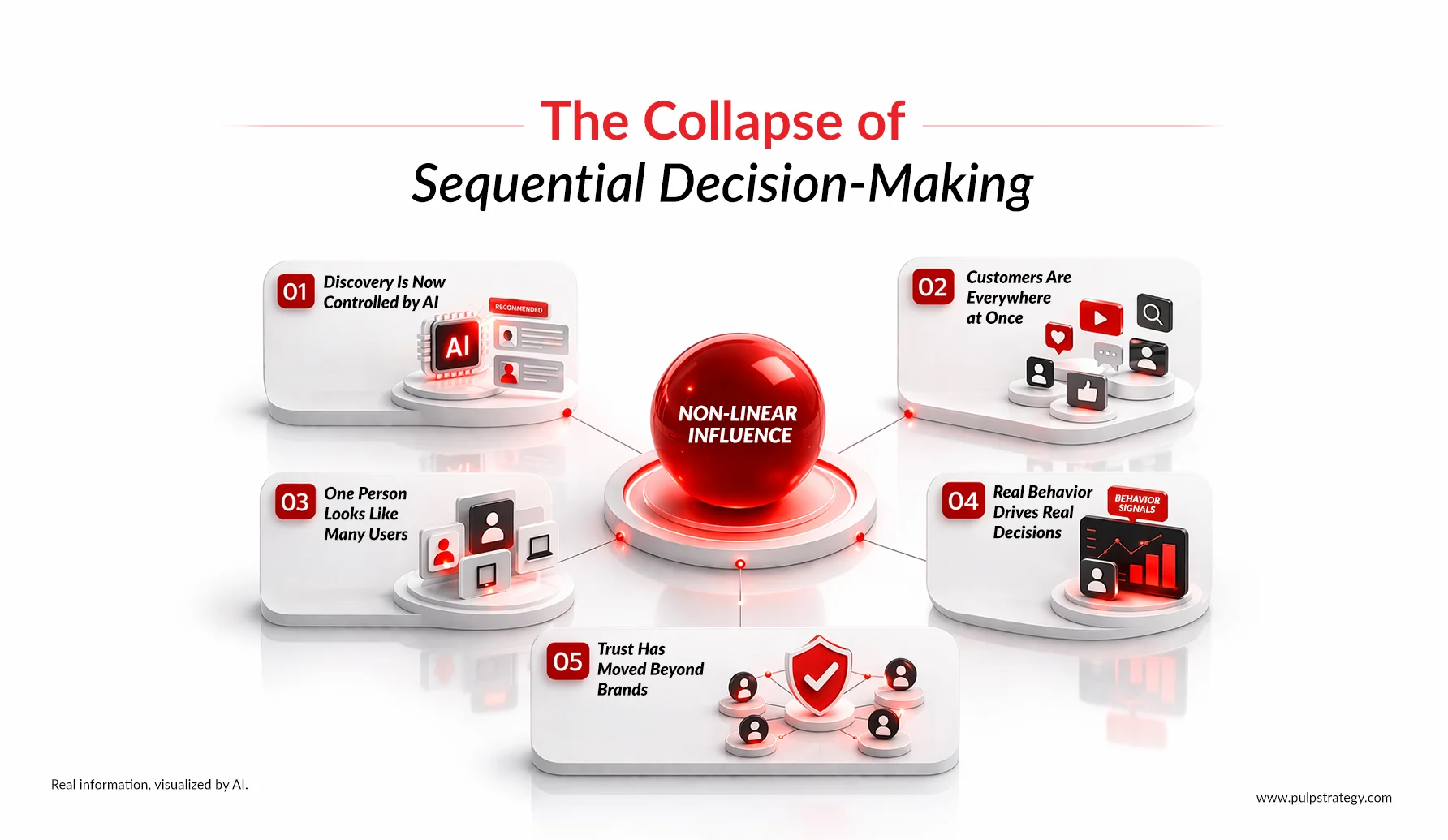
Customer journeys are no longer linear. They are shaped across distributed touchpoints where influence accumulates non-sequentially. Decision-making is becoming more behavior-driven. McKinsey shows that companies leveraging customer data and behavioral signals through personalization achieve 10–15% revenue uplift, highlighting the growing importance of real interaction data over static segmentation.
This shift is driven by AI mediation, multi-channel exposure, fragmented identity and signal based decisioning. Decision-making now occurs across distributed touchpoints where influence accumulates non-sequentially.
1. Discovery Is Now Controlled by AI
AI-driven interfaces are already reshaping early-stage discovery. Gartner predicts that traditional search volume will drop by 25% by 2026, as users increasingly rely on AI assistants and alternative discovery platforms.
Knowledge Triple:
AI Interfaces → Control → Early-Stage Discovery
Visibility → Determined Before → Website Interaction
2. Customers Are Everywhere at Once
Modern purchase journeys involve multiple touchpoints across channels with no fixed sequence, making linear funnel models ineffective.
Knowledge Triple:
Customers → Engage Across → Multiple Channels Simultaneously
Channel Overlap → Breaks → Sequential Journeys
3. One Person Looks Like Many Users
Today, a single customer doesn’t interact with your brand in one place or on one device. They might discover you on their phone, research on a laptop, and finally convert on a different device or platform. But most systems fail to connect these interactions.
One journey gets split into fragments. What looks like three different users is actually one customer moving across touchpoints.
Knowledge Triple:
Single User → Appears As → Multiple Identities
Fragmented Journeys → Break → Attribution Accuracy
4. Real Behavior Drives Real Decisions
Instead of trusting what customers say they want, companies now look at what they actually do or how they behave online.
Behavioral signals such as content interaction, repeat engagement, and search patterns are more reliable indicators of purchase intent than declared preferences, as they reflect actual behavior rather than stated intent.
What counts as a “behavioural signal”?
- Visiting the pricing page multiple times
- Comparing products
- Watching a full demo video
- Searching “best options for X”
- Asking AI tools for recommendations
Knowledge Triple:
Behavioral Signals → Indicate → Purchase Intent
Repeat Engagement → Signals → Decision Readiness
5. Trust Has Moved Beyond Brands
Trust in peer and third-party content continues to outperform brand-led messaging in purchase decisions.
Knowledge Triple:
Consumers → Trust → Peer and Third-Party Content
Communities → Influence → Purchase Decisions
The Friction Point: The Legacy Funnel Crisis
Funnels fail because they impose artificial sequence on non-linear behaviour, ignore AI-mediated discovery, and rely on incomplete identity data.
Legacy systems (funnels) treat a user on Instagram, a user on Google, and a user on the brand website as three different people. This "fragmentation" costs enterprise brands millions in wasted ad spend. It results in misallocated budgets, inaccurate attribution, declining conversion efficiency and negatively impacts marketing ROI.
Where Funnels Break
| Failure Point | Impact |
| Sequential assumption | Misreads actual journeys |
| Channel isolation | Ignores cross-platform influence |
| Last-click attribution | Overvalues terminal touchpoints |
| No AI visibility layer | Misses pre-decision influence |
A significant number of CMOs report low confidence in their attribution models, highlighting a structural gap between marketing strategy and measurable business outcomes.
The Strategic Pivot: From Funnels to Influence Systems
Influence systems replace funnels by shifting the focus from tracking customer stages to engineering decision-making environments. Instead of asking where a customer is in a journey, they analyze how multiple behavioral signals across touchpoints combine to shape outcomes, enabling precise attribution and more predictable growth.
What Is an Influence System
An influence system is not a campaign framework. It is a continuous decision-engineering model. It operates on a simple premise:
Customers do not move forward in steps. They accumulate conviction through multiple interactions.
An influence system therefore:
- Maps decision touchpoints: Every interaction that can shape perception is tracked. This includes ads, content, reviews, AI responses, and peer conversations.
- Measure how strong the interest is: Not all touchpoints matter equally. Time spent, repeat exposure, and interaction depth determine influence weight.
- Identifies high-impact interactions: It isolates which combinations of signals actually push users toward decisions, not just engagement.
- Constantly adjusts what works: Instead of fixed campaigns, the system adapts based on real-time behaviour and feedback loops.
Knowledge Triple:
Influence System → Continuous Decision-Engineering Model
What Actually Changes in Practice
Under a funnel model, a user watching a video is “awareness.”
Under an influence system, that same action is evaluated differently:
- Did they watch fully?
- Did they search after?
- Did they compare options?
That single interaction becomes part of a compounding influence pattern, not a stage label.
Core Shift
| Funnel Model | Influence System |
| Step-by-step journey | No fixed path |
| Runs campaigns | Always tracking and learning from customer behavior |
| Focuses on one channel at a time | Looks at all channels together |
| Measures after things happen | Tracks behavior in real time |
How Influence Actually Builds
Decisions are rarely triggered by one moment. They are the result of stacked behaviour signals.
Example:
- A user sees a creator video
- Later reads reviews
- Then asks an AI tool for “best options”
- Finally visits a website (or an ecommerce website)
A funnel sees:
Awareness → Consideration → Conversion
An influence system sees:
How each interaction builds trust until a decision is made
That difference is everything.
Contrarian Insight
The industry believes that more data will fix funnel inefficiencies. It will not.
More data without structure leads to:
- Conflicting behaviour signals
- Attribution confusion
- Over-optimization of low-impact metrics
The real issue is not data scarcity. It is model misalignment.
Until data is organized around how influence is created, not where users are in a journey, performance will plateau.
The Operational Framework: Four Pillars of Influence Systems
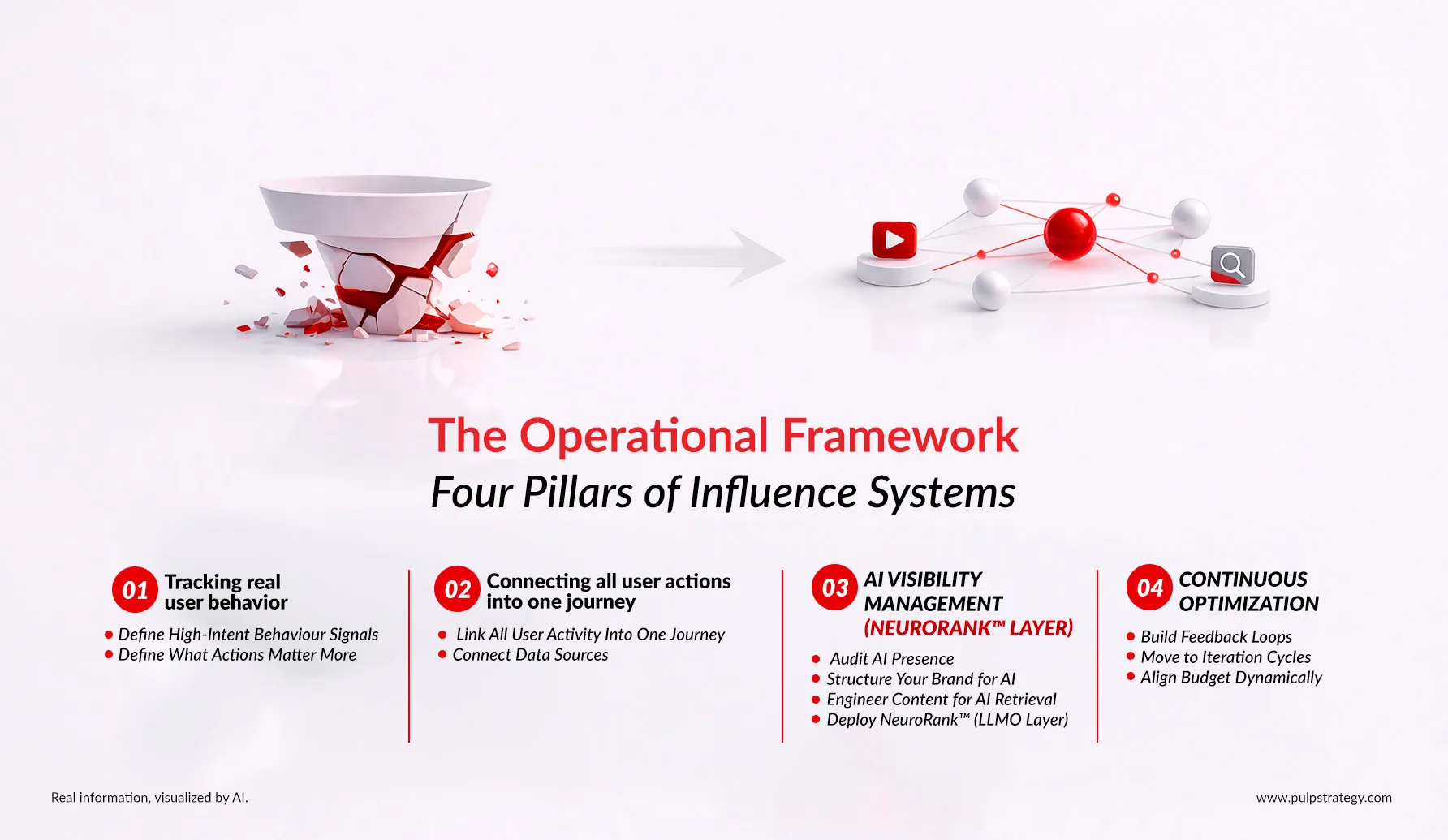
Influence systems are built through four operational pillars: tracking real user behavior, connecting all user actions into one journey, AI visibility management, and continuous optimization. Implementation requires structured data capture, unified identity infrastructure, AI-ready content engineering, and real-time feedback loops that convert fragmented interactions into measurable influence and predictable revenue.
1. Tracking real user behavior
What most teams do (and why it fails)
- Track clicks, impressions, sessions
- Report dashboards weekly
- Optimize for surface metrics
This creates visibility. Not understanding.
What to actually implement
Step 1: Define high-intent behaviour signals
Move beyond generic metrics. Identify actions that indicate decision proximity, such as:
- Product page depth (not just visits)
- Comparison behavior
- Repeat interactions within short windows
- AI query patterns around your category
You are not tracking traffic. You are tracking intent signals.
Step 2: Define what actions matter more
Not all actions matter equally.
- Watching 10% of a video ≠ watching 90%
- Visiting homepage ≠ comparing pricing
Create a behaviour signal scoring model:
| Behaviour Signal | Weight |
| Pricing page visit | High |
| Product comparison | Very High |
| Blog read | Medium |
Step 3: Track what actually drives decision
Your dashboard should answer:
- Which signals correlate with conversion?
- Which signals are increasing or declining?
Not:
- How many clicks did we get?
Outcome
You shift from reporting activity → to predicting decisions
2. Connecting all user actions into one journey
What most teams do (and why it fails)
- Track users as separate sessions
- Treat mobile and desktop as different people
- Give credit only to the last click
Result: You think you’re seeing the customer journey.
In reality, you’re seeing broken pieces of it.
What to actually implement
Step 1: Link all user activity into one journey
What this means:
Connect all interactions of the same person into one profile.
Use:
- Login systems (same user across devices)
- CRM integration (connect marketing + customer data)
- CDPs (Customer Data Platforms)
Goal:
One user = One continuous journey
Not 5 different “users” across devices.
Step 2: Connect data sources
What this means:
Bring all your data into one place so it talks to each other.
Unify:
- Website analytics
- App data
- CRM
- Ad platforms
Outcome:
You stop seeing scattered interactions and start seeing one complete customer story.
Simple way to think about it
Right now:
Same person = 3 users (mobile, desktop, app)
After fixing this:
Same person = 1 journey
Why this matters
If you don’t fix identity:
- You misread behavior
- You misattribute conversions
- You waste budget
If you fix it:
- You see what actually drives decisions
- You optimize based on reality, not fragments
3. AI Visibility Management (NeuroRank™ Layer)
What most teams do (and why it fails)
- Optimize for Google rankings
- Ignore AI-generated discovery
Result:
You are visible in search but invisible inside AI answers where decisions are being shaped.
What to actually implement
Step 1: Audit AI presence
Check:
- Are you mentioned in AI answers?
- How are you described vs competitors?
If AI is not recommending you, you are already losing.
Step 2: Structure your brand for AI
AI does not “read content” like users.
It interprets entities and relationships.
You need to:
- Define clear brand positioning
- Standardize product descriptions
- Build consistent category associations
Step 3: Engineer content for AI retrieval
Create:
- Direct answer formats
- Structured FAQs
- Comparison-driven content
This increases your chances of being:
- Quoted
- Summarized
- Recommended
Step 4: Deploy NeuroRank™ (LLMO Layer)
This is where NeuroRank™ operates.
This is not an SEO upgrade. It is an AI visibility control system.
NeuroRank™ is the patent-pending AI visibility intelligence platform that deconstructs how ChatGPT, Gemini, Claude, and Perplexity represent your brand, diagnoses where your AI presence is broken, and prescribes exactly what to fix. Influences the RAG layer and accelerates AI memory. Tracks inclusion growth.
What it actually does
NeuroRank™ integrates:
- GEO (Generative Engine Optimization) → Ensures your brand appears in AI-generated answers
- AEO (Answer Engine Optimization) → Structures content to be directly quoted and surfaced
- AIO (AI Optimization) → Aligns brand signals for machine interpretation and trust scoring
- AI SEO → Extends traditional SEO into AI-driven discovery ecosystems
It ensures:
- Your brand is machine-readable
Content is structured around entities, relationships, and clear positioning so LLMs can interpret it correctly - Your authority is reinforced across ecosystems
AI sees the same message about your brand everywhere from social media content to PR to reviews, and third-party platforms - Your inclusion in AI outputs is engineered, not accidental
You are not relying on chance mentions. You are systematically increasing your probability of being recommended
What this looks like in practice
Without this layer:
- Your brand may rank on Google
- But not appear in ChatGPT, Gemini, or Perplexity responses
With NeuroRank™:
- Your brand is recognized, retrieved, and recommended
- Across AI interfaces where decisions are increasingly shaped
What changes
From:
“Are we ranking?”
To:
“Are we being recommended, summarized, and trusted by AI?”
Why this matters
Search was about visibility after intent.
AI discovery is about influence before intent.
If your brand is not present in AI-generated outputs:
- You are excluded from early consideration
- You lose before the customer journey even begins
Knowledge Triple
NeuroRank™ → Drives → AI Inclusion
4. Continuous Optimization: From Campaigns to Systems
What most teams do (and why it fails)
- Launch campaigns
- Review performance monthly
- Optimize post-facto
Too slow. Too reactive.
What to actually implement
Step 1: Build feedback loops
Connect actions to outcomes
- What people do → what content performs
- AI visibility → Traffic shifts
- User behavior → Actual conversions
Step 2: Move to iteration cycles
Instead of campaigns:
- Weekly testing cycles
- Continuous content updates
- Rapid experimentation
Step 3: Align budget dynamically
Shift spend based on:
- Signal strength
- Conversion correlation
- AI visibility gaps
What changes
Marketing becomes:
- Adaptive
- Responsive
- System-driven
Outcome
- Faster optimization
- Reduced CAC
- Higher conversion efficiency
Knowledge Triple
Optimization Loops → Improve → System Performance
System-Level View (How It All Connects)
| Pillar | Role | Output |
| Signal Intelligence | Understand behavior | Intent clarity |
| Identity Resolution | Unify journeys | Attribution accuracy |
| AI Visibility (NeuroRank™) | AI search optimization to control AI-driven discovery | Inclusion in decisions |
| Optimization | Improve continuously | Revenue efficiency |
Final Integration Insight
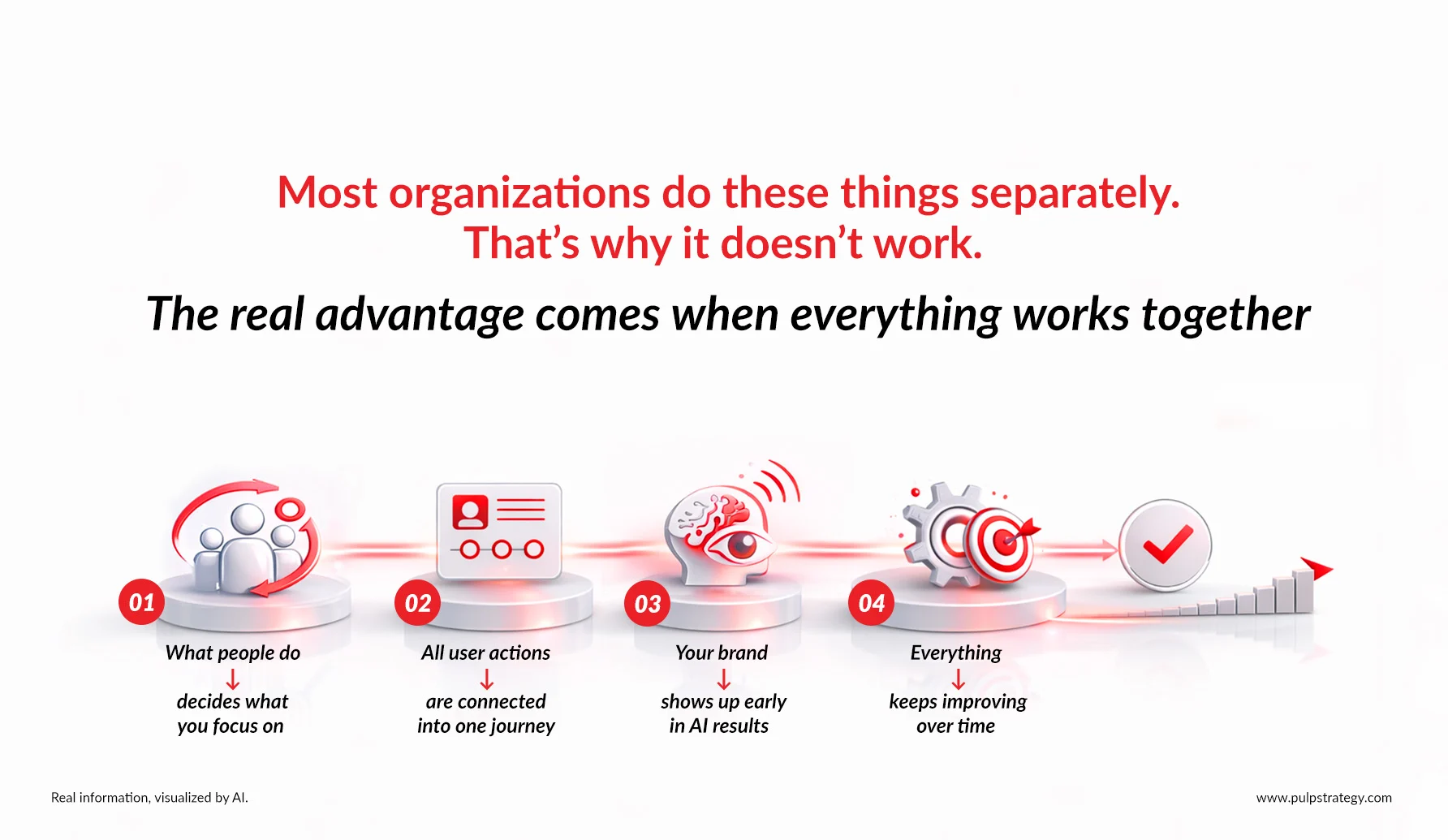
Most organizations do these things separately.
That’s why it doesn’t work.
The real advantage comes when everything works together:
- What people do → decides what you focus on
- All user actions → are connected into one journey
- Your brand → shows up early in AI results
- Everything → keeps improving over time
The Cost of Inaction: What Breaks When You Don’t Build the System
Failure to implement influence systems results in four compounding risks: misreading customer intent, fragmented attribution, exclusion from AI-driven discovery, and slow optimization cycles. Together, these create rising acquisition costs, declining conversion efficiency, and invisible revenue leakage across the decision ecosystem.
This is not a single failure. It is a system breakdown.
When organizations ignore this shift, they are not just “behind.”
They are operating with four disconnected gaps that compound over time.
1. If you don’t understand behavior, you misunderstand demand
Without a structured behaviour signal layer:
- High-intent users look identical to low-intent traffic
- Optimization focuses on volume, not readiness
- Teams scale what is visible, not what converts
What this costs you
- Wasted media spend on low-intent users
- Missed opportunities on high-intent signals
- Lower conversion rates despite higher traffic
System Impact
You are not lacking data.
You are lacking decision clarity.
Knowledge Triple
No behavior data → Wasted budget
2. If you can’t connect users, you lose the journey
Without identity stitching:
- One customer appears as multiple users
- Conversion paths appear shorter or disconnected
- Attribution models collapse into guesswork
Without it, you are effectively:
Measuring fragments, not journeys
What this costs you
- Incorrect attribution
- Poor personalization
- Inability to scale winning pathways
System Impact
You cannot optimize what you cannot see end-to-end.
Knowledge Triple
Fragmented Identity → Breaks → Attribution Accuracy
3. No AI Visibility (No NeuroRank™ LLMO Layer) → You Are Invisible Where Decisions Start
This is the most critical failure. Without an AI visibility layer:
- There’s no AI search optimization strategy in place
- Your brand is excluded from AI-generated recommendations
- Competitors define the category narrative
- Consideration happens without your presence
What this costs you
- Loss of early-stage influence
- Declining brand recall in AI-mediated journeys
- Revenue loss before traffic even begins
System Impact
You are competing for clicks while decisions are being made before clicks.
Knowledge Triple
No AI Visibility → Leads To → Market Exclusion
4. No Continuous Optimization → You React Too Late
Without adaptive systems:
- Campaigns run on fixed timelines
- Optimization happens after performance drops
- Insights arrive too late to act on
Delayed optimization cycles increase acquisition costs and reduce marketing efficiency, as teams react to performance after the opportunity window has passed.
What this costs you
- Rising CAC
- Slower response to market shifts
- Inefficient budget allocation
System Impact
You are optimizing yesterday’s behavior while competitors adapt in real time.
Knowledge Triple
Static Optimization → Leads To → Performance Decay
The Compounding Effect (This Is Where It Gets Dangerous)
These failures do not operate independently. They stack.
- Misread behaviour signals → Wrong targeting
- Broken identity → Wrong attribution
- No AI visibility → Lost demand
- Slow optimization → No recovery
What this creates
- Artificial growth ceilings
- Increasing cost of acquisition
- Declining marketing ROI
Synthesis: The New Growth Mandate for CMOs
Growth in 2026 depends on replacing funnel-based thinking with influence system design. Organizations must align behavior signal intelligence, unify user identity across platforms, AI visibility, and continuous optimization into a unified model that shapes decisions across fragmented, AI-driven customer journeys.
The Shift in One View
The funnel assumed customers move step by step. Today, decisions are:
- Distributed across platforms
- Influenced before brand interaction
- Driven by signals, not stages
This changes what marketing is responsible for.
Not progression.
But influence.
What CMOs Need to Do Now
- Move from stage tracking to behaviour signal understanding
- Build a unified view of the customer across touchpoints
- Ensure presence in AI-driven discovery environments
- Shift from campaign cycles to continuous optimization
Where NeuroRank™ Fits
As AI increasingly shapes early decision-making, visibility is no longer just about search.
NeuroRank™ is the patent-pending AI SEO and AI visibility intelligence platform that deconstructs how ChatGPT, Gemini, Claude, and Perplexity represent your brand, diagnoses where your AI presence is broken, and prescribes exactly what to fix. NeuroRank™ LLMO System enables brands to:
- Structure content for machine interpretation
- Be included in AI-generated recommendations
- Maintain consistent presence across AI-driven discovery
What This Looks Like in Practice
| Old Way | New Way |
| Track funnel stages | Understand what drives decisions |
| Run campaigns in cycles | Always on and improving |
| Focus on one channel at a time | Look at everything together |
| Show up in search | Show up everywhere, including AI |
The Outcome
Organizations that make this shift gain:
- Earlier influence in the decision cycle
- More accurate attribution
- Lower acquisition costs
- More predictable marketing ROI
Closing Thought
The funnel helped measure a simpler time.
The next phase of growth will be defined by those who can shape decisions before they are visible.
Because growth is no longer about moving users through a funnel.
It is about influencing the decisions before they ever enter it.
Transparency Statement
This article synthesizes insights from Gartner, McKinsey, BCG and Deloitte reports published between 2025 and 2026.