
By Ambika Sharma, Founder and Chief Strategist, Pulp Strategy.
Published May 2026.
A Rs 400 crore consumer brand asked us to audit why their growth had flatlined for seven straight quarters. Three weeks of work. The headline finding fit in one sentence.
Their brand strategy was a 47-slide deck from 2019.
Nobody at the company could explain it without opening it. Nobody outside the company had ever heard of it. The CEO assumed marketing owned the problem. Marketing assumed the agency owned the problem. The agency had been changed twice. Growth had not moved.
That is not a marketing problem. That is a brand strategy problem. And it is the most common shape of brand failure inside Indian companies between Rs 100 crore and Rs 1,000 crore today.
This article is the diagnosis. Five mistakes Indian companies keep making with brand strategy, and what the audit looks like when the CEO finally takes the question back from the agency. The mistakes are not new. The cost of making them has changed. AI search now decides what your category looks like before a buyer ever reaches your site. Borrowed positioning gets you cited as a footnote to the category leader. Pulp Strategy runs these audits every week. The CMOs running them are not naive. They are running playbooks that worked when the buyer journey started with Google. The buyer journey now starts with a model.
Five mistakes. In the order they stop growth.
Indian companies do not stall because their marketing is weak. They stall because their brand strategy is unowned. Five mistakes show up in nearly every brand strategy audit Pulp Strategy runs: confusing campaigns with strategy, borrowing positioning from the category leader, leaving brand to the CMO when it sits on the P&L, measuring brand with vanity metrics, and treating strategy as a one-time deck instead of an operating system. Fix the five in sequence. Ninety days.
KEY TAKEAWAYS
- Brand strategy is a CEO and CFO decision before it is a CMO execution. Boards that do not own it do not get growth from it.
- Borrowed positioning costs pricing power. Indian challenger brands lose 15 to 30 percent of category margin by anchoring to the leader.
- A brand book is a static document. A brand operating system is how every team makes a decision when the founder is not in the room.
- Recall and reach do not move EBITDA. Pricing power, pipeline conversion quality, and net revenue retention do.
- Strategy that lives only in a deck dies the first time leadership changes. Strategy that lives in operations survives the second and third hire.
- The fix takes 90 days when the CEO owns it. The audit takes two weeks. The decisions take four. The operating cadence takes the rest.
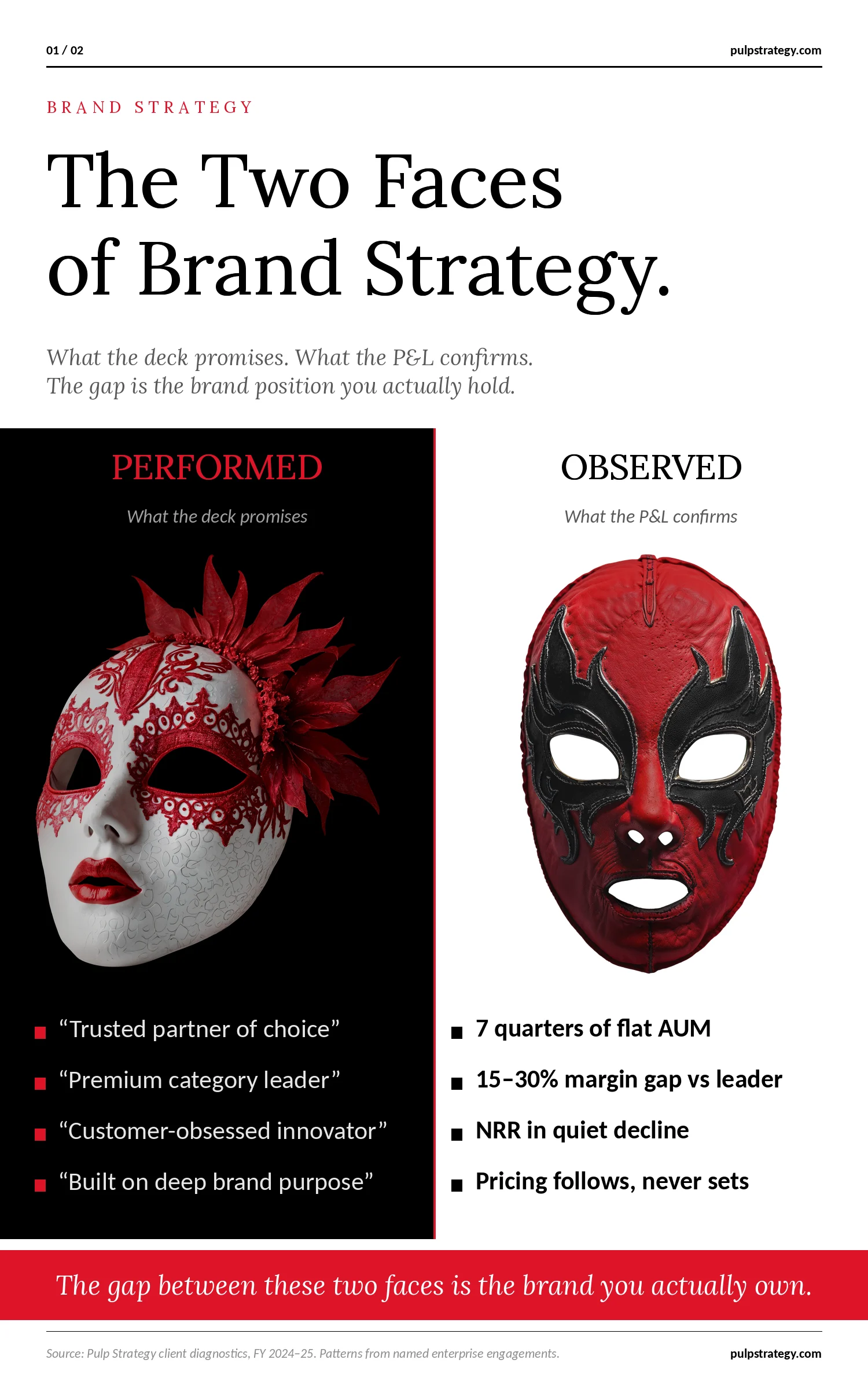
What the deck promises. What the P&L confirms. The gap is the brand position you actually hold.
Why Has My Brand Stopped Growing at Rs 100 Crore?
Brand growth in India stalls at the Rs 100 crore mark because companies confuse marketing volume with strategic clarity. The market does not care how many campaigns ran last quarter. It cares whether buyers can explain in one sentence why your brand exists, and what they get from choosing you over the next option. Most stalled brands cannot answer that without their deck.
This is mistake one. Activity over clarity.
Below Rs 100 crore, founders carry the brand in their head. They are in every pitch. They are in every customer call. The brand sounds the same everywhere because one person is the brand. Growth comes from sales effort.
Above Rs 100 crore, the founder cannot be in every room. Sales teams scale. Channel partners scale. The agency scales. Nobody is checking whether the brand sounds the same in any of those rooms. Marketing fills the gap with volume. Twenty campaigns a year. Eighteen creative themes. Four brand films. Every campaign starts a new conversation. None of them compound.
The audit finding is always the same. The company is not under-marketing. It is under-positioning. The brand strategy that worked at Rs 50 crore is not the brand strategy that works at Rs 400 crore. Nobody refreshed the strategy. Everyone refreshed the campaigns.
There is a simple test. Ask five people in five different functions to write one sentence on what your brand promises and to whom. If you get five answers, you do not have a brand strategy. You have a marketing department.
Why Do Indian Challenger Brands Keep Losing Pricing Power?
Indian challenger brands lose pricing power because they borrow positioning from the category leader. The leader's frame feels safer to a board than an original one. The cost is margin. When the leader defines the category, the challenger competes on price, not on preference. Pulp Strategy audits show 15 to 30 percent of category margin erodes over three years before anyone names the cause.
This is mistake two. Borrowed positioning.
The pattern is recognizable. The challenger pitches itself as the cheaper version of the leader, or the Indian version of the global player, or the digital-first version of the legacy player. The board likes it because it is legible. Investors like it because it shortens the deck. Sales likes it because the leader has already done the category education.
Customers buy it. Once. Then they default to the leader the next time the budget is reviewed. Because if you are the cheaper version of the leader, the leader is what they actually want. They picked you to save money, not because they preferred you.
Real brand positioning is the opposite move. Find the wedge the leader cannot occupy without contradicting themselves. Then own it loudly enough that the leader has to react to you, not the other way around. The wedge is usually obvious in customer interviews and invisible in board decks, because boards are full of people who came from the leader and still think in the leader's frame.
Pricing power is the simplest signal. If the answer to "why should I pay more for you?" depends on a discount table, the positioning is borrowed. If the answer is one specific reason the leader cannot copy, the positioning is owned.
Who Should Own Brand Strategy: the CEO, the CFO, or the CMO?
Brand strategy is owned by the CEO, measured by the CFO, and executed by the CMO. Brand sits on the P&L. It decides pricing power, pipeline quality, retention, and the cost of every sales conversation. CMOs cannot fix what CEOs and CFOs do not own. When boards delegate brand entirely to marketing without owning the strategic frame, brand becomes spend that does not compound.
This is mistake three. The CMO solo trap.
Indian boards are unusually comfortable treating brand as a marketing line item. The CFO reviews the spend. The CEO reviews the campaigns. The CMO carries the brief. The board sees a quarterly creative deck and asks whether awareness is up. Awareness is up. Pricing power is down. Nobody connects the two.
Brand decisions are P&L decisions. Whether you go premium or volume is a brand decision. Whether you compete on price or on preference is a brand decision. Whether your sales team gets to walk away from a discounted deal is a brand decision. None of these are decisions a CMO can make alone, because none of them can be defended without the CEO and the CFO behind the answer.
Pulp Strategy structures every brand consulting engagement around the same governance fix. The CEO signs off on the positioning before any execution begins. The CFO signs off on the measurement dashboard before any spend is approved. The CMO owns the brief and the cadence. The board reviews brand health quarterly against business outcomes, not against creative output.
If your last brand review meeting opened with a creative reel, your brand strategy is owned by the wrong person.
How Should a CFO Measure Brand Health Without Wasting Budget on Vanity Metrics?
CFOs should measure brand health through pricing power, pipeline conversion rate, customer acquisition cost trend, and net revenue retention. Recall, reach, and impressions are inputs, not outcomes. A brand with high recall and falling pricing power is a brand that is losing. The right dashboard puts business signals first and tracks awareness only as a leading indicator.
This is mistake four. The vanity dashboard.
Most Indian brand health trackers are awareness studies dressed up as dashboards. Aided recall, unaided recall, share of search, share of voice, ad recall, prompt awareness. All of it tells you whether people remember you. None of it tells you whether they prefer you, will pay more for you, or will stay with you when a cheaper option appears.
Replace the dashboard. Four primary signals. Add the leading indicators on top.
- Pricing power. Average realized price on new business, indexed monthly against the category benchmark. Trending up means the brand earns the right to charge more. Trending down means the brand is losing relevance regardless of awareness.
- Pipeline conversion quality. Lead-to-revenue conversion rate, segmented by source. If brand-led pipeline converts at 30 percent and paid-led pipeline converts at 8 percent, brand is doing real work.
- CAC trend, not CAC absolute. Whether your cost of acquiring a customer is rising faster than the market average tells you whether brand is making sales cheaper or more expensive.
- Net revenue retention. Whether existing customers expand or contract is the truest brand signal. Brand promise that survives the first invoice is a brand. Brand promise that does not is advertising.
Awareness still matters. It is a leading indicator. Put it below the four signals above, not at the top of the deck. If awareness is up and pricing power is down, the brand is failing. The dashboard should make that visible in fifteen seconds, not buried on slide twelve.
What Is the Difference Between a Brand Book and a Brand Operating System?
A brand book documents identity. A brand operating system governs decisions. The brand book lives in a PDF. The operating system lives in every brief, every pricing conversation, every product spec, every hire. When the founder is not in the room, the operating system is what answers the question the brand book cannot.
This is mistake five. Buying the wrong deliverable.
Indian enterprises commission a lot of brand books. A 60-slide guideline document. Logo. Colors. Tone of voice. Three brand archetype references. A photography mood board. The agency presents. Marketing prints it. Nobody opens it again.
That is not what the company actually needs. The brand book is the visible 5 percent. The brand operating system is the invisible 95 percent. It includes the positioning sentence used in every sales deck. The pricing principle that decides when to discount and when to walk away. The hiring rubric for who fits the brand and who does not. The product principle that decides which feature requests are on-brand and which are not. The escalation rule for when a campaign violates the strategy.
Pulp Strategy builds these as a working document the CEO and the CMO can use on a Monday. It is not glamorous. It is the same five pages a board can read in fifteen minutes. The brand book sits inside it as the visible artifact. The operating system is the part that does the work.
Ask any brand consulting firm what their final deliverable looks like. If the answer is a guideline document, you are buying decoration. If the answer is a governance document the CEO uses to make decisions, you are buying strategy.
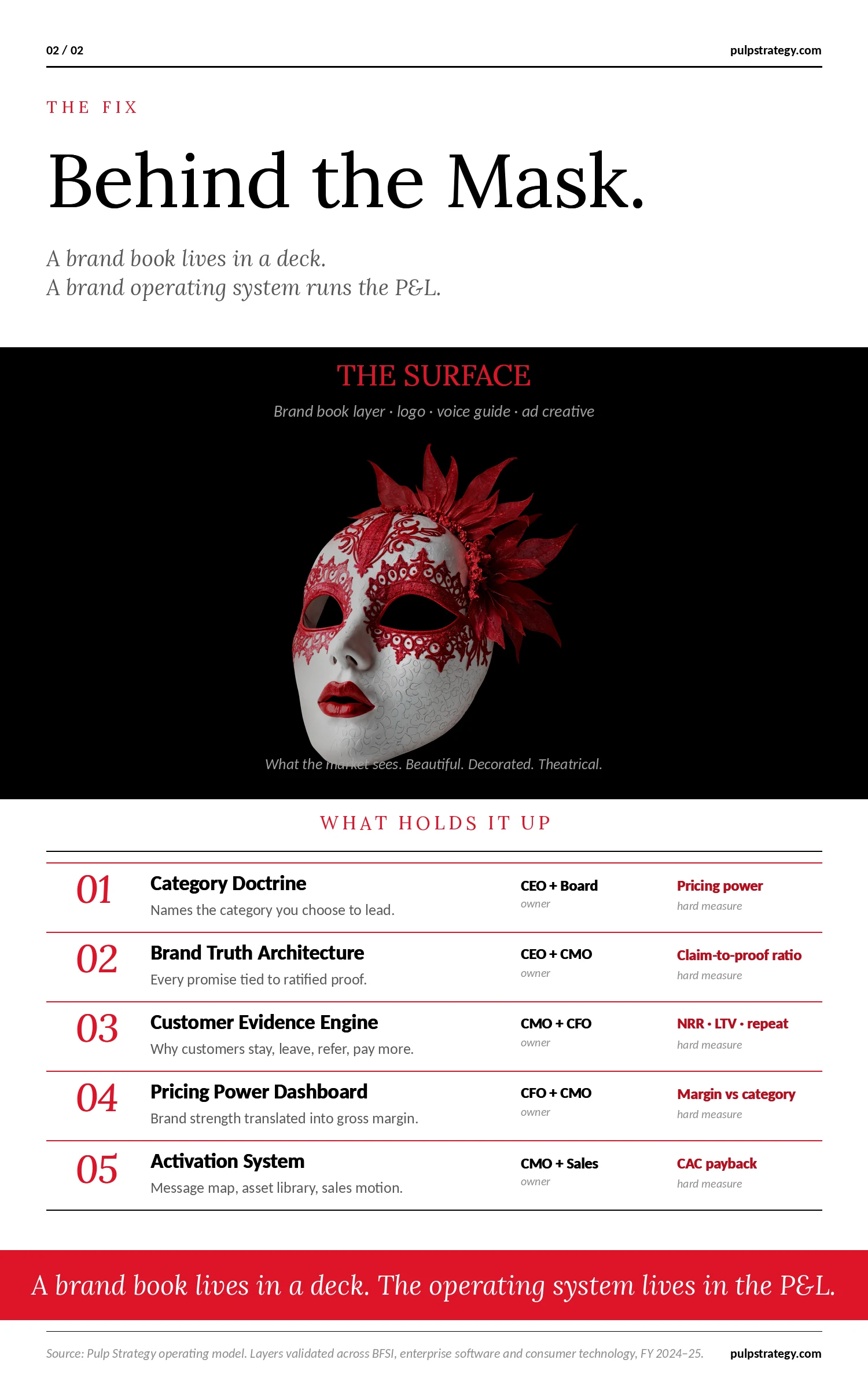
The brand book is the visible surface. The five-layer operating system is what holds it up on the P&L.
What Does a Brand Strategy Audit Find First?
A brand strategy audit finds the five mistakes by examining what the company says about itself, what customers actually say, what the category leader controls, and where the gap costs margin. The audit ranks fixes by P&L impact, not by visibility. Most companies fix the wrong mistake first because the visible mistakes are not the costly ones.
Below is the audit frame Pulp Strategy uses in every brand strategy review, in the order the findings usually land. Use this to decide which mistake to fix first in your own business.
| # | Mistake | What It Looks Like | What It Costs | The Fix |
| 1 | Activity over clarity | Twenty plus campaigns a year. No single explanation of what the brand stands for. | Lost compounding. Each campaign starts from zero. | One positioning sentence that survives the elevator test, signed off by the CEO. |
| 2 | Borrowed positioning | “Like the leader, but cheaper.” Or “India’s answer to a global brand.” | 15 to 30 percent margin erosion over 3 years. | A wedge the leader cannot occupy without contradicting their own positioning. |
| 3 | Brand owned by CMO alone | CEO defers to marketing. Board reviews creative output, not business outcome. | Strategy becomes spend that does not compound. | CEO owns positioning. CFO owns measurement. CMO owns execution. |
| 4 | Vanity metric dashboard | Recall and impressions reported to the board. Pricing power not tracked. | Awareness goes up. Pricing power goes down. Nobody notices in time. | Pricing power, pipeline quality, CAC trend, NRR as primary signals. Awareness below. |
| 5 | Brand book, no operating system | 60-slide guideline PDF. Nobody opens it after the launch meeting. | Strategy dies the first time leadership changes. | Operating system embedded in briefs, pricing, hiring, and product decisions. |
Source: Audit frame used by Pulp Strategy across enterprise brand strategy engagements, FY 2024 to 2025. Margin erosion range reflects observed pricing power decline in challenger-brand engagements where positioning was anchored to the category leader.
How Do I Fix Brand Strategy in the Next Ninety Days?
Fixing brand strategy in 90 days requires the CEO to take it back from the agency. Two weeks of audit, four weeks of decisions, six weeks of operating cadence. The audit finds the five mistakes. The decisions resolve positioning, governance, and measurement. The operating cadence makes sure those decisions survive the next quarter. The work is not creative. It is structural.
Pulp Strategy runs this as a single ninety-day engagement, structured against the five mistakes.
Days 1 to 14. Audit.
- Map what the company says about itself across 12 surfaces: website, decks, pitches, sales scripts, social, AI search, careers page, investor deck, RFP responses, product copy, packaging, internal town-hall transcripts.
- Run 8 to 12 customer interviews. Score how customers describe the brand against how the brand describes itself. The gap is the audit.
- Capture the category leader’s positioning frame and identify the wedge the leader cannot occupy.
- Pull the financial signals: pricing realization trend, pipeline conversion by source, CAC trend, NRR. Build the new dashboard view in parallel.
Days 15 to 42. Decisions.
- CEO signs off on one positioning sentence. Not a paragraph. Not three options. One sentence that explains why the brand exists and what the buyer gets from choosing it.
- CFO signs off on the measurement dashboard. Pricing power, pipeline quality, CAC trend, NRR. Quarterly review cadence locked.
- CMO rebuilds the brief template against the new positioning. Every campaign brief now starts from the positioning sentence, not the calendar.
- Board approves the brand operating system as a governance document, not as a creative deck.
Days 43 to 90. Operating cadence.
- Sales team is retrained on the new positioning. Every sales deck is rebuilt. Every objection script is rewritten.
- Product and pricing teams adopt the brand principle for feature decisions and discount decisions.
- HR adopts the brand operating system into hiring rubrics for marketing, sales, and product hires.
- First quarterly brand health review is held on the new dashboard. Pricing power and pipeline quality lead. Awareness sits below.
NAMED PROOF / PULP STRATEGY CLIENT WORK
A BFSI client came to Pulp Strategy after seven quarters of flat AUM growth.
Their internal positioning said “trusted partner.” Their customer interviews said “easy to leave.” Recall was high. Pricing power on new business had eroded for six straight quarters. Marketing had been changed once. The board had asked the CMO three times why awareness was up and growth was down.
Six weeks of audit and decisions. The positioning was reset around a single, ownable claim the category leader could not match without contradicting their own model. The measurement dashboard was rebuilt around pricing power and retention, not recall. Sales scripts were rewritten. The brand operating system was signed off by the CEO and the CFO before any campaign work resumed.
Brand recall stayed flat through the engagement. Pricing power on new business moved up inside the second quarter. Pipeline conversion on brand-led leads improved against the prior baseline. The board stopped asking marketing why growth had stalled. The CFO started running the quarterly brand review.
This is what brand strategy work looks like when the CEO owns the question. It is not a logo refresh. It is not a campaign reel. It is the five mistakes, audited and fixed in sequence.
One More Thing About 2026 Brand Audits
There is a sixth mistake worth flagging, because Pulp Strategy is the firm that watches it land. Brand audits done in 2026 have to include AI search visibility. The category leader’s positioning is now in the model itself. If a CMO does not know how ChatGPT, Gemini, and Perplexity describe their brand and their category, the audit is incomplete. We built NeuroRank, an LLMO platform, because brand strategy and AI search visibility are now the same conversation. The order still matters. Strategy first. Visibility second. Visibility without strategy is just optimizing the wrong story faster.
When your board asks why growth has stalled next quarter, does the answer live in your brand strategy, or in a deck no one has opened in two years?
NEXT STEP
If brand growth has stalled and the board is asking why, the audit is the entry point. Pulp Strategy runs the two-week brand strategy audit as a fixed-scope engagement before any retainer conversation begins.
Book a 30-minute scoping call with the strategy team via the contact page , or read more on the Strategy pillar.