

The Rules of Brand Positioning Have Changed
For years, brand positioning was about shaping market perception, building a reflection of your brand and brand values in the mind of the audience.
You defined who you are, repeated it across channels, delivered value to the customers and trusted that over time, customers would remember, and your brand would be the first choice whenever it came to the decision stage.
That model has worked successfully for decades, when people did the searching, comparing, and deciding.
But that system assumed something fundamental:
That people would encounter your brand directly (without any intermediary), before making a decision.
That assumption is now changing.
According to Gartner’s 2025 research on AI-led discovery, a growing share of user journeys now begin inside AI systems rather than traditional search interfaces. That means fewer people are browsing multiple options. They’re asking a question and getting a curated answer.
And that creates a subtle but important shift:
Your brand is no longer just positioned by what you say. It’s increasingly being defined by what AI systems can find, verify, and recommend about your brand. It’s like you have no control over how your brand is positioned and being perceived because now AI sits between your brand and your customers.
Executive Overview
Brand positioning is no longer just what you communicate. It is also what AI systems construct about you from everything they can find.
So, what happens is that when someone is looking for more information around your products or services, they ask ChatGPT or Gemini for a recommendation. Your brand gets represented on the basis of signals spread across the internet.
If those signals aren’t strong enough or inconsistent to satisfy the user intent/query, AI fills the gaps on its own version of the information. And that version of your brand is what customers see first. It’s AI’s version of your brand positioning.
This means brands must focus on AI visibility, structured presence, and validation across sources to remain competitive.
Key driving factors include:
- AI is becoming the first layer of discovery
- Visibility now comes before perception
- Fewer brands are evaluated per decision
- Trust is built through verifiable signals
- Creativity matters, but later in the journey
- Positioning works only after inclusion
What this means:
Brand positioning still matters. But now, it only works if AI systems can access and validate it. This means that control over how AI is representing your brand has become non-negotiable.
Key Highlights:
Why A Brand Positioning Strategy Matters More Now
Brand positioning is still very much relevant because it provides a brand with clarity around how they want to be perceived, and it allows brands to be consistent across channels and adapt to the increasingly fragmented demands of the fast-moving market.
The marketing ecosystem in 2026 is faster, noisier, and far more competitive than ever before.
Consumer attention is split across platforms.
Consumers aren’t focused on just one place anymore. They’re bouncing between apps, platforms, and tabs all the time.
Trends emerge and disappear within weeks.
New categories form overnight.
In such an environment, brand positioning transforms into an adaptive strategic imperative that you actively manage and strengthen. It is no longer a one time exercise.
Strong positioning delivers three core advantages:
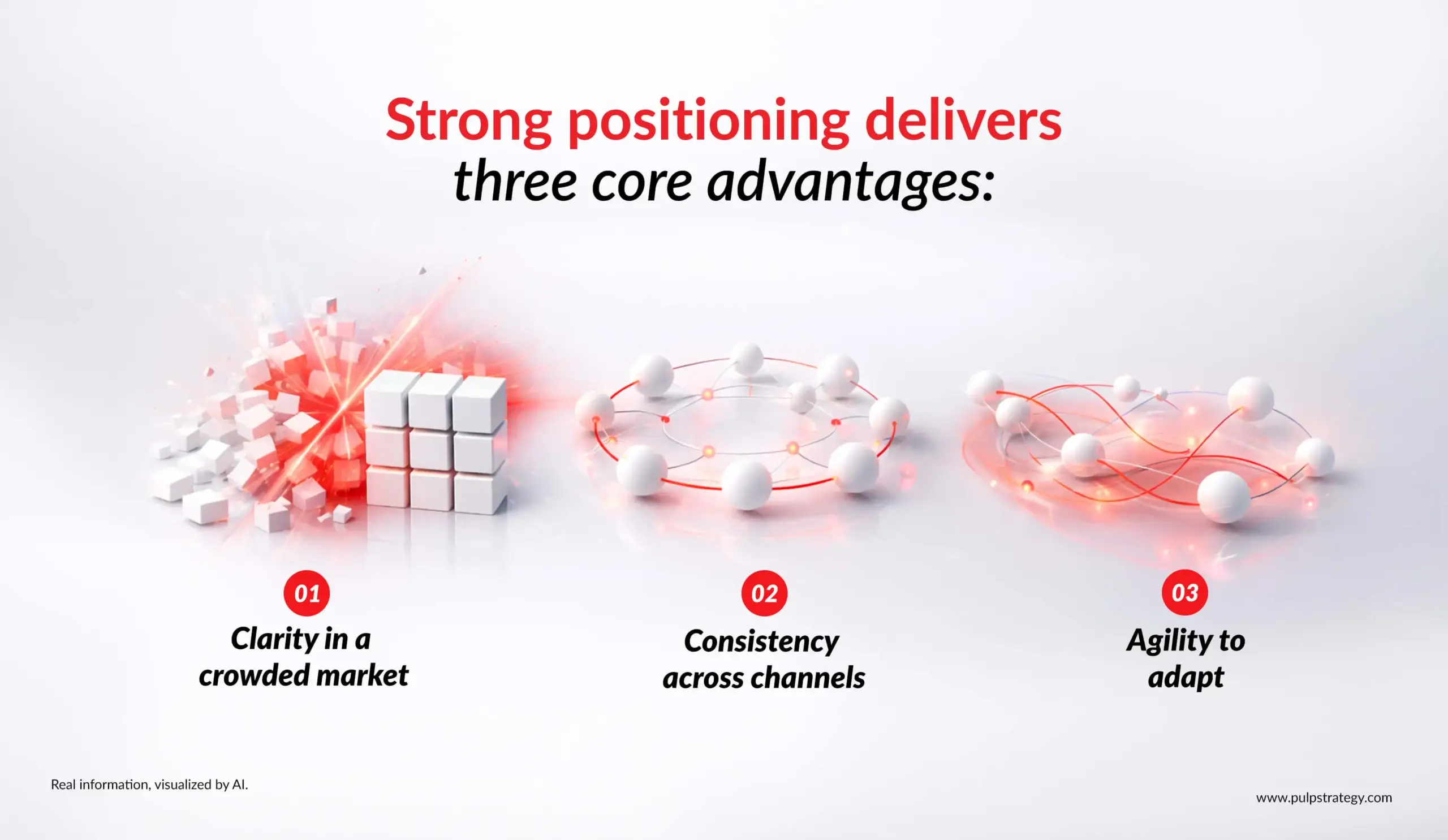
1. Cut through the noise and provide clarity around your brand in a crowded market
People instantly understand what your brand is about and what makes you different.
2. Consistency across channels
It ensures your messaging holds together across ads, content, product experience, and sales.
3. Agility to adapt
It allows you to refine your narrative as the market shifts without losing your identity.
But here’s the shift:
Earlier, positioning helped you stand out when people found you.
Now, it also needs to help you get found in the first place.
The Macro Force: What’s Changing Globally
AI is reshaping decision-making by reducing exploration and increasing reliance on curated recommendations. This shifts brand positioning from a market perception-led model to one that depends on AI brand visibility, validation, and contextual relevance.
For years, brand positioning followed a predictable flow.
You identified a gap in the market.
You crafted a clear narrative.
You amplified that narrative through various channels.
The expectation was simple:
If people see you enough, they will remember you.
If they remember you, they will consider you.
That worked because discovery was purely human-led without any external influence.
People searched.
They compared.
They evaluated multiple options.
For years, positioning worked in a predictable loop:
Exposure → Familiarity → Consideration → Conversion
That loop depended on users doing the work of discovery. It was just between the brand and the people.
But now there’s a new player out there – AI. The entire process is being compressed into recommendations.
McKinsey's "New Front Door to the Internet" report (2025) states that 40 to 55 percent of consumers in top sectors use AI-based search for purchasing decisions.
What this looks like in real life
Earlier:
You searched “best CRM for startups”
You opened multiple tabs
You compared pricing, features, and reviews
Each brand had a chance to communicate its positioning.
Now:
You ask an AI assistant
You get a shortlist
You evaluate only those options
You are no longer exploring the expanded market space.
You are exploring the AI’s compressed version of the market space.
What this changes for brand positioning
A brand positioning framework used to work because brand exposure created familiarity and people chose familiar brands. Now, the sequence looks different:
- Inclusion creates exposure
- Exposure creates consideration
- Consideration enables positioning
If your brand is not included early or misrepresented, your brand positioning becomes irrelevant. You are dropped out in the consideration stage itself.
The Friction Point: Where Legacy Brand Positioning Frameworks Struggle
Traditional brand positioning frameworks struggle because they assume users will evaluate multiple options and perceive the brand the way brand has positioned itself. But AI systems now pre-select a limited set of brands and position them as per AI’s interpretation of the brand, based on the data it could gather from resources it trusts like Reddit, Medium and LinkedIn. Moreover, AI bias further influences how the brand is being represented (or misrepresented).
Frameworks like:
- SWOT
- Porter’s Five Forces
- Perceptual mapping
have helped brands:
- understand competition
- define differentiation
- align messaging
These are still valuable. But what’s next when AI steps in as an intermediary.
A skincare brand positions itself as:
“dermatologist-approved, science-backed, clean”
In the traditional model:
- Ads reinforce credibility
- Influencers validate the claim
- Website content builds trust
Over time, users associate the brand with expertise.
In an AI-led model:
A user asks:
“What are good dermatologist-approved skincare brands?”
AI evaluates:
- Are you mentioned across credible sources?
- Do reviews support your claims?
- Are you consistently categorized correctly?
If yes, you appear.
If not, your positioning never enters the conversation.
The Strategic Pivot: From Messaging to Systems Built For AI-First Positioning
Modern brand positioning requires shifting from message creation to building systems that ensure visibility, validation, and AI recognition. Instead of only defining how a brand should be perceived, companies must now ensure that AI systems can accurately interpret, verify, and recommend them and position them correctly.
This is where the shift becomes practical.
For a long time, brand strategy conversations started with questions like:
“What do we want to stand for?”
“What should our messaging sound like?”
Those questions still matter. But they are no longer enough on their own.
Because today, before your positioning shapes perception, it has to pass through another layer: AI systems that are constantly scanning, organizing, and interpreting information about your brand.
What actually changes
| Aspect | Earlier (Traditional Positioning) | Now (AI-Led Positioning) |
| Starting Point | You define your positioning | You still define your positioning |
| What You Do Next | Communicate it consistently across channels | Ensure it exists across multiple credible sources |
| How It Spreads | Through ads, campaigns, and content | Through data signals across the internet |
| What Gets Evaluated | Your messaging strength and repetition | Where you appear and how consistently you’re described |
| Role of External Signals | Helpful but not critical | Critical (reviews, mentions, third-party validation) |
| Category Clarity | Implied through messaging | Must be clearly understood by AI systems |
| What Drives Success | Repetition builds familiarity | Validation builds inclusion |
| When Positioning Works | As long as people see your message | Only after AI systems evaluate and surface you |
| End Outcome | Customers associate you with an idea over time | AI decides whether your positioning gets shown at all |
A simple example
Take a B2B SaaS brand positioning itself as:
“the most intuitive workflow automation platform”
In the traditional model:
- Website messaging reinforces simplicity
- Ads highlight ease of use
- SEO makes them discoverable
- Case studies support the claim
Over time, customers begin to associate the brand with usability.
In an AI-led model, when someone asks:
“What are the easiest workflow automation tools to use?”
AI doesn’t rely on your website or Google rankings alone.
It looks at:
- Product reviews
- Comparison sites
- Documentation clarity
- Mentions across forums and articles
If those signals consistently reinforce “ease of use,” you appear inside AI recommendations. If they don’t, your positioning doesn’t make the shortlist.
Where most brands struggle
Most brands are still operating as if positioning is primarily a communication problem. In reality, it has also become a visibility and validation problem.
- You may have a clear message
- But if it isn’t reflected across the ecosystem
- AI cannot confidently represent you
And when AI is unsure, it simply moves on to brands with stronger signals.
The real shift
Positioning is no longer just about defining a message. It’s about ensuring that message:
- exists across the right sources
- is consistently reinforced
- and can be confidently retrieved by AI systems
Because in this environment, clarity alone is not enough. Clarity that cannot be validated does not get surfaced.
What changes in practice
Earlier:
You asked, “What should we say?”
Now:
You also need to ask,
“Where and how does our brand exist across the ecosystem AI reads?”
The Operational Framework: AI-first brand positioning
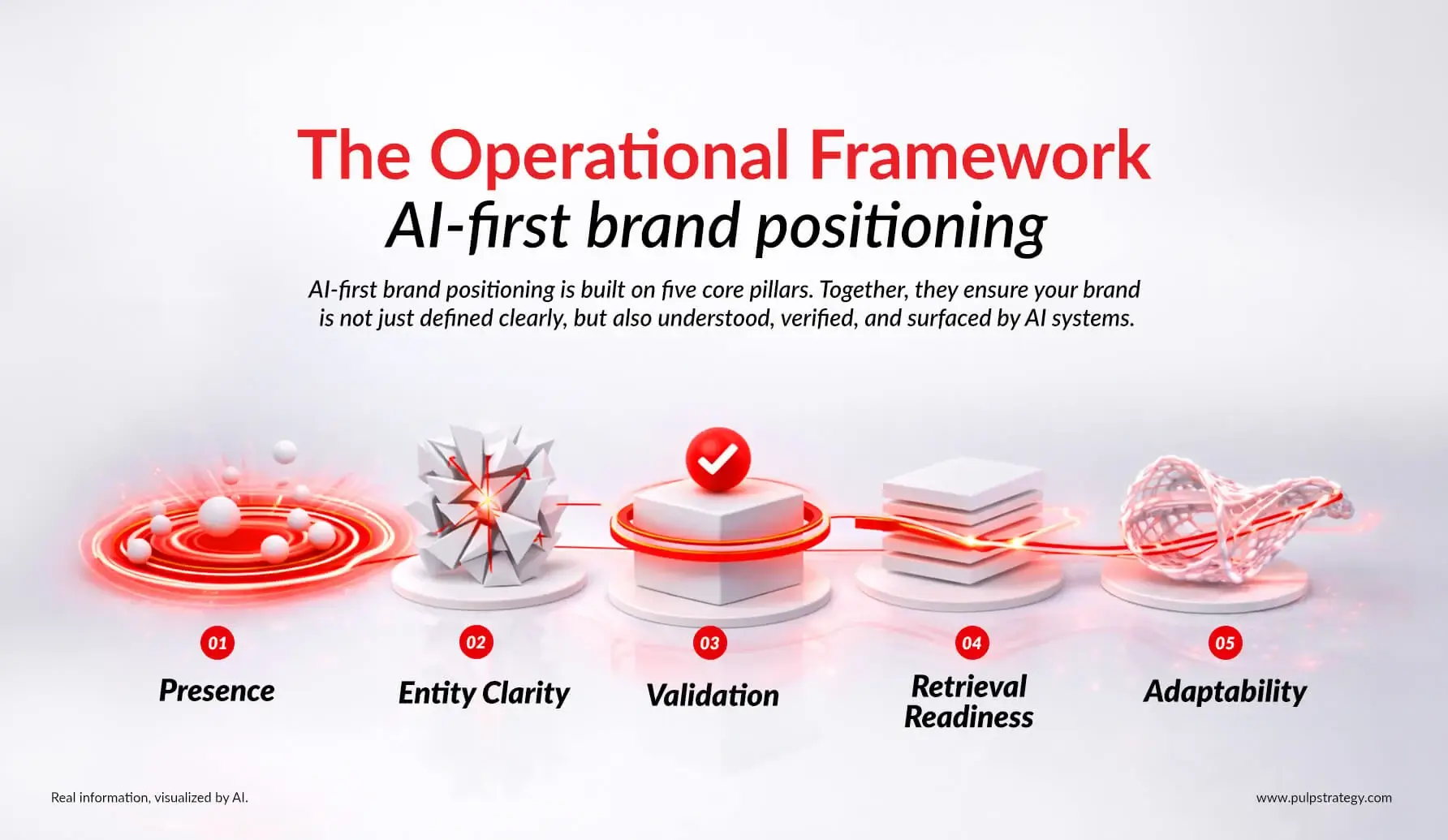
AI-first brand positioning is built on five core pillars. Together, they ensure your brand is not just defined clearly, but also understood, verified, and surfaced by AI systems.
1. Presence
Your brand needs to exist across the sources AI actually reads: websites, reviews, articles, directories, forums, and more.
If you’re only visible in your own channels, AI has very little to work with. The broader and more credible your presence, the stronger your chances of being picked up.
2. Entity Clarity
You can feature inside AI recommendations only when your brand is clearly positioned across the sources that AI models trust. What your brand is about, what market space you serve and what differentiates you from the competitors, everything should be clear, structured and machine-readable.
If your brand positioning is vague or inconsistent across signals, AI struggles to recommend your brand. Clear, consistent descriptions across platforms help Ai models “lock in” your identity.
3. Validation
It’s not enough for you to claim something. You need that claim to be validated across trusted sources like Reddit, Medium, LinkedIn, review sites, etc. The more your brand positioning is reinforced externally, the more confidently AI can recommend your brand.
4. Retrieval Readiness
Your content should be structured such that AI can easily extract and recommend.
What this means is your content should be clear, simple to understand, well-organized information, and have direct answers to common user queries that satisfy the user intent.
5. Adaptability
AI representations are not fixed, they change as new data appears. You need to continuously monitor how your brand is being described across AI systems and then make the necessary adjustments accordingly.
This turns brand positioning into an ongoing process rather than a one-time decision, which we already stated earlier in this article.
IDC (2025) shows companies with strong data structures improve discoverability by up to 40%.
The NeuroRank™ Logic: From Brand Positioning to AI Visibility
AI-first brand positioning requires active management of how your brand is interpreted and recommended by AI systems. NeuroRank™ enables this by auditing AI presence, structuring brand signals, and engineering content for consistent inclusion in AI-generated outputs.
Step 1: Audit your AI presence
Start with a simple but critical question:
Does AI even recognize and recommend your brand?
Check:
- Are you mentioned in AI-generated answers?
- How is your brand described?
- Which competitors are being recommended instead?
This gives you a clear view of your current inclusion gap. If AI is not recommending you, you are already losing consideration.
Step 2: Structure your brand for AI interpretation
AI does not read your brand the way a human does.
It builds an understanding based on:
- entities (who you are)
- attributes (what you offer)
- relationships (how you compare)
To make sure this is effective, you need to:
- Define a clear and consistent positioning
- Standardize product and service descriptions
- Establish strong category associations
The goal is simple:
Make your brand easy for AI to classify and recall.
Step 3: Engineer content for AI retrieval
Not all content is equally useful for AI systems.
AI prefers content that is:
- direct
- structured
- easy to extract
This means creating:
- Clear, question-based answers
- Structured FAQs
- Comparison and category-focused content
This increases your chances of being:
- quoted
- summarized
- recommended
Because AI systems don’t browse, they extract.
Step 4: Deploy the NeuroRank™ layer
This is where everything comes together.
NeuroRank™ is the patent-pending AI visibility intelligence platform that deconstructs how ChatGPT, Gemini, Claude, and Perplexity represent your brand, diagnoses where your AI presence is broken, and prescribes exactly what to fix.
This is not an SEO upgrade. It is a visibility control system for AI environments.
What NeuroRank™ actually does
NeuroRank™ integrates multiple layers into one system:
- GEO (Generative Engine Optimization)
Makes sure your brand appears in AI-generated answers
- AEO (Answer Engine Optimization)
Structures content to be directly quoted and surfaced
- AIO (AI Optimization)
Aligns brand signals for machine interpretation and trust scoring
- AI SEO
Extends traditional SEO into AI-driven discovery ecosystems
What this ensures for your brand positioning
1. Your brand becomes machine-readable
AI can clearly understand who you are, what you do, and where you fit
2. Your positioning is reinforced across ecosystems
From PR to reviews to social content, your narrative stays consistent
3. Your inclusion is engineered, not accidental
You are no longer relying on chance mentions
You are increasing your probability of being recommended
The shift in one line
Earlier, you positioned your brand for people to understand.
Now, you also need to position it for AI systems to recognize and recommend.
The Cost of Inaction
Brands that do not adapt to AI-driven positioning risk reduced discoverability, fewer inclusions in decision sets, and declining conversion rates.
KPMG (2025) estimates:
- 30–40% drop in discoverability
- 20–25% lower conversion rates
What this looks like
You may still:
- Run effective campaigns
- Have a clear brand story
But:
- Fewer users discover you
- Fewer AI systems recommend you
- Fewer decisions include you
Comparison: Then vs Now
| Aspect | Earlier | Now |
| Discovery | Search + browsing | AI recommendations |
| Positioning | Brand-defined | AI-interpreted |
| Trust | Messaging-led | Validation-led |
| Creativity | Entry point | Differentiator |
Synthesis: What CMOs need to do
Brand positioning is as relevant as it has always been, but now there’s a new layer that has been added to it. Now you also need to make sure your brand is visible and positioned correctly across AI systems.
Across Pulp Strategy’s work with global brands, one pattern stands out:
Brands that adapt:
- Show up consistently in AI responses
- Remain part of decision sets
- Strengthen performance outcomes
Brands that don’t:
- Stay visible in campaigns
- But become less visible in actual decisions
Brand positioning hasn’t disappeared. It has simply moved downstream.
Before you shape perception, you now have to earn inclusion.
Transparency Statement
This article is based on insights from McKinsey, BCG, Gartner, Deloitte, PwC, KPMG, and other global research firms. NeuroRank™ insights are derived from proprietary analysis of AI-driven discovery systems.